
 Search Articles


CHARLOTTE, N.C. (CN) — Front Row Motorsports owner Bob Jenkins took the stand on the third day of the NASCAR antitrust trial, telling the jury that his company has never made a profit in over 20 years of racing, despite being “very frugal.”
The team’s losses increased after signing charter agreements in 2016, he said. The charters, NASCAR’s version of a franchise agreement, provide racing teams guaranteed compensation and assured entry into the Cup Series.
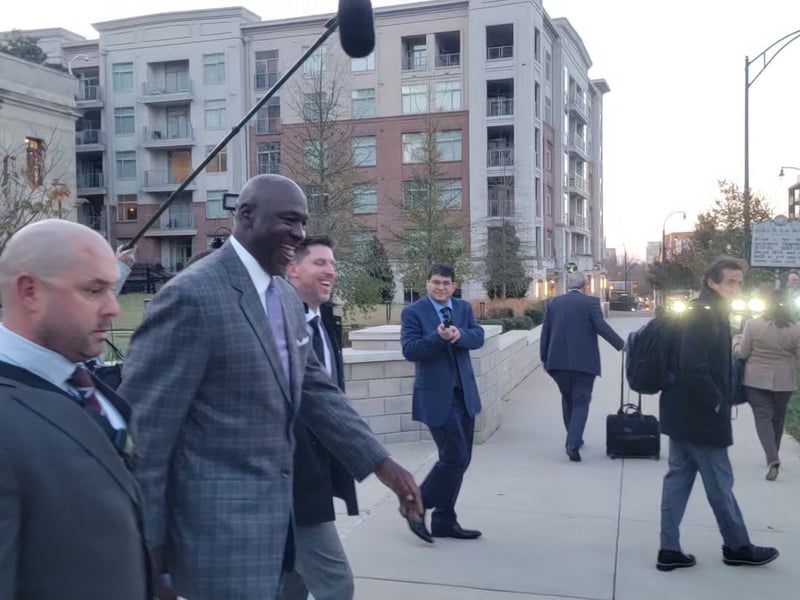
Front Row and 23XI Racing — which is partially owned by basketball legend Michael Jordan — have argued that NASCAR’s 2025 charter agreements, which they did not sign, are anticompetitive. NASCAR has a monopsony on the top-tier stock car racing industry and has used it to offer teams much less profitable contracts than they could enter if NASCAR had competition, they said in their antitrust lawsuit.
Jenkins, who said he has never taken a salary from the team, said the charter system has granted the teams stability, but the agreements have not benefited them. Since 2016, Front Row has earned more, but also incurred more costs, as teams are not allowed to repair damaged parts on cars, and instead have to mail them off to be fixed, he said.
Between 2022 and 2024, Front Row spent $4.7 million repairing parts on their Next Gen cars, which the team could not take and race in a different series, as NASCAR owns the intellectual property rights to the car.
“When the tracks are tied up, the IP is tied up, now the drivers are going to be tied up, it’s pretty hard to leave,” he said.
Scott Prime, NASCAR’s executive vice president and chief strategy officer, finished his testimony Wednesday, confirming that NASCAR increased restrictions on Next Gen cars and their IP restrictions to prevent the cars from being used in a copycat series.
Prime said he feels the 2025 charter agreements are fair, even after messages were shown to the jury Tuesday in which he said that the teams “have a point” in their complaints about NASCAR’s cut of revenue distributions. Cup Series teams get a cut of 20 to 25% of revenue from NASCAR, and in exhibits introduced by the teams, NASCAR estimated that it pays the lowest revenue share to the teams compared to percentages paid out to franchises in other major sports leagues.
The teams got “basically everything” they wanted in their initial, 2016 charter contract with NASCAR, Prime said, including no more race entry fees, an increase in their cut of broadcasting profits and fixed income.
NASCAR also removed an exclusivity provision extending beyond the length of the charters in the 2025 agreement, Prime said. If chartered teams forfeit their charters, they have the ability to own a separate racing series, race in one or return racing ‘open,’ where they have to qualify for NASCAR races.
The 2025 charters — signed by 13 other racing teams — also removed a “three strikes rule,” which allowed a team council to vote on proposed changes by NASCAR that could increase their costs.
Before the charter system was created in 2016, this was one of the teams’ biggest issues, Jeffrey Kessler, counsel for Front Row and 23XI Racing, told the jury.
Without the council, Jenkins said, NASCAR could decide to make a change to the cars and require the teams to foot the bill.
“I call it taxation without representation,” he said. “That’s exactly what it is.”
A point of discussion was the “Amanda Chart,” a visual created by NASCAR attorney Amanda Oliver in May 2024, towards the end of the two-and-a-half-year negotiations between NASCAR and the teams. It details progress made and if the progress was neutral, a win for NASCAR or a win for the teams. Only one item in the chart is labeled a team win, out of dozens of disputed points.
“Only a monopolist has the power to go to someone they’re dealing with and say take my offer, or you’re not going to be in this business,” Kessler said. The teams have said they were presented with a take-it-or-leave-it offer on the 2025 charters and told to sign by midnight.
In the 2025 charter agreement, teams got an increase from NASCAR of $13 million, falling below their ask of $20 million to cover car costs. The teams are required to have seven cars for each one racing, with the biggest teams having three chartered cars. They also pushed for a permanent charter system, increased control over their costs — such as a decision to host international races — and wanted a cut of the profits generated from their IP usage, along with any new revenue streams.
The teams didn’t secure permanent charters — the 2025 agreement ends in 2031 — and lost the three strikes rule. They also didn’t get a guaranteed share of funds from their IP usage or new revenue sources.
The jury will have to determine if NASCAR maintained its monopsony over the premium stock car racing market by using anticompetitive conduct, and if the teams were injured by its decisions.
Before the trial began, U.S. District Judge Kenneth Bell, who is presiding over the trial, ruled that NASCAR has a 100% market share in premier stock car racing. NASCAR has and exercises monopsony power over the racing market, Bell said.
Bell scolded NASCAR’s counsel while wrapping up Wednesday, warning them that violating court orders by trying to introduce impermissible evidence would be met by severe penalties going forward.
Counsel for NASCAR and the plaintiffs declined to comment after the hearing. The two-week trial is expected to wrap up Dec. 12.
 Follow @SKHaulenbeek
 Follow @shaulenbeek.bsky.social
Subscribe to our free newsletters
Our weekly newsletter Closing Arguments offers the latest about ongoing trials, major litigation and rulings in courthouses around the U.S. and the world, while the monthly Under the Lights dishes the legal dirt from Hollywood, sports, Big Tech and the arts.