
 Search Articles


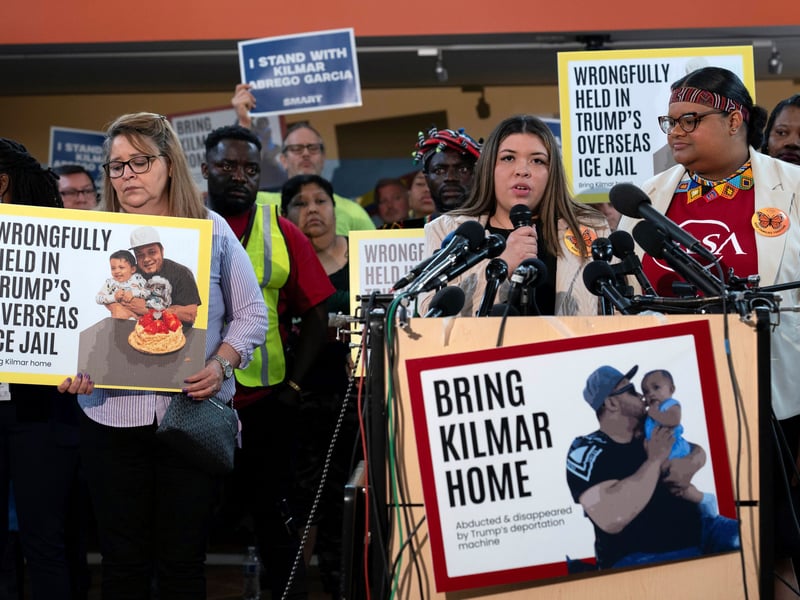
WASHINGTON (CN) — Legal experts are calling out President Donald Trump for defying the Supreme Court’s order to help return a Maryland father to the U.S. after the administration unlawfully deported him to a notorious prison in El Salvador.
“We are in a moment of constitutional crisis,” Elora Mukherjee, a law professor at Columbia, said. “The U.S. Constitution sets up a system of checks and balances where the branches respect one another, and the executive branch generally complies with federal court orders — especially when they’re issued by the U.S. Supreme Court.”
In the case of Kilmar Abrego Garcia, a Maryland father sent to El Salvador last month, the Trump administration has crossed a line between veiled resistance and actual defiance, court watchers say.
Last week, the Supreme Court said the Trump administration had to “‘facilitate’ Abrego Garcia’s release from custody in El Salvador and to ensure that his case is handled as it would have been had he not been improperly sent to El Salvador.”
Legal experts say there is no way to interpret the administration’s actions as complying with that ruling.
“I don’t think any good faith interpretation of [the Supreme Court’s ruling] allows the administration to say, ‘we’re not actually going to do anything to facilitate his return home,’” Katherine Hawkins, senior legal analyst at the Project on Government Oversight, said.
While legal experts see a clear violation of court orders, the Trump administration has pushed its own interpretation to argue it is complying with the justices’ ruling. In the Oval Office Monday, White House senior adviser Steven Miller claimed that the ruling affirmed that courts have no role in foreign policy, saying the Trump administration “won the case 9-0.”
Instead of shaping the president’s actions around the court’s ruling, Mukherjee said the administration was trying to create a legal basis for Trump’s actions.
“What we’ve seen is an executive branch that is intent on pushing the bounds of its authority as far as possible and now beyond the breaking point of our constitutional democracy,” Mukherjee said.
The Trump administration declared its actions followed a narrow reading of the word “facilitate” that would only require the U.S. to let Abrego Garcia back in the country if El Salvador released him.
“We would facilitate it, meaning provide a plane,” Attorney General Pam Bondi said.
Legal experts blame the Supreme Court for leaving an opening for the Trump administration to make these arguments, however. Unlike in the majority opinion, Hawkins said Justices Sonia Sotomayor, Elena Kagan and Ketanji Brown Jackson explicitly noted that the Trump administration had an obligation to provide Garcia with due process. The three liberal justices also said it was U.S. policy to return a wrongfully deported migrant.
“If we had had an opinion phrased more like Justice Kagan’s and Sotomayor’s and Jackson’s statement … it would be very clear that the Supreme Court would back up a lower court’s contempt finding,” Hawkins said. “That statement is a very crystal clear statement of all the laws the government is in violation of. The majority opinion has some more room for interpretation.”
Court watchers have suggested that the majority’s ambiguity was intentional, meant to avoid the exact confrontation with Trump it now faces.
“It’s an effort by the Supreme Court to stop the executive branch from flat-out defying its ruling,” Mukherjee said.
In a potential attempt to preserve its institutional legitimacy, the majority didn’t order an outcome — Abrego Garcia’s return to the U.S. — but used softer language to encourage Trump to try to “facilitate” his return, according to Mukherjee.
But even under that toned-down reading, Mukherjee and other legal experts say the administration is violating the justices’ order.
Abrego Garcia was sent to the foreign prison in violation of another order from an immigration judge that prohibited his return to El Salvador. Abrego Garcia, 29, fled that country as a teenager for fear of persecution by local gangs. He has lived in the U.S. for nearly 14 years; he was a resident in Maryland with his wife and three children.
U.S. Immigration and Customs Enforcement officials said an administrative error led them to deport Abrego Garcia. Trump administration attorneys have conceded the mistake in court documents and briefings before multiple courts.
But Miller’s statements Monday moved to seemingly absolve the administration of its initial error in the case.
The Trump administration claims without evidence that Abrego Garcia was a member of MS-13, a U.S.-designated terrorist gang. Abrego Garcia’s attorneys say the administration’s assessment was based on an unnamed informant who linked him to the gang’s offshoot in New York, where Abrego Garcia has never lived.
According to the Justice Department, Abrego Garcia was no longer eligible for deportation protections because of his MS-13 membership — which has not been proven in any court.
Mukherjee said the administration’s argument would retroactively apply MS-13’s recent terrorist designation to the immigration judge’s ruling from 2019. Abrego Garcia’s removal proceedings would have had to be reopened for the administration to make that argument, Mukherjee said. Instead, ICE removed Abrego Garcia without due process — a right the Supreme Court affirmed migrants are due before boarding flights to the prison.
“If they’re following the rule of law, they can’t just assert this and then take someone to a different country,” Mukherjee said. “That is not how the rule of law works.”
In a hearing Tuesday, U.S. District Judge Paula Xinis plans to examine whether the Trump administration violated her order to provide status updates on Abrego Garcia. The Justice Department didn’t offer news about Abrego Garcia last week, only later confirming that he was alive and being held at El Salvador’s Centro de Confinamiento del Terrorismo, or CECOT.
Abrego Garcia’s lawyers and wife, who is a U.S. citizen, have been unable to contact him since his deportation in March, and the government has not given an update on his conditions. His lawyers asked Xinis, a Barack Obama appointee, to consider whether the Trump administration should be held in contempt over violating her instructions.
With little precedent to go on, legal experts are unsure what would happen if the courts tried to hold the administration in contempt.
“The court giving a pretty direct order and the government just ignoring it is unusual,” Hawkins said. “So I don’t know exactly what form it’s going to take. Criminal contempt of court is most often prosecuted by the Justice Department, which creates obvious conflicts in this case.”
 Follow @KelseyReichmann
 Follow @kelseyreichmann.bsky.social
Subscribe to our free newsletters
Our weekly newsletter Closing Arguments offers the latest about ongoing trials, major litigation and rulings in courthouses around the U.S. and the world, while the monthly Under the Lights dishes the legal dirt from Hollywood, sports, Big Tech and the arts.