
 Search Articles


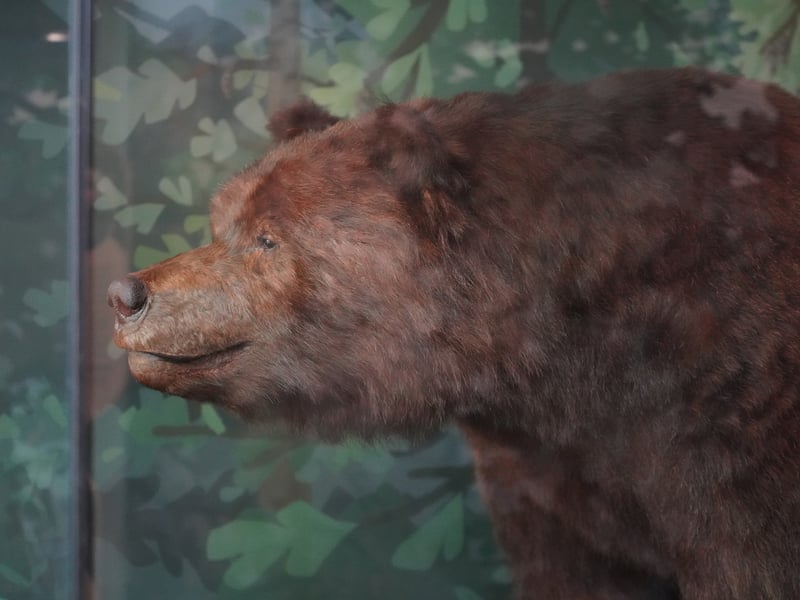
SAN FRANCISCO (CN) — At the California Academy of Sciences in San Francisco’s Golden Gate Park, visitors can encounter a quiet but commanding presence.
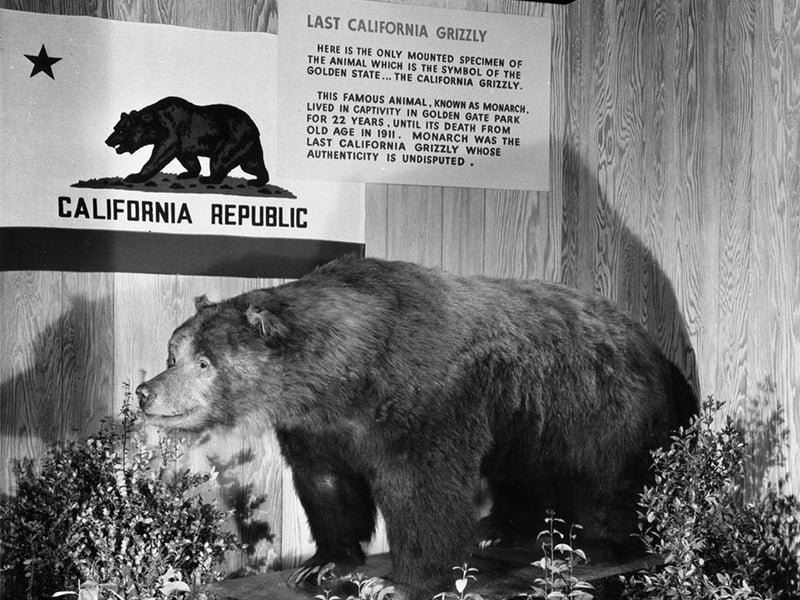
It’s the taxidermied figure of Monarch, one of history’s most famous grizzly bears.
More than just a bear, Monarch was a California icon: a Golden State marketing sensation, a symbol of the vanishing wilderness and a reminder of California’s complicated relationship with its natural history.
Supposedly, Monarch is also the bear on California’s flag — though experts say that’s likely just a myth. More on that later.
Monarch’s story begins in 1889, when newspaper mogul William Randolph Hearst launched an expedition to capture a live California grizzly bear.
At the time, the species was already in decline due to hunting and habitat loss. Nonetheless, Hearst was eager to boost readership for his paper, the San Francisco Examiner.
Hearst hired a group of hunters. Led by journalist and outdoorsman Allen Kelley, they scoured the remote landscapes of Ventura County near Los Angeles. After a grueling effort, they finally found Monarch, chaining him up and transporting him from the rugged San Gabriel Mountains.
So goes the story, at least. Some sources say Kelley did not capture Monarch at all but simply bought him in captivity, then transported him to San Francisco.
Whatever the case, Monarch’s life was a stark contrast to the wild landscapes he once roamed.
“I’m pretty sure Monarch wasn’t happy in captivity,” said Rebekah Kim, head librarian of the California Academy of Sciences.
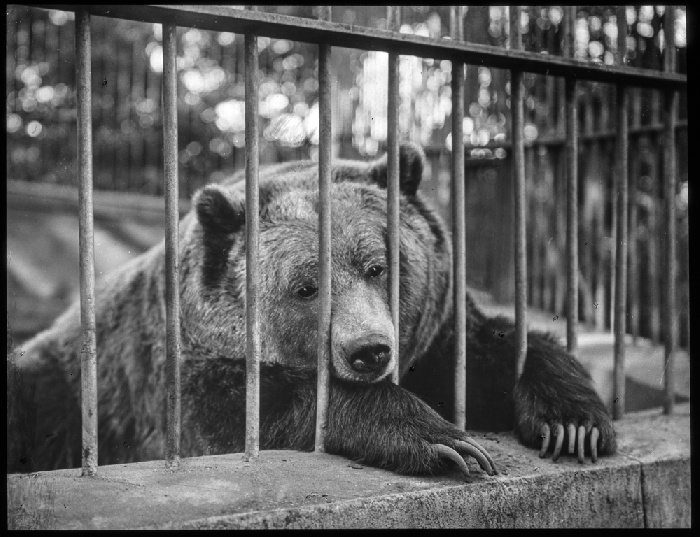
Grizzlies have a vast natural range. In captivity, Monarch spent his days in an inappropriately small pen. And while grizzlies can hit a whopping 600 pounds as they gorge themselves for hibernation, Monarch nonetheless became obese, nearing 1,000 pounds as visitors fed him junk food.
It’s a fitting metaphor for the California wilderness in Monarch’s time. Like Monarch himself, California’s vast natural spaces were also being tamed, put in a proverbial cage by money-hungry industrialists.
“The reason California grizzlies don’t exist anymore is because people destroyed them,” Kim said. “There were bear hunters who would go out and poison bears and hunt them down.” Spanish accounts from the mid-1800s described packs of grizzlies roaming through the Bay Area — but by 1889, the mighty animal was nearly gone in the Golden State. California was being domesticated, its forests and coastal landscapes slowly turning to subdivisions.
In San Francisco, Monarch became an attraction at Woodward’s Gardens, a popular amusement park and zoo in the Mission District. He later moved to Golden Gate Park, where he lived for more than two decades in the park’s “bear pit” near Haight and Stanyan streets.
Monarch had a mate named Montana. Together, they had several cubs. One of them, Monarch II, lived to adulthood and was featured on a commemorative half-dollar coin from 1936.
While Monarch II may have found fame in coinage, head librarian Rebekah Kim was quick to dispel a widely circulated myth about Monarch Sr.: that he’s the bear who appears on California’s flag.
“He’s not!” she exclaimed.
It’s unclear how the rumor started — though Kim acknowledges that “we definitely helped with that myth.” At various times, the Academy has displayed the flag as a backdrop for Monarch, further cementing a link in the minds of some Californians.
California first featured bear symbolism on its flag during the Bear Flag Revolt of 1846 — decades before Monarch was ever captured. Still, the design was standardized in 1911 and finalized in 1953, making it feasible that Monarch appeared in later iterations.
Flag designer Don Kelley (no relation to Allen) worked at the Academy and would have seen his taxidermied body. For armchair vexillologists, that’s further evidence that it’s Monarch on the modern flag. As Kim explained, “the assumption is that he used Monarch as the model."
Dig a little deeper, though, and holes start showing up in that version of events. For one thing, there’s no mention of Monarch in Kelley’s detailed and meticulous notes about designing the flag. In letters with Tracy Storer, a zoologist at the University of California at Davis with whom Kelley collaborated on bear accuracy, Kelley includes sketches of bears but never cites Monarch as an inspiration.
One letter in particular throws cold water on the Monarch flag myth. In it, Storer and Kelley discuss how the bear’s teeth should look. Monarch’s taxidermied figure is toothless, while his skull has been missing since 1953.
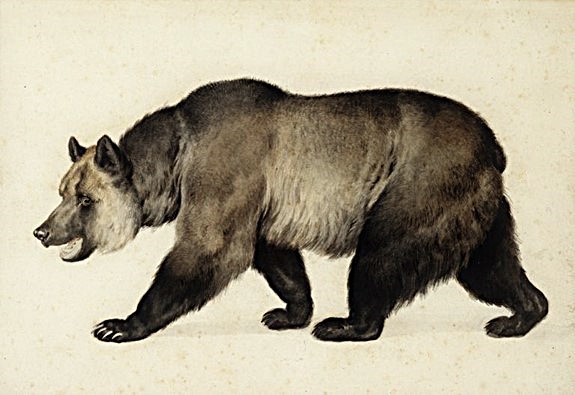
Instead, some flag truthers say the bear from California’s flag is Samson, a bear owned by famed outdoorsman John “Grizzly” Adams. So says Tod Swindell, who helps promote Adams’ legacy through the website grizzlyadams.com.
Swindell cites an excerpt from the “The Great Bear Almanac” from 1993, in which author Gary Brown argues the modern California flag design is based on an 1855 drawing of Samson by French artist Charles Nahl (though Brown misspells his name as Nahn). The images are indeed strikingly similar: Nahl’s drawing shows Samson walking with his left front leg forward and his mouth agape, just like the bear on the flag.
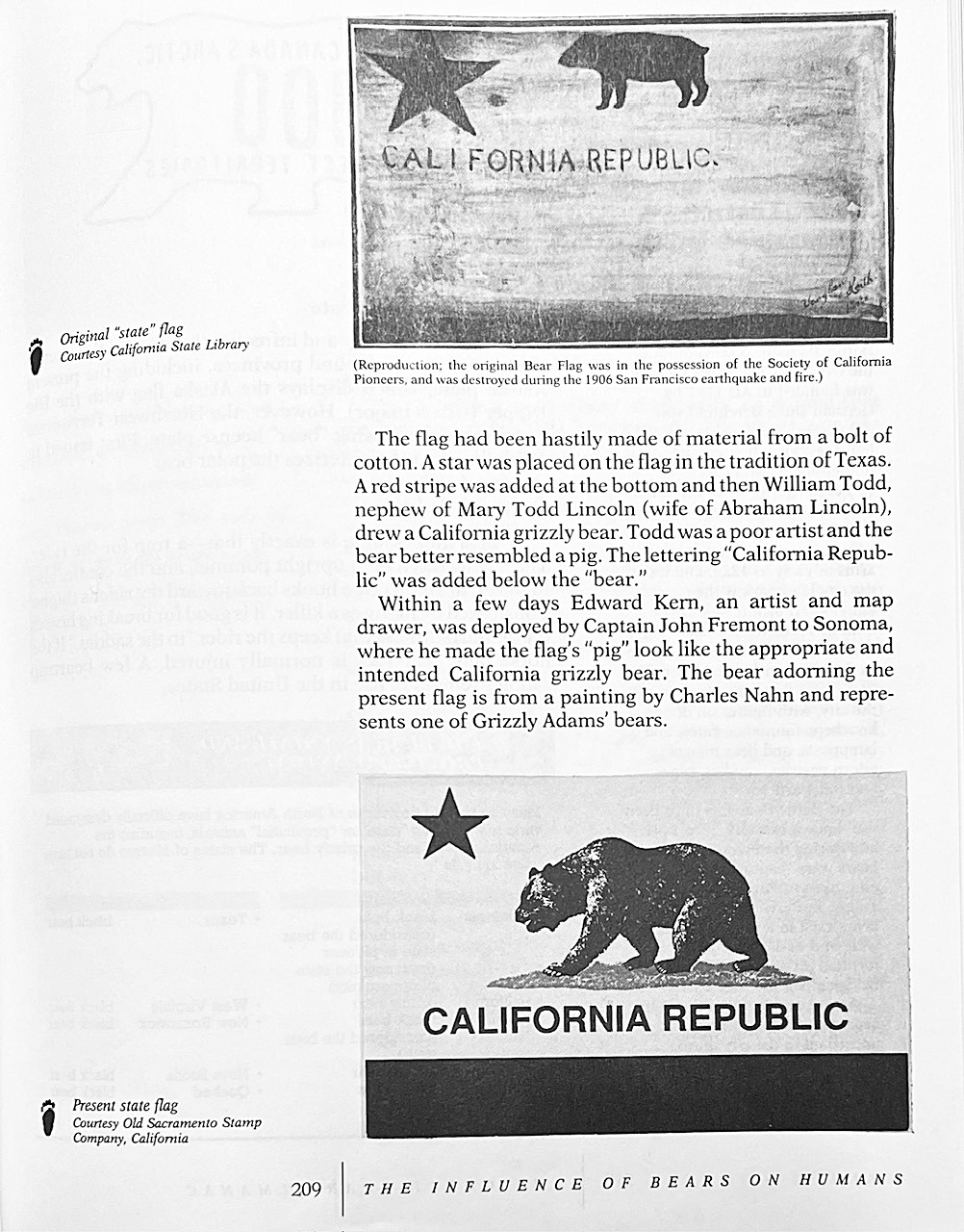
“If you do a transparent overlay of the two, they match exactly,” Swindell said.
Whatever the case, the Monarch flag myth lives on. Kim thinks the story has staying power because it’s easy, simple and neat. “Monarch is so popular [as] an idea,” she said. “He’s often counted as the last California grizzly. I think people just naturally assume they go hand in hand.”
Monarch’s final days were painful. Suffering from rheumatoid arthritis, he was unable to move freely in his cage and eventually became paralyzed. A policeman euthanized him. “He might have died differently,” Kim said, “were he not confined to a cage.”
After Monarch died in 1911, taxidermist Vernon Shepherd preserved him, and he was once again put on display. The grizzly remains a public fixture today, his watchful gaze frozen in time inside the California Academy of Sciences building.
It’s unclear if Allen Kelley ever felt any regrets for capturing and caging Monarch.
His writings suggest mixed feelings. In his 1903 book “Bears I Have Met—and Others,” Kelley describes Monarch as “independent and militant.” He notes the bear’s fierce spirit and resistance to handling, as well as the hardships Monarch faced while he was living in a small cage.
In spite of Monarch’s sad fate or perhaps because of it, Monarch remains a powerful symbol of the state’s identity, emblazoned on logos, memorabilia and flags, even if not the actual California flag.
His story has inspired discussions on conservation, as wildlife lovers aim to protect today’s endangered species from a similar fate. These days, the California Academy of Sciences displays Monarch as part of its “California: State of Nature” exhibit, educating visitors about the importance of preservation and biodiversity.
That focus is intentional, said Paige Laduzinsky, who helped design the exhibit.
It’s “kind of the first major exhibit that we’ve done at the Academy since our new mission to really actively focus on regenerating ecosystems and regenerating the natural world,” she said. “We wanted to use Monarch as an example.”
The decline of the California grizzly was tied directly to settler-colonialism, Laduzinsky said. As such, she and her team also interviewed 10 Indigenous leaders from within Monarch’s historic range, to ensure the exhibit didn’t just include the voices of scientists.
Besides educating visitors about conservation, Laduzinsky hopes the exhibit will help dispel a well-worn grizzly myth: that they’re ferocious and violent creatures.
“We wanted to move away from that kind of scary stereotype,” she said. Indigenous Americans lived alongside grizzlies for centuries, she noted, and grizzly diets are about 85% vegetarian.
Visitors can still admire Monarch today as he stands like a silent guardian of history in the halls of the Academy. His presence is both a tribute and a lesson, a reminder of what once was and what can still be saved.
Ironically, he’s become “a powerful symbol of conservation,” Kim said.
One a recent visit, guests were as usual admiring the majestic specimen. “Seeing Monarch up close makes you realize how incredible and powerful these animals were,” said visitor James Rivera from Oakland. “It’s sad to think that we lost them forever, but it’s also a reminder of why conservation is so important today.”
For other visitors, seeing Monarch’s exhibit can bring up more somber feelings. Another sightseer from Oakland, Annie Cohen, said that learning about Monarch reminded her about the history of Indigenous Americans.
Like Monarch, they were forced from their lands. Like Monarch, they were celebrated in museums and history books — as if that could ever make up for all the cruelties they endured. “He was taken from the wild, put in a cage and turned into a symbol,” Cohen said. “But at what cost?”
Subscribe to our free newsletters
Our weekly newsletter Closing Arguments offers the latest about ongoing trials, major litigation and rulings in courthouses around the U.S. and the world, while the monthly Under the Lights dishes the legal dirt from Hollywood, sports, Big Tech and the arts.