Search Articles


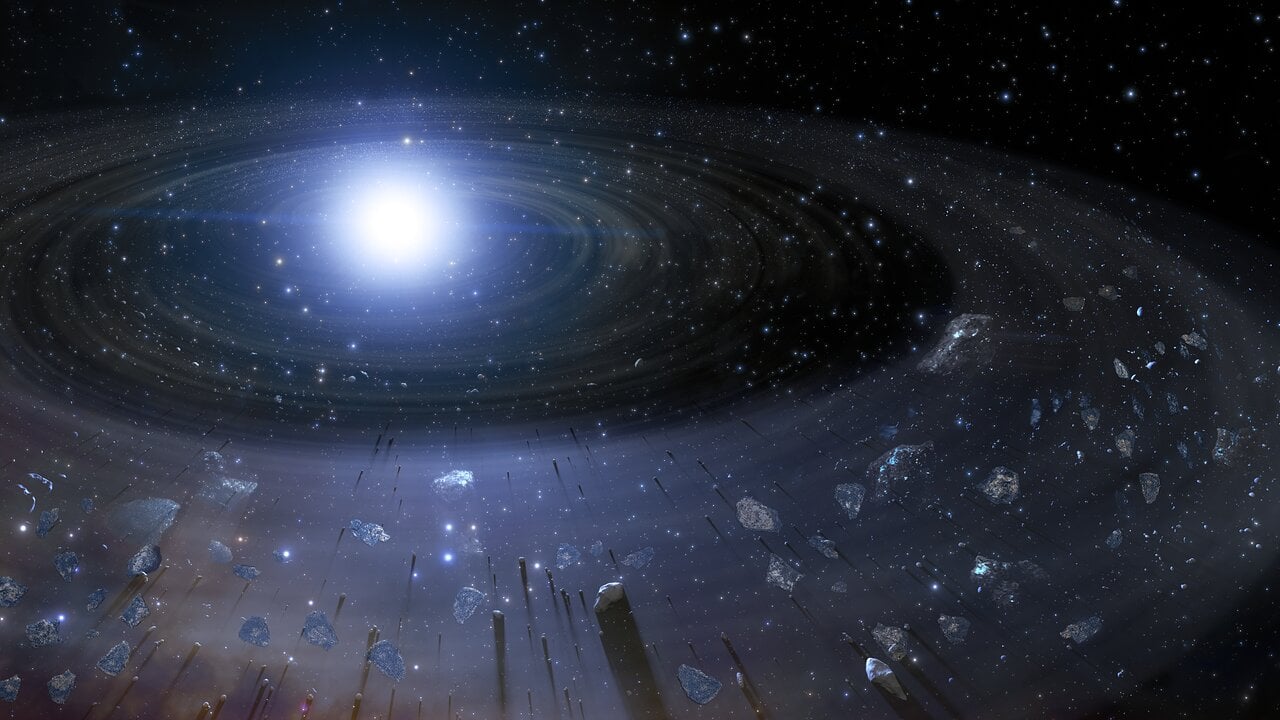
(CN) — A star’s final act may be to give itself one last push.
Researchers suggest aging stars experience thousands of tiny kicks as they shed their outer layers, gradually adding up to a final shove strong enough to alter their paths through space and even break apart some binary star systems.
The findings, presented Monday at the 248th meeting of the American Astronomical Society, offer a possible explanation for a long-standing mystery surrounding white dwarfs — the dense stellar remnants left behind when sun-like stars reach the end of their lives.
Most stars in the universe eventually become white dwarfs. Before reaching that stage, they expand into red giants and begin losing their outer layers. Over time, the stars shed much of their mass while their core contracts into a compact remnant.
For years, astronomers have suspected white dwarfs receive a small velocity boost during this process. Evidence for those kicks has come from observations showing that widely separated pairs of stars are less common once one member evolves into a white dwarf.
However, what remains unclear is exactly how those kicks occur.
Jim Fuller, a professor of theoretical astrophysics at the California Institute of Technology, has proposed a new explanation. Rather than losing mass smoothly, dying red giant stars may eject blobs of material in random directions over hundreds of thousands of years.
“In this model, blobs of matter are chaotically being ejected from the surface of the bloated stars in an asymmetric fashion,” Fuller said in a press release. “And every time that happens, the star gets a little kick in the opposite direction. Like Newton said, for every action there is an equal and opposite reaction.”
According to Fuller’s calculations, a star in the final stages of its life could experience roughly 10,000 of these small kicks. Each individual push would move the star at only a few meters per second.
“That’s a slow jogging pace for humans,” Fuller said.
However, because the kicks occur repeatedly, they add up over time. Much like a person wandering in random directions eventually ends up far from where they started, the star gradually begins to move in one direction.
Researchers estimate the final velocity of the resulting white dwarf could reach roughly 1 kilometer per second.
That may not sound fast by cosmic standards, but it is enough to have major consequences for some binary star systems.
The idea builds on previous work by Kareem El-Badry, a Caltech assistant professor of astronomy, who found widely separated binary stars become less common after one star evolves into a white dwarf. His observation suggested white dwarfs receive a kick strong enough to disrupt their orbits.
“If the orbital speed of the binaries is less than the kick speed, the wide binaries will become gravitationally unbound,” Fuller said.
To develop the new model, Fuller combined El-Badry’s observations with computer simulations showing that material escaping from red giant stars is often expelled unevenly rather than in a smooth, symmetrical flow.
The model is the first to connect those random mass-ejection events to the suspected kicks experienced by white dwarfs.
“I am pleased to see a physical model that can explain this observation, which has puzzled me for several years,” El-Badry said in the press release.
Researchers also point to a more dramatic possibility.
In some binary systems, the repeated kicks could gradually alter the stars’ orbits until the two objects collide. Such collisions could trigger stellar explosions or other bright transient events that astronomers may be able to detect in future observations.
Fuller says future studies could test the theory by searching for evidence of those collisions and other signatures predicted by the model.
For now, the work suggests the deaths of ordinary stars may be far more chaotic than they appear.
“In this model, blobs of matter are chaotically being ejected from the surface of the bloated stars in an asymmetric fashion,” Fuller said.
This story first appeared in The Caltech Weekly.
Subscribe to our free newsletters
Our weekly newsletter Closing Arguments offers the latest about ongoing trials, major litigation and rulings in courthouses around the U.S. and the world, while the monthly Under the Lights dishes the legal dirt from Hollywood, sports, Big Tech and the arts.