
 Search Articles


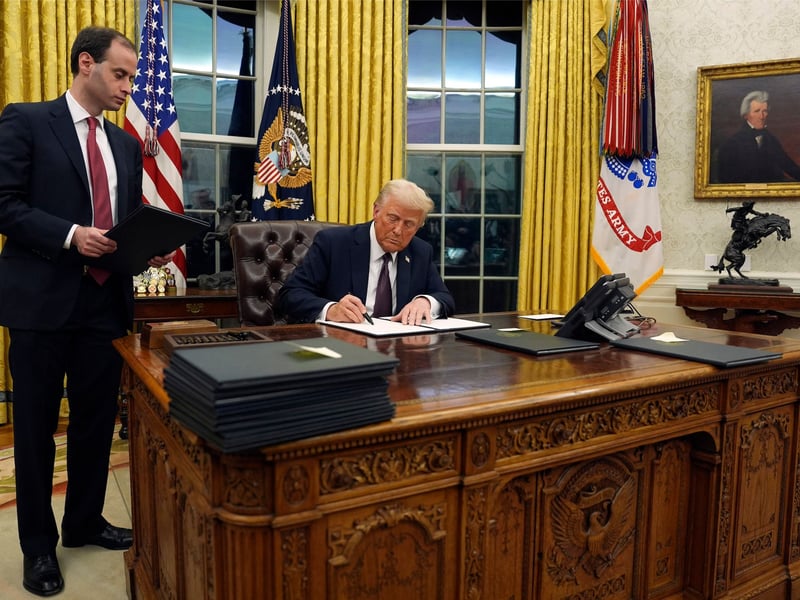
WASHINGTON (CN) — President Donald Trump’s retribution agenda is setting up Supreme Court showdowns that could redefine the American presidency.
Instead of laboring through tedious federal agency rulemaking procedures or flexing his dealmaking skills to advance congressional legislation, Trump is using unilateral executive orders to implement key policy goals.
Legal experts suspect Trump will use the dozens of lawsuits challenging his executive orders to legislate through the courts.
“I get the sense that they are operating legal test balloons that animate a lot of these executive orders,” said Andrea Katz, a law professor at Washington University School of Law in St. Louis.
Trump’s test balloons overturned birthright citizenship, stripped civil-service protections from federal workers, handed a billionaire access to government operations without oversight, and ordered an immediate pause on congressionally allocated funding.
States, advocacy groups, federal employees, and others say the orders violate the Constitution, duly enacted legislation, and Supreme Court precedent. Adam Winkler, a constitutional law professor at UCLA, said Trump’s executive actions could be intentionally broad, pushing the court to extend presidential power.
“The way he does that is by making these bold and aggressive executive actions and daring people to challenge them in court, with the idea being that, yeah, maybe the courts will strike some of them down, but the courts have really been expanding executive power in recent years, especially the Roberts court,” Winkler said.
Under Chief Justice John Roberts, the Supreme Court has embraced the unitary executive theory — giving the president broad Article II authority over federal government operations. In 2010, the court ruled that Congress unlawfully protected a financial oversight board from presidential removal in Free Enterprise Fund v. Public Co. Accounting Oversight Board .
Roberts said for-cause removal protections insulated the board members from presidential oversight, preventing the president from faithfully executing his oath of office. A decade later in Seila Law LLC v. Consumer Financial Protection Bureau , Roberts cemented a legal rule barring any statute that limits the president’s ability to oversee the executive branch.
Katz said increasing the president’s power limits the authority of the federal bureaucracy. Presidents can’t unilaterally shut down federal agencies. Congress would need to repeal the agency by statute.
“But if you don’t have numbers to do that in Congress, what you can do is use the president’s power to — and we’re seeing this from Trump — silence civil servants,” Katz said.
Trump has ordered massive changes to federal work policies and pressured employees to resign voluntarily. He also tried to freeze agency funding, preventing many civil servants from doing their jobs.
“This is all sort of how you can push presidential power to really kneecap the bureaucracy,” Katz said.
At the same time, the Supreme Court curtailed federal agency authority, attempting to rein in their ability to operate with any autonomy. In June, the conservative majority overturned Chevron deference — a 40-year-old precedent giving agencies control to interpret statutes.
Winkler said the justices think agencies have a certain independence and authority distinct from presidential power. While Trump is taking advantage of expanded executive authority, his actions conflict with the justices’ theory that agencies are not accountable.
“By taking power away from these agencies and investing it in courts who will get the final word on agency regulation, the court has actually put the power in the hands of unaccountable judges,” Winkler said. “So in the name of enhancing accountability, we’ve taken power away from accountable administrative agencies whose policies change with each new presidential election and given that power to judges where there’s no accountability.”
Legal experts will closely watch for inconsistencies in how the justices rule between the Biden and Trump administrations. President Joe Biden’s policies on student debt forgiveness, immigration, and vaccine mandates were all overturned by the justices for being outside of his executive authority.
Winkler said the hallmark of the Roberts court has been to overturn longstanding precedents so it’s hard to predict how the justices will rule on even seemingly easy cases. Birthright citizenship is protected by the 14th Amendment, supported by decades of Supreme Court precedent and written into federal law, but it’s impossible to be certain how the justices will rule on an issue until they do.
“It’s hard to have faith that the Roberts court is going to adhere to long-standing precedent and understandings of the Constitution when its hallmark is to depart from those long-standing understandings of the Constitution,” Winkler said.
Thanks to the Roberts court, Trump’s expanded executive authority includes criminal immunity. While the conservatives maintain that the president needs unencumbered power to faithfully execute the country’s laws, their liberal colleagues have lamented that the court has made presidents kings above the law.
Those ideological divides will play a key role in whether or not executive authority extends to unilateral policymaking.
“The Supreme Court has definitely opened the door for presidents to be much more aggressive and less concerned with the law, including the criminal law, in pursuit of their agenda, and that is a fundamentally different kind of system than the one we’ve always had,” Winkler said.
 Follow @KelseyReichmann
 Follow @kelseyreichmann.bsky.social
Subscribe to our free newsletters
Our weekly newsletter Closing Arguments offers the latest about ongoing trials, major litigation and rulings in courthouses around the U.S. and the world, while the monthly Under the Lights dishes the legal dirt from Hollywood, sports, Big Tech and the arts.