
 Search Articles


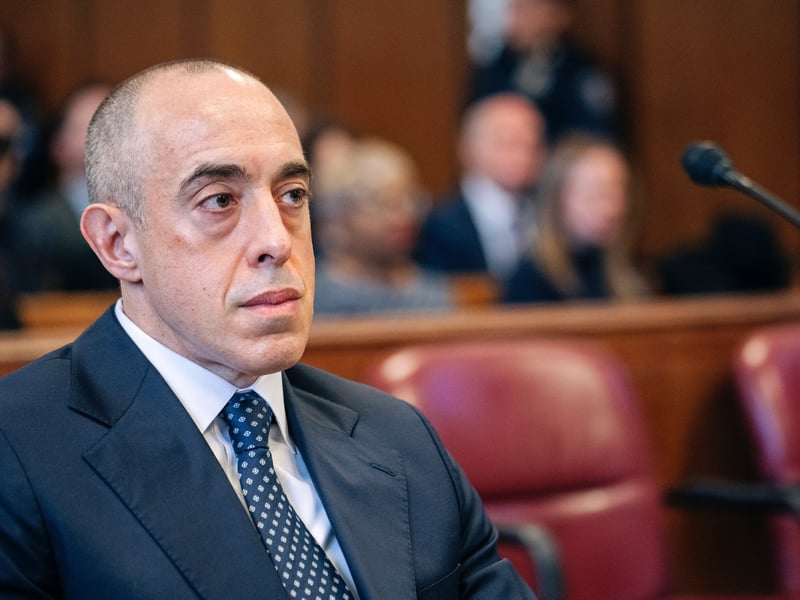
WASHINGTON (CN) — As he seeks confirmation to a key vacancy on the federal judicial bench, Emil Bove has staked out a carefully balanced position on the Jan. 6, 2021, Capitol riot, according to his answers in a written questionnaire provided to lawmakers last week.
Bove, President Donald Trump’s nominee to the U.S. Court of Appeals for the Third Circuit and a former member of his personal legal team, told the Senate Judiciary Committee in the questionnaire that he condemned illegal activity and acts of violence against law enforcement. But he also suggested that the government’s prosecution of Jan. 6 rioters amounted to overreach, something he said was “equally unacceptable.”
The nominee’s Jan. 6 balancing act comes ahead of a crucial vote in the Judiciary Committee, where one Republican senator has already tanked a Trump administration judicial appointee over his stance on Capitol riot prosecutions.
In questions for the record, submitted to the Senate’s legal affairs panel on July 2 and obtained Friday by Courthouse News, Bove defended his involvement in the Justice Department’s move to fire federal prosecutors who worked on Jan. 6 cases in the early weeks of the second Trump administration.
The nominee had faced tough questions about the firings during his June confirmation hearing before the Judiciary Committee. At the time, Bove argued that the terminated prosecutors working in the D.C. U.S. attorney’s office were “probationary” employees made permanent by former President Joe Biden after the 2024 election.
Writing in response to questions from Judiciary Committee chairman Chuck Grassley last week, Bove repeated those claims, citing a public memo from January in which he framed the Biden administration’s move as a mass hiring of assistant U.S. attorneys which “improperly hindered” then-acting U.S. attorney for D.C. Ed Martin’s ability to staff his own office.
“The memorandum further explained that these ‘subversive personnel actions’ drove my thinking about the termination decisions of these probationary employees,” Bove wrote.
But in his memo to the U.S. attorney’s office, then-deputy attorney general Bove referred to the Capitol riot prosecutions as a “grave national injustice.”
The nominee also addressed a separate memo from January in which he requested a list of FBI employees assigned to Jan. 6 cases for review, pointing out that ongoing litigation has kept the Justice Department from undertaking such a review. And he referenced a private email he sent to the FBI in February in which he said that FBI employees who “simply followed orders and carried out their duties in an ethical manner” would be at risk of termination.
Though he explained away the Justice Department’s firings and reviews of officials working on Capitol riot cases, Bove took a more measured approach to the prosecutions themselves.
Pointing to his own experience as a federal prosecutor in New York, the Third Circuit nominee said that he condemned “all forms of illegal activity,” especially with respect to acts of violence against law enforcement.
“At the same time, based on a variety of professional experiences, I find overreach and heavy-handed tactics by prosecutors and law enforcement to be equally unacceptable,” Bove wrote.
And those concerns, the nominee added, were not “mutually exclusive,” and both were implicated by the events of the Capitol riot.
Bove also refused to directly denounce the riot in responses to Senate Minority Whip Dick Durbin, reasoning that if confirmed to the federal bench he may be required to address litigation related to Trump’s sweeping pardons of Capitol rioters.
But he also left room for debate on the character of the Jan. 6 attack. “The characterization of the events on January 6, 2021 is a matter of significant political debate and subject to ongoing litigation,” Bove wrote.
Asked by Durbin where he was on Jan. 6, 2021, Bove said that he could not recall. In response to questions from Connecticut Senator Richard Blumenthal, he clarified that he was not in Washington or on the Capitol grounds during the riot.
The nominee further demurred at the Illinois Democrat’s questions about his contribution to Jan. 6 prosecutions during his time as an assistant U.S. attorney in the Southern District of New York, telling Durbin that he did not “personally observe” abuse of the criminal justice system in those cases but that he “did not have access to all relevant information” at the time.
It remains to be seen whether Bove’s tightrope walk on Jan. 6 will have any effect on the Judiciary Committee’s Republican majority — but at least one GOP lawmaker has already scuttled a Trump nominee based on his stance on the Capitol riot.
The White House in May was forced to withdraw Martin’s nomination to become D.C.’s permanent U.S. attorney after North Carolina Senator Thom Tillis voiced his opposition. Tillis, who has long said that anyone who breached the Capitol on Jan. 6 should be fined or imprisoned, told reporters that Martin was too concerned with the “over-prosecution” of rioters.
Martin had previously defended Capitol rioters and as acting U.S. attorney for D.C. opened an investigation into his office’s prosecution of Jan. 6 defendants.
So far, Bove’s own veiled criticism of the Justice Department’s prosecution of Capitol rioters doesn’t appear to have swayed Tillis against him. The senator, who has announced that he will not seek reelection, indicated this week that he would vote for Bove. And Tillis has previously said that he hadn’t seen any Trump nominees that “would be problematic,” framing his opposition to Martin as an “outlier.”
A spokesperson for Tillis’ office did not immediately return a request for comment on Bove’s written questionnaire.
Meanwhile, Bove in his written responses to senators broadly refused to address the details of a whistleblower report sent to the Senate by a former Justice Department attorney who claimed that the nominee had expressed intent to defy a federal court order while serving as a top agency official.
The nominee would not explain the events of a March 14 meeting with Justice Department officials, during which the whistleblower claimed that Bove said the agency may have to say “fuck you” to a federal judge to carry out the Trump administration’s planned mass deportations. Bove told senators that he had an “ethical obligation” to preserve confidential communications from the executive branch.
“[E]ven the prospect that the executive branch’s confidential information could be required to be disclosed in the context of a confirmation hearing would undermine the candor and free exchange of ideas that is necessary to the effective operation of the executive branch,” Bove wrote.
Bove told the Judiciary Committee last month that he did not recall using the phrase “fuck you” when referring to a federal court order. And in his written questionnaire last week, the nominee said that he “had not advised a DOJ attorney or other government official to violate a court order.”
The Justice Department whistleblower has claimed that Bove advised the Homeland Security Department in March that it could unload deportation flights in El Salvador despite a federal court order demanding such flights be turned around, because the court had not issued a written order in the case docket before the planes left U.S. airspace.
The Republican-led Judiciary Committee is expected to vote on Bove’s nomination to the Third Circuit next week. If it passes, he will move to a final confirmation vote in the full Senate — but a defection from just one GOP lawmaker on the panel could put his appointment in jeopardy.
 Follow @BenjaminSWeiss
Subscribe to our free newsletters
Our weekly newsletter Closing Arguments offers the latest about ongoing trials, major litigation and rulings in courthouses around the U.S. and the world, while the monthly Under the Lights dishes the legal dirt from Hollywood, sports, Big Tech and the arts.