
 Search Articles



OMAHA, Neb. (CN) — The outcome of this year’s presidential race could come down to a few thousand voters in and around this mid-sized Midwestern city.
So, too, could everything that comes after. U.S. policy in the Middle East and Ukraine. The economy. Climate change. The whole ball game, really, might rest on voters in and around Omaha, Nebraska’s largest city.
“The folks there in Nebraska will be in rarified air, where they literally can make the difference,” said Robert Alexander, a professor of political science at Bowling Green State University in Ohio who studies the Electoral College.
A few voters in Nebraska, he emphasized, could determine “who the next president is, who the Supreme Court is, how we handle Israel and Hamas.”
Though overall a conservative state, Nebraska doesn’t award all five of its Electoral College votes to the state’s popular-vote winner.
Instead, two go to the overall winner in the state, while one goes to the respective winner in each of the state’s three U.S. House districts. This allows the overall loser — in Nebraska, almost always a Democrat — to still pick off a single electoral vote. Only Maine has a similar system.
While Nebraska as a whole is Trump country, the 2nd U.S. House District, which contains Omaha and some surrounding areas, is favored for Kamala Harris. And in more than one scenario, that one electoral vote could decide whether it’s Harris or Donald Trump who gets the 270 electoral votes needed to clinch the presidency.
Michael Tiedeman is the GOP chairman for Sarpy County, about half of which is in the 2nd District.
He puts its importance in stark terms.
“I’m looking at polling every day … I think it’s a good possibility that it’s going to come down to Nebraska’s one (competitive) electoral vote,” he said. “It seems to kind of change daily, but right now I’d say [it’s] maybe 50-50.”
No Democrat has won all five Nebraska electoral votes since 1964, when President Lyndon B. Johnson took nearly 53 % of the vote in that year’s wipeout of Republican Barry Goldwater.
In 1991, former state SenatorDiAnna Schimek, a Democrat from Lincoln, introduced a measure to change the state from winner-take-all to this district-based system.
In an interview with Courthouse News, she said her goal was to drive up participation. She wasn’t even thinking in terms of the 2nd District specifically, she said.
“There were some other states that were looking at it at the time. Maine already had the system,” said Schimek, now 84. “I just immediately latched on to it. I thought, ‘What a great idea.’”
LB 115 passed the legislature 25-23. Then-Governor Ben Nelson, a Democrat, quickly signed it into law.
In 2008, Barack Obama won the single electoral vote of the 2nd District. In 2020, Joe Biden won it. And polling shows Vice President Kamala Harris is favored to win it this year.
CNN has reported that if Harris carries Wisconsin, Michigan and Pennsylvania, and Trump wins Arizona, Nevada, North Carolina and Georgia, the 2nd District electoral vote could be the deciding factor. Nor is that the only path where the 2nd decides the presidency.
It’s a possibility that’s invigorated many Democrats living here.
Drive across the eastern half of Omaha, through its oldest and most politically liberal precincts, and you’ll see yard signs, many white with a big blue dot in the middle. It’s a symbol of the unique role the 2nd District plays in this high-stakes race.
In the city’s Aksarben neighborhood, Mandy Roth, 47, doesn’t just have a blue-dot sign in her front yard. She also has a smattering of blue dot-stickers decorating her front door, as well as a blue porch light.“It’s been really fantastic to get involved and feel that my voice makes a difference,” Roth said. “It’s nice to know there are some of us who can have a voice and be seen.”
But the significance of this Omaha-area electoral vote has galvanized conservative voters too, Tiedeman said.
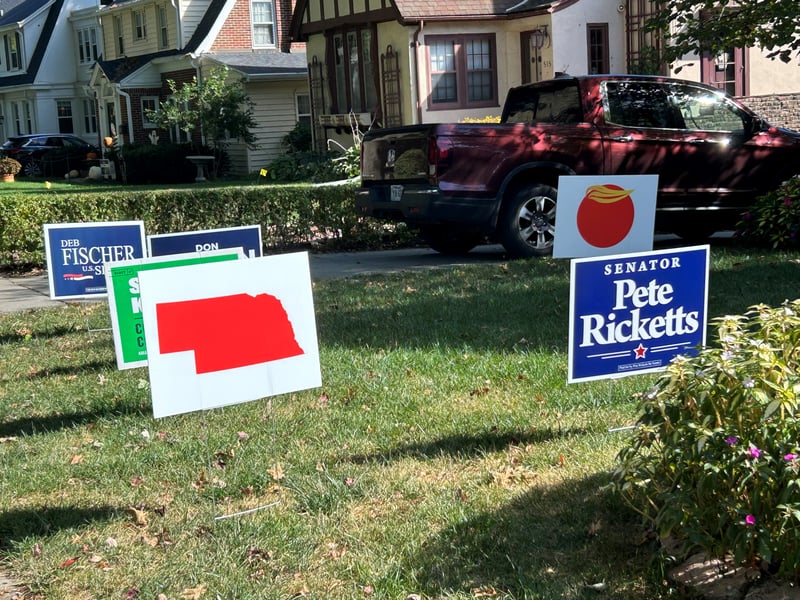
Some GOP organizations have responded by distributing red-dot signs, along with signs showing Nebraska colored red. One sign sports a red dot with an image of Trump’s wavy reddish-blonde pompadour.
“I’ve been seeing a lot more people reaching out to me to get some Republican signs in response to the blue-dots sign popping up,” Tiedeman said. “I do think it is actually helping Republicans paying a little more attention to this election."
Could the 2nd District really tip the race? Citing the unpredictability of elections, experts hesitate to say for sure.
Gregory Petrow, a professor of political science at the University of Nebraska at Omaha, doubts it will come down to the 2nd District, putting the odds at 1 or 2%. He sees Pennsylvania as far more critical. “That’s the tipping point state,” he said.
“You’d have to have a very exact breakdown of how the other states vote," he added. “It is just very unlikely that that exact configuration will occur.”
Alexander, the Bowing Green professor, was also tempered.
“Obviously the 2nd District there is really important," he said. “If it wasn’t, there wouldn’t have been such a push, certainly by the Trump campaign, to move Nebraska to a winner-take- all state.”
Alexander was referencing a Trump-backed effort in September to end the Nebraska practice. That effort was stymied by a single Republican state senator from Omaha, who said he would not support the move so close to the November election.
If the electoral count comes down to the the 2nd District, Nebraskans might see attorneys from both campaigns filling the hallways of Omaha-area courthouses. Both Petrow and Alexander predicted lawsuits should Trump lose narrowly.
“If Trump wins, then there are no shenanigans. But if Trump loses, than there will be challenges to the results," said Petrow. And in the legal realm, “he could be more successful this time than he was last time.”
Tiedeman, the GOP official, saw things differently.
“I definitely could see either side filing a lawsuit,” he said. “It kind of comes down to the circumstances. You are not going to file a case if you don’t have evidence.”
One might ask if it’s okay for Nebraska to award electoral votes this way.
The answer, according to experts, is yes.
“Most everything that a state decides when it comes to issuing its electoral votes [is] going to be constitutional,” said Wilfred Codrington III, professor of constitutional law at the Cardozo School of Law in New York City. Among other things, he cited Article 2, which addresses the presidency and the Electoral College and gives state legislators broad presumptive authority over electors.
“The Constitution does give states the ability to choose electors as they wish,” Alexander said. “That was indeed part of the argument that team Trump was making in the days after the 2020 election.”
The 2024 results could lead to a renewed push by Republicans to take Nebraska back to winner-take-all. Or, Alexander said, it could encourage other states to also split electoral votes.
“It will be interesting to see what pushback if any occurs after the election," he said. “It will also be interesting to see if other states kind of go in that direction, if they feel they will be better advantaged under a district system as opposed to under a winner-take-all system.”
 Follow @nelson_aj
Subscribe to our free newsletters
Our weekly newsletter Closing Arguments offers the latest about ongoing trials, major litigation and rulings in courthouses around the U.S. and the world, while the monthly Under the Lights dishes the legal dirt from Hollywood, sports, Big Tech and the arts.