
 Search Articles


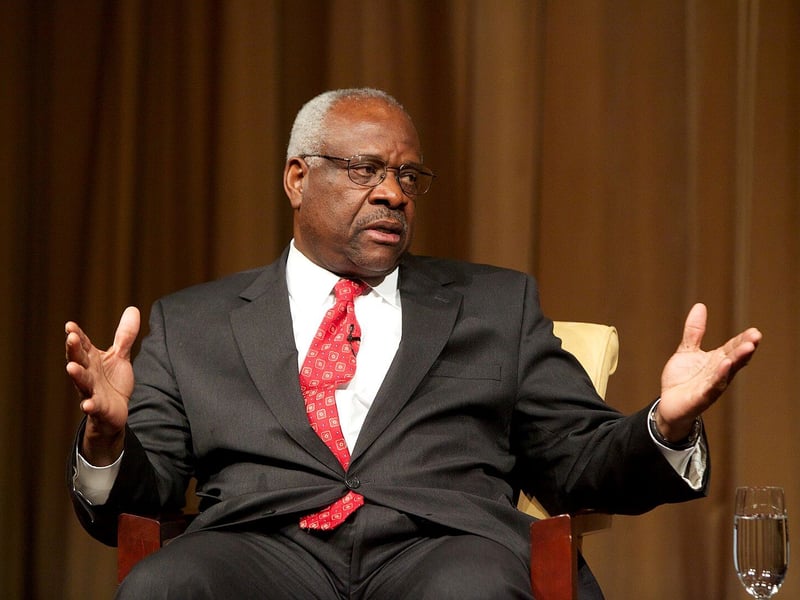
WASHINGTON (CN) — Justice Clarence Thomas railed against his colleagues Monday for shutting down opportunities to review blue state litigation against oil giants and discrimination standards for religious groups.
Republican-led states sued their neighbors attempting to curb pollution beyond their borders. The George H.W. Bush appointee stated the Supreme Court had an obligation to hear disputes between states, but his colleagues were neglecting their duties based on unfounded policy preferences.
“In my view, such prudential decisions are not ours to make,” Thomas wrote in a dissent joined by Justice Samuel Alito, a George W. Bush appointee. “The Constitution and Congress have set the bounds of our original jurisdiction. Those parameters should be conclusive: ‘We have no more right to decline the exercise of jurisdiction which is given, than to usurp that which is not given.’”
The admonishment stemmed from a motion filed by 19 Republican-led states in an original jurisdiction complaint. While the Supreme Court is typically a court of last review, rare circumstances — such as disputes between states — fall solely under the justices’ jurisdiction.
Thomas said the court’s discretion to hear such appeals is suspect at best. The Supreme Court, however, has strictly limited the use of original jurisdiction appeals. According to Thomas, that policy position is a modern invention that has never been persuasively justified.
Thomas said the court’s reluctance to hear these appeals leaves 19 states without a judicial forum in which to seek relief.
Alabama and others sued five Democratic-led states for trying to dictate interstate energy policy through lawsuits against entities outside of their borders. The attorneys general of California, Connecticut, Minnesota, New Jersey and Rhode Island sued oil and gas companies for deceiving consumers about the relationship between fossil fuels and climate change.
Red states claimed the blue states sought massive penalties, disgorgement and injunctive relief against energy producers based on out-of-state conduct with out-of-state effects.
Alabama argued Democratic-led states were threatening American’s basic way of life.
“On their view, a small gas station in rural Alabama could owe damages to the people of Minnesota simply for selling a gallon of gas,” Alabama wrote in its motion before the court. “If defendant states are right about the substance and reach of state law, their actions imperil access to affordable energy everywhere and inculpate every state and indeed every person on the planet.”
Red states’ climate dispute was just one of two appeals Thomas thought the justices should have heard Monday. In a separate dissent — this time joined by Justice Neil Gorsuch, a Donald Trump appointee, Thomas said the high court needed to review the confusing framework governing discrimination claims.
Last month, the Supreme Court heard oral arguments in a dispute over “reverse discrimination” where several justices questioned the validity of the court’s 1973 ruling in McDonnell Douglas Corp v. Green .
McDonnell Douglas implemented a three-part test for Title VII employer discrimination claims. An Ohio woman asked the justices to find that majority-group plaintiff didn’t have a higher burden when establishing that an employer took adverse action against them in a way that implies a form of unlawful discrimination.
The justices appeared to settle on a simple solution, holding that minority and majority-group plaintiffs carry an equal burden. However, Thomas said the court should have taken up an appeal from a Christian firefighter who was fired for inappropriate use of city time and a city vehicle to attend a religious event.
“This case highlights how McDonnell Douglas may distort a lower court’s analysis,” Thomas wrote.
According to Thomas, the firefighter, Ronald Hittle, presented ample evidence that his termination was based on discriminatory intent. However, two lower courts ruled in favor of the city.
Thomas said the current framework has taken on a life of its own in the lower courts, leading to confusion. McDonnel Douglas ’ problems, Thomas said, stem from the court not grounding the standard in the text of Title VII or any other source of law.
“Some courts treat McDonnell Douglas as a substantive legal standard that a plaintiff must establish to survive summary judgment or to ultimately prove a claim,” Thomas said.
But, Thomas said McDonnell Douglas is at most a procedural device.
“Analyzing evidence exclusively under McDonnell Douglas may lead a court to overlook the other ways that a plaintiff can prove his claim,” Thomas wrote.
The majority in both cases did not explain its decision to reject the petitions.
 Follow @KelseyReichmann
 Follow @kelseyreichmann.bsky.social
Subscribe to our free newsletters
Our weekly newsletter Closing Arguments offers the latest about ongoing trials, major litigation and rulings in courthouses around the U.S. and the world, while the monthly Under the Lights dishes the legal dirt from Hollywood, sports, Big Tech and the arts.