
 Search Articles


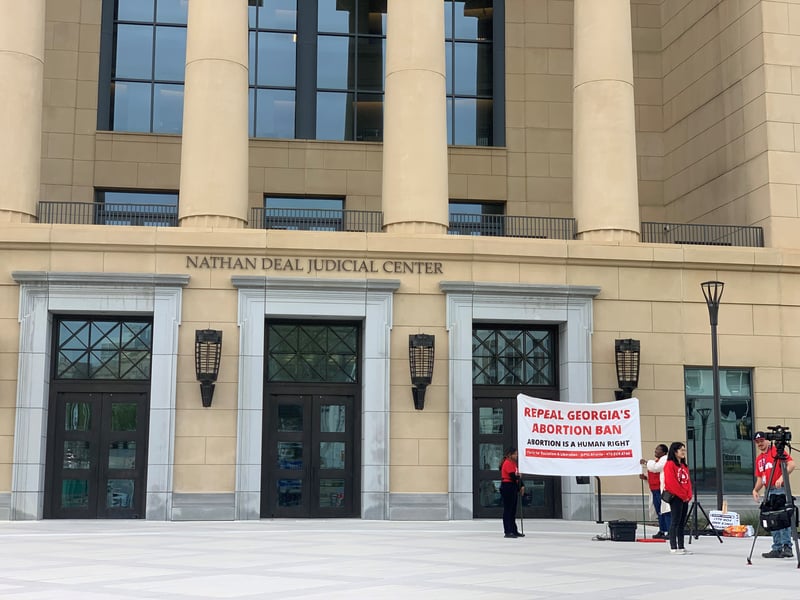
ATLANTA (CN) — Georgia’s high court reinstated the state’s six-week abortion ban Monday, just one week after a trial court judge deemed the law unconstitutional.
Georgia Supreme Court granted the state attorney general’s emergency request to put Fulton Superior Court Judge Robert McBurney’s ruling on hold while the state appeals it.
The judge ordered a return to regulations in place before Georgia’s law, which went into effect after the U.S. Supreme Court’s 2022 Dobbs ruling, allowing the procedure again up until about 22 weeks of pregnancy.
But the state Supreme Court order means that as of 5 p.m. Monday, abortions cannot be performed once medical professionals can detect fetal cardiac activity — the earliest point in which ultrasounds can detect electrical impulses from the cells inside an embryo — which typically occurs at about six weeks, and before many women know they are pregnant.
Six of the justices agreed with granting the state’s request. Presiding Justice Nels Peterson was disqualified and Justice Andrew Pinson did not participate in the decision.
Justice John Ellington concurred in part, but dissented in part, ultimately concluding that the court should deny Georgia’s request. He said the state failed to show any reason for urgency beyond its underlying arguments and noted the court typically denies requests for supersedeas and tends to affirm trial court rulings regarding injunctions pending appeal.
“The injunction at issue here concerns much more than a discrete legal dispute between particular parties,” Ellington wrote.
“Fundamentally, the state should not be in the business of enforcing laws that have been determined to violate fundamental rights guaranteed to millions of individuals under the Georgia Constitution.”
In its emergency motion, the state said there is no right to an “elective abortion” in the Georgia Constitution and the right to privacy doesn’t include abortion because it “always harms a third party.”
McBurney ruled that the state’s abortion law violated the state constitution because it denied a woman’s right to privacy by not allowing her to make medical decisions over her own body, however and there is no harmed third party until a fetus growing inside a woman’s body reaches viability and can survive outside of her womb. Only then, he concluded, can society intervene and assume the rights of that separate life.
SisterSong Women of Color Reproductive Justice Collective and other abortion rights activists and doctors sued the state in 2022 saying the law violated a woman’s right to privacy under the state’s constitution.
The law — known as the Living Infants Fairness and Equality, or LIFE, Act was passed in 2019, but did not take effect until 2022 after the U.S. Supreme Court overturned Roe v. Wade , which had guaranteed the national right to an abortion for nearly 50 years.
Last year, Georgia’s Supreme Court reversed a 2022 ruling from McBurney in which he said the 2019 law had been passed illegally since Roe v. Wade was the law of the land at the time. The justices remanded the case to McBurney, who then was asked to rule on the constitutionality of the law.
“Today, the Georgia Supreme Court sided with anti-abortion extremists. Every minute this harmful six-week abortion ban is in place, Georgians suffer,” SisterSong Executive Director Monica Simpson said in a statement.
“Denying our community members the lifesaving care they deserve jeopardizes their lives, safety and health — all for the sake of power and control over our bodies.”
In the order, the justices said they will determine the merits of the state’s claims after hearing oral arguments, which have not yet been scheduled.
 Follow @Megwiththenews
Subscribe to our free newsletters
Our weekly newsletter Closing Arguments offers the latest about ongoing trials, major litigation and rulings in courthouses around the U.S. and the world, while the monthly Under the Lights dishes the legal dirt from Hollywood, sports, Big Tech and the arts.