
 Search Articles


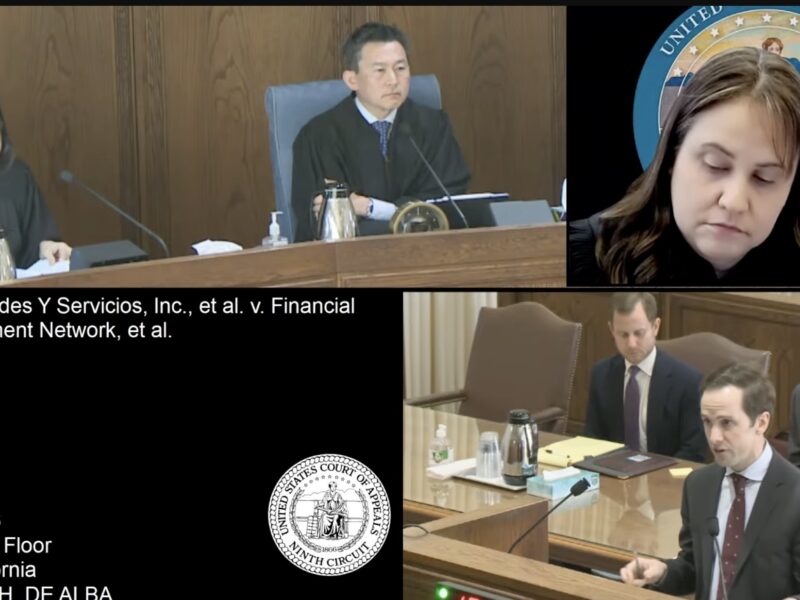
PASADENA, Calif. (CN) — A financial crimes enforcement agency in the U.S. Treasury Department asked the Ninth Circuit Court of Appeals on Monday to vacate a preliminary injunction that prevents it from enforcing a new order that requires money service businesses along the U.S.-Mexico border to report transactions over $200 to federal law enforcement.
The federal government argued the plaintiff in the case — Novedades y Servicios, a check-cashing service in San Diego — did not demonstrate a likelihood of success on the merits of the case. It also argued the Financial Crimes Enforcement Network, or FinCEN, was well within its rights to issue the geographic targeting order, or GTO, in an effort to target money laundering operations at financial businesses in 30 ZIP codes in California and Texas.
The FinCEN order is intended to target cartel-related financial crimes in the southwest United States.
U.S. District Judge Janis Sammartino, a George W. Bush appointee, issued a preliminary injunction in May 2025, preventing enforcement about a month after the lawsuit was filed by Novedades y Servicios owner Esperanza Gomez Escobar. Escobar said in her initial complaint that the FinCEN order burdened her small, independently run shop with a heavy load of unnecessary paperwork and forced her to surveil customers who were using perfectly legal services, such as cashing checks and sending money to family members.
A three-judge panel on the Ninth Circuit peppered Department of Justice attorney Simon Jerome with questions over various irregularities within a FinCEN memo that was used to justify targeting businesses at the $200 threshold, which the government relied on in District Court. Dates on the memo appeared incomplete, for example, U.S. Circuit Judge Lucy Koh said.
“The District Court raised a lot of concerns that the date is March XX 2025 and the authorizations have FinCEN director basically saying MM for month and DD for date and YYYY for year,” Koh, a Joe Biden appointee, said. ”There are all these redactions. There are redlines on this document. It’s not even clear this document is final. The conclusion is basically redacted. The analytic plan is completely redacted. When the District Court asked questions about this, this is what the government said, which gives me pause.”
Another discussion revolved around the government’s argument that the GTO was not subject to public notice and rule-making procedures because it was a more narrowly tailored order and not a rule.
“You have a GTO that covers about five counties in Texas and California with over 1 million people,” Koh said. “If I look at the FinCEN memo, it’s just talking about fentanyl; it’s just general drug trafficking statements. It has nothing about specific individuals. It doesn’t identify a particular dispute of facts. It doesn’t resolve any specific disputes. Tell me why, with all of the criteria we are supposed to consider in rule versus order, why this isn’t a rule.”
Jerome argued the government was only able to use the information that it had at the time to begin the GTO.
“We have to begin with the understanding that there are going to be things FinCEN doesn’t know,” he said. “Departing from that place, there was a considerable measure of specificity in the region FinCEN was considering that looked at a particular type of suspected money laundering that is transnational criminal involvement tied to the fentanyl trade.”
However, Koh disputed this, saying the GTO only looked at the currency transaction reports filed in the targeted ZIP codes relative to the population.
“This is an important law enforcement investigative tool,” Jerome said. “Being unable to implement an order that was under the statutory authority throughout the entirety of the Southern District of California and the two California counties to which it applied is an infringement on the government’s ability to exercise that prerogative.”
In September of 2025, FinCEN revised its order, raising the threshold for financial service reporting from $200 to $1,000.
Robert Johnson, an attorney at the Institute for Justice representing Novedades y Servicios, maintained that FinCEN’s order would cause irreparable harm to his client by putting Escobar at a severe disadvantage to other financial service businesses in nearby ZIP codes. The new requirements also required extensive reporting for customers using FinCEN forms that can take 25 minutes to complete.
“Why is this business asking for this info when there is another business five minutes away that is not?” Johnson asked. “Now they’re outside of the ordered ZIP code, and they don’t have to provide this information.”
The new requirements also pose potential fines in the thousands of dollars for mistakes.
“It’s an enormous liability suddenly being imposed on these businesses if they make a mistake filling out these forms,” Johnson said.
The panel asked whether the financial services could simply raise their prices or utilize new software that could more efficiently manage the forms.
Johnson said those types of options may be available for larger businesses or mid-size banks, but not a one-man business like his client. Implementing new software poses several problems, he said.
“One is that it’s expensive. It’s another cost for the business,” he said. “It takes time to ramp up. It’s not something that can be done right away. It also doesn’t eliminate the burden.”
Johnson asked the panel to uphold the lower court’s decision.
In addition to Koh, the panel included U.S. Circuit Judges Ana de Alba, also a Biden appointee, and Kenneth Lee, a Donald Trump appointee. The panel did not make a ruling on the preliminary injunction.
Subscribe to our free newsletters
Our weekly newsletter Closing Arguments offers the latest about ongoing trials, major litigation and rulings in courthouses around the U.S. and the world, while the monthly Under the Lights dishes the legal dirt from Hollywood, sports, Big Tech and the arts.