
 Search Articles


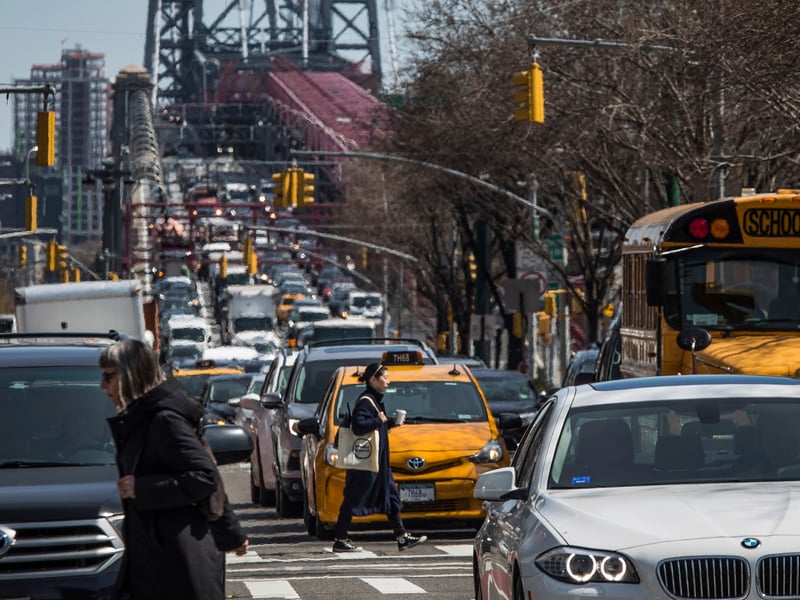
MANHATTAN (CN) — New York City’s congestion pricing program may be on its last legs.
The toll, slated to raise $1 billion per year and fund repairs to aging public transit infrastructure in the U.S.’s largest city, no longer has federal approval, the U.S. Department of Transportation’s Federal Highway Administration announced Wednesday.
In a letter to New York Governor Kathy Hochul, Transportation Secretary Sean Duffy said the Federal Highway Administration would contact the New York State Department of Transportation and project sponsors “to discuss the orderly cessation of toll operations under this terminated pilot project.”
It’s not an unexpected move by the White House: President Donald Trump has made his disdain known for the first-in-the nation toll, which charges passenger vehicles a $9 daily toll to enter Manhattan below 60th Street during peak hours on weekdays. Trump previously said he was in negotiations with Hochul over the future of congestion pricing.
“CONGESTION PRICING IS DEAD,” Trump said in a Wednesday social media post. “Manhattan, and all of New York, is SAVED. LONG LIVE THE KING!”
Duffy, meanwhile, called the program a “slap in the face to working class Americans and small business owners."
“Commuters using the highway system to enter New York City have already financed the construction and improvement of these highways through the payment of gas taxes and other taxes,” Duffy said in a statement Wednesday. “But now the toll program leaves drivers without any free highway alternative, and instead, takes more money from working people to pay for a transit system and not highways. It’s backwards and unfair.”
In his letter to Hochul, Duffy complained that revenue generated from the toll funds public transit, which most New Yorkers use to get around. He said the money should go to highways instead.
“I do not believe that this is a fair deal,” he said.
While axing the program came as no surprise, rolling it back still blows a multibillion-dollar hole in the MTA’s capital plan, which could hamper the rollout of new train switches, safety features and accessibility updates for the next several years.
But the toll’s cancellation will have to survive in court. Shortly after Duffy sent his letter to Hochul, the MTA filed a federal lawsuit in the Southern District of New York, accusing Duffy of being “unlawful” in his bid to terminate the approved tolling program.
“In addition to being inconsistent with its own broader policy statements, the Trump administration’s efforts to ‘terminate’ the Program are contrary to its purported respect for federalism,” the MTA argued in the 51-page lawsuit. “The program is the first congestion pricing program of its kind in the United States, and a necessary solution to the unique policy challenges facing the New York metropolitan region and one that reflects the will of the majority of New Yorkers and their elected representatives at every level of government.”
Hochul told reporters on Wednesday that she’s confident the MTA will prevail and has no plans to shut off the toll.
“We are keeping the cameras on,” she said.
Environmental lawyer and Columbia Law School professor Michael Gerrard agrees that Duffy and Trump lack the power to ax the program in the way that they did.
“The agreement they signed in November provided that the Triborough Bridge and Tunnel Authority could decide to cancel the tolls, but it did not say that the Federal Highway Administration could cancel the tolls,” Gerrard told Courthouse News on Wednesday. “Federal Highway approved it. They allowed it to go into effect. And I think it’s probably too late for them to shut it down without far stronger reasons than they have presented in their letter.”
A key player in getting congestion pricing up and running in the first place, Gerrard said he and his allies have been preparing for this very possibility.
“This is not surprising,” he added. “I thought they might come up with a stronger legal basis.”
Congestion pricing, which has existed in cities like London for over a decade, has been a controversial topic here in the United States ever since then-Governor Andrew Cuomo signed it into law for New York City in 2019.
A February poll from Partnership for New York City said 6 in 10 New York voters are in favor of keeping it. About 75% of respondents who regularly commute into the central business district said that there has been less traffic and faster commutes in and out of the city.
 Follow @Uebey
 Follow @uebey.bsky.social
Subscribe to our free newsletters
Our weekly newsletter Closing Arguments offers the latest about ongoing trials, major litigation and rulings in courthouses around the U.S. and the world, while the monthly Under the Lights dishes the legal dirt from Hollywood, sports, Big Tech and the arts.