
 Search Articles


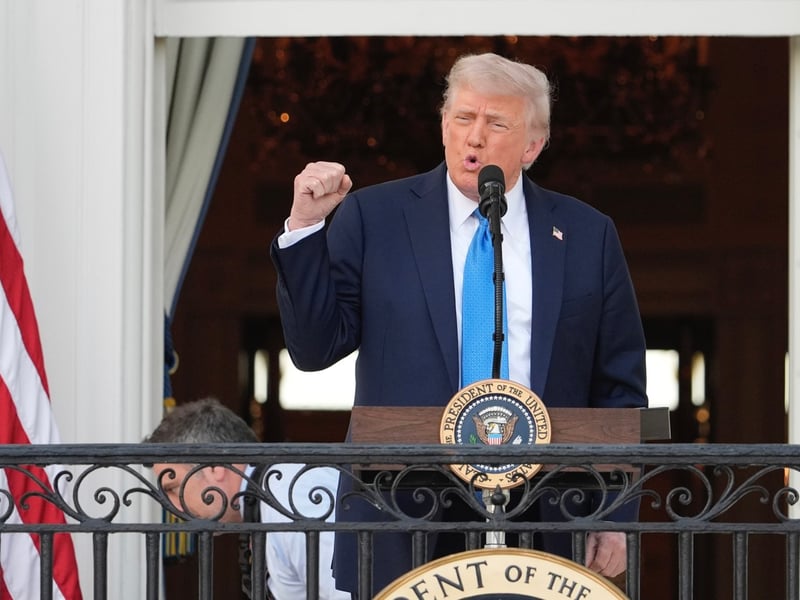
RIO DE JANEIRO (CN) — President Donald Trump on Wednesday confirmed 50% tariffs on nearly 60% of Brazilian exports to the United States, citing an “unusual and extraordinary threat" to national security and the economy.
The executive order, which takes effect Aug. 6, spares about 700 products — including Embraer aircraft, oil derivatives, minerals, and foods like orange juice and Brazil nuts — but coffee and meat will be subject to the tariffs.
Trump linked the measure to rulings by Brazil’s Supreme Court and the criminal case against former Brazilian President Jair Bolsonaro.
The text directly names Justice Alexandre de Moraes, accusing him of persecuting political opponents and imposing censorship on U.S. companies. Earlier on Wednesday, the U.S. government announced the application of the Magnitsky Act to de Moraes.
The executive order capped weeks of tension between Brazil and the U.S. Since Trump unveiled the plan on July 9, Brazil’s Vice President Geraldo Alckmin and Foreign Minister Mauro Vieira had sought direct talks with Commerce Secretary Howard Lutnick and Secretary of State Marco Rubio, but the White House stayed silent.
In addition to the lack of dialogue with the U.S. government, Brazilian authorities also faced a lobbying offensive from Brazilian Congressman Eduardo Bolsonaro, the son of Jair Bolsonaro, who has been in the U.S. pushing for sanctions against de Moraes and conditioning any truce on amnesty for his father.
Tania Emily Laredo Cuentas, a tax and customs attorney at the São Paulo-based law firm Gaia Silva Gaede Advogados, said the unilateral imposition of tariffs outside the agreed parameters could violate the most-favored-nation principle and tariff commitments, opening the door to a potential formal challenge at the World Trade Organization.
She added that citing the Supreme Court as justification for the tariff hike — on the grounds that the court’s rulings harm U.S. commercial interests — represents a misuse of trade policy.
“Such an allegation runs directly counter to basic principles of public international law, such as the sovereignty of states and nonintervention in internal affairs,” she said.
Luis Guilherme Gonçalves, an international tax attorney and partner at BT7 Partners, said that even with the tariffs now confirmed, Brazil can trigger formal dispute mechanisms, including the WTO, while continuing to pursue a bilateral or multilateral solution with the U.S.
“Another path is to coordinate with other affected countries, seeking a joint response that increases political pressure on the U.S.,” he said.
On July 15, Brazil enacted a law creating the legal basis to suspend trade concessions, investments and even intellectual property rights of countries that adopt unilateral measures against Brazilian interests.
The law sets out two tracks: a standard procedure with public consultations and technical analysis by the Chamber of Foreign Trade — the government body responsible for shaping trade policy — and an emergency procedure that allows for immediate provisional measures by an interministerial committee chaired by Vice President Alckmin.
“From a legal-constitutional perspective, the action is consistent, as it seeks to uphold the principles of proportionality, legality and respect for due process, which may be relevant if there is a future court challenge,” said Fabrício Bertini Pasquot Polido, a professor of international law at the Federal University of Minas Gerais and partner at L.O. Baptista Advogados.
He noted, however, that any retaliatory measures must adhere to the principles of international law, multilateral trade rules and the limits of WTO agreements. Measures that exceed those parameters can be challenged by trade partners and weaken Brazil’s position in international disputes.
“Any measure that goes beyond those limits could be challenged by trade partners and compromise Brazil’s standing in international forums,” he said.
Gonçalves noted that Brazil has already taken part in major WTO disputes, such as the 2002 cotton case against the U.S. and the 2003 sugar case against the European Union. “These precedents show that the country has the technical and legal capacity to handle complex litigation in the multilateral system,” he said.
Lucas Azeredo da Silva Teixeira, a professor at the Institute of Economics at the State University of Campinas, is less optimistic
“Taking this issue to the WTO will not necessarily resolve the tariffs, because the WTO has no power to change U.S. trade or tariff policy,” said Teixeira, who researches international economics, input-output economics and development.
Teixeira said the new tariffs signal a change in strategy compared to Trump’s first term. Previously, his trade policy rhetoric was focused on recovering industrial jobs lost over decades of globalization, directly tied to his electoral base.
Now, the logic does not seem to be related to the trade deficit with Brazil — especially because the U.S. runs a trade surplus with the country and does not suffer significant losses from imports such as coffee, orange juice or soybeans.
“It seems that this is part of a broader strategy that does not concern only the sectors that would be affected,” he said. “It seems that, beyond the political agenda, he also wants to bring big techs in Brazil to the negotiating table.”
An example would be the attacks on Pix, Brazil’s free instant payment system, which competes with paid services offered by U.S. communications and fintech companies.
Another potential issue is rare earths. Seventeen elements, used in the production of high-tech products and military equipment, are at the center of a global dispute. The U.S. remains heavily dependent on imports, while China controls about 60% of global production and 90% of refining, according to the International Energy Agency.
Brazil plays a strategic role in this scenario: The U.S. Mineral Commodity Summaries estimatesthat the country holds up to 23% of known reserves of these elements and is a global leader in niobium production, another critical metal for sectors such as steelmaking and aerospace.
On Saturday, during a meeting with the Brazilian Mining Institute, a private association representing companies in the sector, U.S. Embassy Chargé d’Affaires Gabriel Escobar reportedly expressed Washington’s interest in Brazilian critical and strategic minerals.
Brazilian President Luiz Inácio Lula da Silva has used the crisis to reaffirm national sovereignty. In social media posts, speeches and official statements since the tariff announcement on July 9, the presidential palace has repeatedly stressed that Supreme Court decisions cannot be used as justification for punitive trade measures and that Brazil will not accept political conditions in its bilateral relations.
Rafael R. Ioris, a professor of Latin American history and comparative politics at the University of Denver, said Brazil is being made a scapegoat in a larger battle for hegemony. “Trump does not accept the idea that countries have more autonomy and less dependence on the U.S.,” he said. “The U.S. logic of seeing Latin America as subordinate is part of inter-American relations. They think they can set limits on what we can or cannot do.”
Ioris said Brazil, which has long been under U.S. influence, is now beginning to gain more leverage, capacity and options globally — especially through its ties with China and the BRICS, a bloc of major emerging economies that also includes China, Russia, India and South Africa.
“What happens in this negotiation with Brazil is not limited to Brazil; it is symbolic for other countries to either become more fearful or attempt a more autonomous position,” he said.
Carlos Gustavo Poggio, a political scientist and professor at Berea College who specializes in U.S. foreign policy and Latin America, said Trump views tariffs as his main political and economic tool — “an obsession that has remained constant since his campaign,” he said.
Poggio noted that the 50% tariff imposed on Brazil is the highest ever applied by Washington and, considering the U.S. trade surplus with Brazil, cannot be justified by commercial reasons. He said the measure, coupled with the application of the Magnitsky Act to Moraes, underscores a political component far stronger than any economic calculation — and undermines trust.
“The trust that existed between the two countries will be shaken, and I don’t think it can be fixed by a change of government in the United States,” he said. “The precedent has been set: Brazil, at any moment, depending on who occupies the White House, can be the target of unilateral coercion, including legal coercion.”
Teixeira said the economic impact of the tariffs will likely be uneven. Although Brazil is a significant economy, its growth depends far more on the domestic market than on exports, unlike smaller countries more reliant on foreign trade.
He noted that in the past 20 years, Brazil grew during periods of global crisis — such as in 2009 and 2010 — and fell into deep recession during times of global stability, like in 2015 and 2016. This, he said, shows that domestic economic policy and internal consumption are the main drivers of growth.
The tariff impact will likely be concentrated in specific sectors and regions, particularly those heavily dependent on the U.S. market. In some areas, Teixeira said, half of local production is exported to the U.S., which could trigger significant local crises.
In the short term, agricultural and commodity products that lose access to the U.S. market could be redirected to domestic consumption, pushing down prices in some segments — such as coffee and food — while currency devaluation is likely to have an inflationary effect. Industrial and service sectors should feel fewer direct effects. Teixeira called it a negative and unnecessary shock that is hard to measure in the short term.
In the medium and long term, the trend is a reconfiguration, according to Teixeira. Exporters will need to diversify markets and reduce dependence on the U.S. Brazil could use the shock to open new markets and strengthen production chains, but if it fails, it will lose ground in the U.S. market and increase the vulnerability of dependent sectors.
On ways to mitigate the impact, Teixeira said Brazil’s economic dynamics are heavily tied to the domestic market, which is driven by government decisions on public spending, taxation, credit and monetary policy.
He noted that fiscal rules impose restrictions, but crises often create room for exceptional measures, as seen during the pandemic and the floods that hit Rio Grande do Sul, Brazil’s southernmost state, in May 2024, when extraordinary credit lines were opened. This, he said, shows that despite the constraints, the government still has room to act.
So far, the Brazilian government has not officially announced any measures, but the Treasury said a plan is already in place. In interviews with local outlets, Treasury Secretary Rogério Ceron said the economic team has assembled a contingency package to mitigate the effects of the U.S. tariff, with a focus on a technical, rational approach tailored to the severity of the situation.
Ceron stressed that the plan aims to minimize sectoral impacts and avoid distortions — noting that thanks to the exceptions granted by the U.S. (such as for orange juice, civil aviation and energy), “this announced scenario is not the worst possible,” and that although the macro design is already ready and has been presented to President Lula, activating the measures depends on a formal order from the presidency.
Subscribe to our free newsletters
Our weekly newsletter Closing Arguments offers the latest about ongoing trials, major litigation and rulings in courthouses around the U.S. and the world, while the monthly Under the Lights dishes the legal dirt from Hollywood, sports, Big Tech and the arts.