
 Search Articles


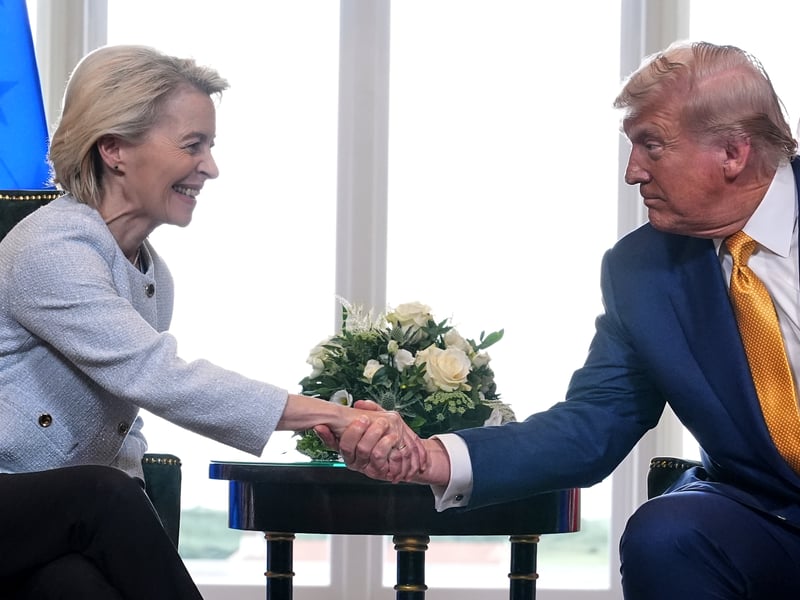
BRUSSELS (CN) — President Donald Trump and European Commission President Ursula von der Leyen announced a breakthrough trade agreement Sunday at his Scottish golf resort, setting a 15% tariff rate and averting a damaging trade war just days before Trump’s Friday deadline.
The deal, struck after high-stakes negotiations at Trump’s Turnberry club, represents the largest trade agreement of Trump’s presidency and ends months of escalating tensions that threatened to disrupt the world’s biggest trading relationship. Von der Leyen — the head of the EU’s executive branch — was joined by EU Trade Commissioner Maroš Šefčovič — the EU’s chief negotiator for trade — while U.S. Trade Representative Jamieson Greer and Commerce Secretary Howard Lutnick represented the American side.
“We have reached an agreement,” Trump told reporters after concluding talks with von der Leyen. The pact establishes a 15% tariff on European Union imports, including automobiles, semiconductors, and pharmaceuticals, while also creating zero-tariff zones for strategic products such as aircraft parts, semiconductor equipment and certain chemicals.
Under the agreement, the EU committed to purchasing $750 billion worth of American energy products over three years and pledging an additional $600 billion in military equipment investments beyond previously planned levels. The zero-tariff provisions also extend to some agricultural products and critical raw materials.
For steel and aluminum, the agreement establishes reduced tariffs and quota systems modeled after existing UK-EU frameworks “to address global overcapacity issues,” said von der Leyen.
The breakthrough came after both leaders maintained cautious 50-50 odds earlier in their public remarks. “Both sides want to see fairness,” Trump had said during their joint appearance in the club’s ballroom.
Von der Leyen had acknowledged the fundamental trade imbalance issue: “We have a surplus. The United States has a deficit, and we have to rebalance it,” before retreating into private negotiations that ultimately yielded the accord. The deal addresses Trump’s longstanding complaints about the EU’s trade surplus, which reached €198.2 billion ($216 billion) in 2024, according to Eurostat data.
The agreement caps a volatile period that began in April when Trump imposed 20% “reciprocal” tariffs on EU goods, later reduced to 10% during a three-month negotiating window. Trump argued that European trade barriers were higher than America’s and that tariffs should match each other’s rates. Earlier this month, Trump abruptly escalated to threatening 30% tariffs starting Friday, sending European officials scrambling to salvage talks that had appeared close to success.
Sunday’s deal averts those threatened tariffs that could have made everything from French cheese to German cars significantly more expensive for American consumers. The 15% rate represents a compromise that both sides described as “balanced.”
Still, von der Leyen described the negotiations as “very difficult” and “tough,” with both sides starting “far apart from each other.” She said the 15% rate was “the best we could get” compared to the 30% tariffs that would have taken effect Friday.
The U.S. and European Union together account for $1.7 trillion in annual trade, according to EU sources, and about one-third of global commerce.
The energy purchase commitment represents a major win for American producers, with von der Leyen saying that the EU will buy $250 billion annually over three years to replace Russian energy imports. The military equipment investments align with Trump’s push for European allies to increase defense spending.
Trump had criticized existing trade barriers, citing restrictions on American car sales in Europe as European automakers like Mercedes, BMW and Volkswagen sell millions of vehicles in the U.S. Von der Leyen noted that European car exports previously faced tariffs as high as 27.5% before Sunday’s deal reduced them to 15%.
The pharmaceutical exclusion reflects Trump’s insistence that such products be manufactured domestically. However, von der Leyen clarified that pharmaceuticals are included in the 15% tariff rate for EU exports, with Trump’s broader pharmaceutical policies applying separately.
Von der Leyen accepted Trump’s invitation on Friday to join him in Scotland, where he was spending a five-day visit at his golf properties.
Historic agreement averts trade war
The accord represents Trump’s largest trade victory, surpassing even the $550 billion deal with Japan announced earlier this week. “If we are successful, I think it would be the biggest deal each of us has ever struck,” von der Leyen had predicted, with Trump agreeing it could be “the biggest deal” ever struck between major economies.
The breakthrough eliminates the threat of EU retaliation measures that would have targeted €72 billion ($84 billion) worth of American products, including aircraft, cars, machinery and agricultural goods. European officials had prepared countermeasures designed to pressure Trump politically, but the successful negotiations made such measures unnecessary.
Meanwhile, Chinese Vice Premier He Lifeng continues separate trade discussions with U.S. officials in Sweden as China faces its own Aug. 12 deadline to avoid higher American tariffs.
The EU negotiations were part of Trump’s broader trade strategy, which has yielded agreements with Britain, Japan, Indonesia and Vietnam. However, his administration fell short of an ambitious promise to complete “90 deals in 90 days.”
The outcome of Sunday’s Scotland meeting validates Trump’s high-pressure trade tactics and provides both sides with a framework for managing the world’s most important commercial relationship. The deal offers American farmers and manufacturers greater access to European markets while providing European exporters certainty about tariff rates.
Subscribe to our free newsletters
Our weekly newsletter Closing Arguments offers the latest about ongoing trials, major litigation and rulings in courthouses around the U.S. and the world, while the monthly Under the Lights dishes the legal dirt from Hollywood, sports, Big Tech and the arts.