
 Search Articles


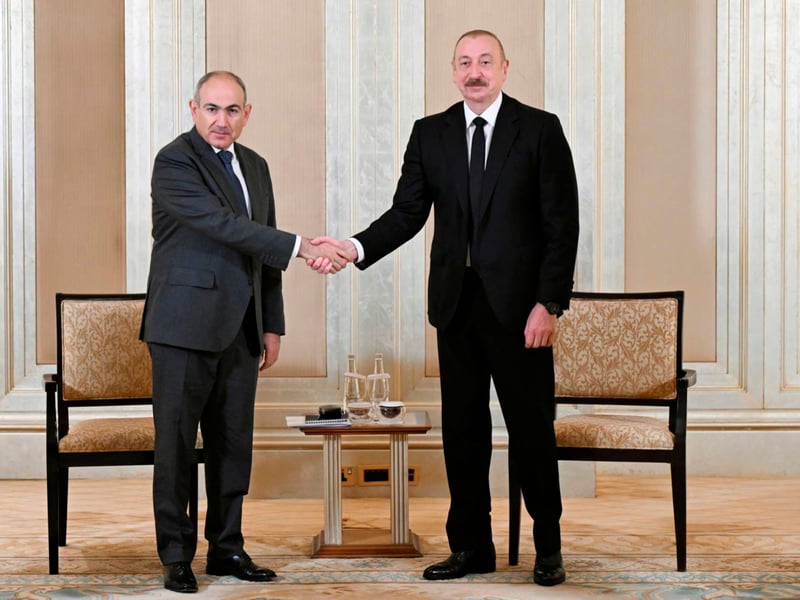
(CN) — The balance of power in the highly volatile and contested South Caucasus shifted Friday in favor of the West and Turkey after U.S. President Donald Trump got Armenia’s pro-Western prime minister to allow the United States to open a strategic corridor through his country, a major win for Armenia’s neighbor and long-time nemesis, Azerbaijan.
U.S. control of the corridor — to be named the Trump Route for International Peace and Prosperity — was central to political and economic agreements Armenian Prime Minister Nikol Pashinyan and Azerbaijani President Ilham Aliyev were expected to sign Friday at the White House.
Conflict has raged on and off between Armenia and Azerbaijan since they became independent republics after the collapse of the Soviet Union in 1991. The conflict is based around historic grievances, territorial disputes and ethnic clashes.
It remained doubtful Friday’s deal would calm regional tensions and instead it had the potential to breed more conflict because Russia and Iran view American involvement in the South Caucasus as a threat to their security.
“America’s getting involved here because it’s in the neighborhood of Russia and Iran, I think that’s quite obvious,” said Kamal Makili-Aliyev, an international law professor at the University of Gothenburg in Sweden and expert on the South Caucasus. “This creates a geopolitical tension in itself.”
He cautioned it was too early to call Friday a success, noting past Armenia-Azerbaijan peace efforts have collapsed.
“We need to be cautiously optimistic about this because Azerbaijan and Armenia have come to the brink of peace so many times and so many times it was derailed,” he said, speaking by telephone.
Pashinyan agreed to grant the U.S. a 99-year development lease on the 27-mile Zangezur Corridor, located along Armenia’s border with Iran — a highly contested area that has drawn interest from parties from around the globe, such as the U.S., Iran, Azerbaijan, Turkey, Russia, the European Union, Israel and China.
Azerbaijan and Turkey have long sought to open the corridor, as it would connect the allies and link Azerbaijan to its landlocked Nakhchivan exclave, situated between Armenia and Turkey.
The White House said it would sublease the Zangezur Corridor to a private consortium that would develop rail, oil, gas and fiber optic lines and potentially electricity transmission across it.
In Western circles, the corridor is viewed as a potential route to connect Asian markets and Europe, thereby competing with China’s burgeoning Eurasian trade routes that pass through Russia.
Since Russia’s 2014 annexation of Crimea and 2022 invasion of Ukraine, the EU has sought alternatives to Russian energy. They’ve looked to Azerbaijan and Central Asia for its energy and minerals, and financed gas and rail projects through Turkey to access Azerbaijan.
In power since 2018, Pashinyan has steered Armenia away from Russia’s sphere and toward NATO, the EU and other Western institutions. Friday’s deal further weakened Russia’s influence in the South Caucasus.
Russia has long been an ally to Armenia, but Pashinyan has reduced reliance on Moscow, replacing Russian troops with EU monitors along disputed borders with Azerbaijan.
The split deepened in 2023 when Azerbaijani forces swiftly retook Nagorno-Karabakh — a breakaway ethnic-Armenian region — while Russian peacekeepers did little to intervene. Around 100,000 ethnic Armenians fled Nagorno-Karabakh after the invasion.
Inside Armenia, Pashinyan is very unpopular and he has been blamed for Armenia’s defeat over Nagorno-Karabakh, a region of great historical significance for Armenians.
He faces reelection next year and tensions inside Armenia are high, especially after he jailed Armenian Apostolic Church leaders whom he accused of seeking to stage a coup against him with the help of Russia.
On Friday, opposition parties denounced Pashinyan as giving in to Azerbaijani demands and conceding Armenian territory. However, Pashinyan’s opponents are also very unpopular, according to opinion polls, leaving it unclear what next year’s election outcome may be.
Regardless, Friday’s deal showed Russia’s influence in the South Caucasus is weakening as Moscow finds itself embroiled in the conflict over Ukraine.
Makili-Aliyev said Friday’s deal had the potential to create more cooperation and trade among Armenia, Azerbaijan and Turkey, a NATO member and key player in the South Caucasus with its strong ties to Azerbaijan. Pashinyan and Turkey have been in talks about normalizing relations too.
“What’s going to happen next is — if this is successful and it doesn’t produce some kind of cataclysmic conflict in the South Caucasus — is that Armenia, Azerbaijan and Turkey will start getting closer,” he said. “We’re going to see the tightening of interests in the South Caucasus, creating a kind of counterbalance against Iran and Russia.”
In turn, this could lead to the South Caucasus getting “closer to the West as a counterweight to Russia and Iran,” he added.
Courthouse News reporter Cain Burdeau is based in the European Union. **
 Follow @cainburdeau
Subscribe to our free newsletters
Our weekly newsletter Closing Arguments offers the latest about ongoing trials, major litigation and rulings in courthouses around the U.S. and the world, while the monthly Under the Lights dishes the legal dirt from Hollywood, sports, Big Tech and the arts.