
 Search Articles


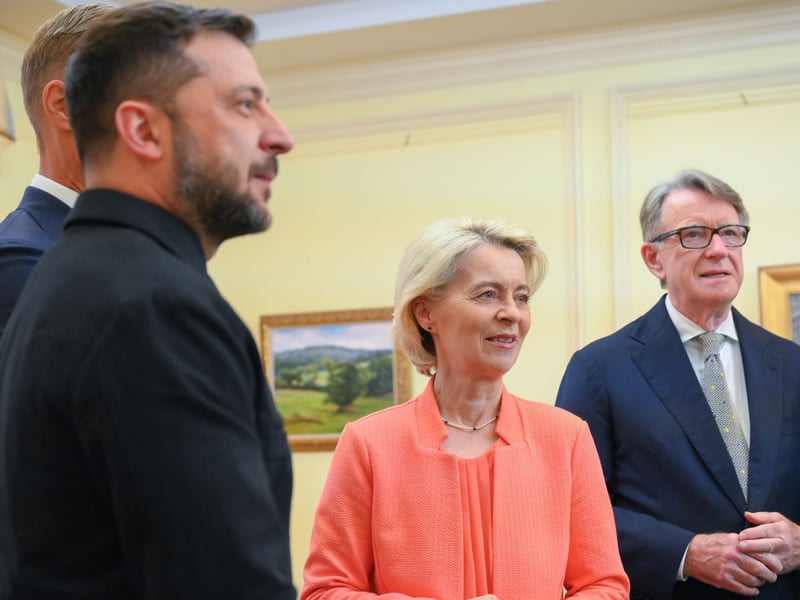
BRUSSELS (CN) — President Donald Trump expressed confidence Monday that the Ukraine conflict could be resolved “within weeks,” following White House talks with European leaders that concluded with claims of breakthrough progress on security guarantees and plans for trilateral negotiations including Russian President Vladimir Putin.
“We will come to a resolution on almost everything, including security,” Trump told reporters at the start of the multilateral session, which included European Commission President Ursula von der Leyen, German Chancellor Friedrich Merz, French President Emmanuel Macron, Italian Prime Minister Giorgia Meloni, British Prime Minister Keir Starmer, Finnish President Alexander Stubb and NATO Secretary-General Mark Rutte.
The meeting concluded with Trump expressing optimism about comprehensive resolution. “We will give [Ukraine] very good protection, very good security,” Trump said about the possibility of granting NATO-like protection for Ukraine.
Rutte called Trump’s willingness to participate in such arrangements “a big step” and “really a breakthrough,” while von der Leyen emphasized the importance of “Article Five-like security guarantees” — NATO’s mutual defense clause.
“I think that we had very good conversation with President Trump. Very good,” said Ukrainian President Volodymyr Zelenskyy, who held a bilateral meeting with Trump prior to joining the European delegation.

The cordial tone marked a dramatic shift from February’s confrontational White House encounter, when Trump and Vice President JD Vance publicly challenged the Ukrainian leader over what they characterized as insufficient gratitude for American assistance.
However, disagreements emerged over the sequencing of peace efforts, with both Merz and Macron advocating for a ceasefire before further negotiations. “I can’t imagine that the next meeting would take place without a ceasefire,” Merz said.
The potentially seismic negotiations pitted Trump’s demands for Ukrainian territorial compromises against Zelenskyy’s warnings that ceding land would create “a springboard” for renewed Russian attacks. European leaders rushed to Washington to prevent what they feared could be a diplomatic capitulation that would rewrite international law and embolden aggression worldwide.
Monday’s meetings followed Trump’s Alaska summit with Putin on Friday, which had hardened the U.S. president’s position against Ukraine. Trump used Truth Social on Sunday evening to demand Ukrainian territorial compromises, asserting Zelenskyy could terminate the conflict “almost immediately” by abandoning NATO aspirations and accepting Russian control of Crimea, the Black Sea peninsula Russia seized in 2014.
“President Zelenskyy of Ukraine can end the war with Russia almost immediately, if he wants to, or he can continue to fight,” Trump posted. “Remember how it started. No getting back Obama given Crimea (12 years ago, without a shot being fired!), and NO GOING INTO NATO BY UKRAINE.”
The Alaska summit with Putin had shifted Trump’s approach from seeking ceasefires to demanding comprehensive territorial concessions. The Russian leader characterized the war he initiated as a “tragedy” while claiming Russia still viewed Ukrainians as “brothers and sisters” despite three years of combat.
Europe rallies to counter Trump pressure
Zelenskyy met with von der Leyen in Brussels on Sunday before the European contingent coordinated their strategy during emergency consultations and decided to depart for Washington, reflecting deep alarm about Trump’s accommodation of Moscow’s positions.
European leaders arrived with significant financial leverage that could determine any deal’s viability. The continent has become Ukraine’s primary military supporter, contributing 72 billion euros ($78 billion) versus America’s 65 billion euros ($70 billion) in assistance, according to Kiel Institute’s figures. Europe also controls approximately 200 billion euros ($220 billion) in frozen Russian assets essential for Ukraine’s reconstruction, giving European officials effective veto power over any comprehensive settlement.
European officials are also preparing to escalate economic pressure on Russia, with the EU’s 19th sanctions package expected in early September to target Russia’s energy, finance and technology sectors while expanding restrictions on the shadow fleet of tankers circumventing oil price caps.
In a sign of European tactical flexibility, Britain indicated Monday it would support a Ukrainian peace agreement without requiring a ceasefire as a precondition. Speaking en route to Washington, Starmer emphasized the need for peace that is “lasting” and “fair and just,” explaining: “It’s in everyone’s interests, it’s in the U.K.’s interests that we get this right.”
Facing Trump’s ultimatums, Zelenskyy has adopted a dual strategy of resistance and flattery in recent weeks. “Russia must end this war,” he declared upon arriving in Washington, while cautioning against repeating historical errors “when Ukraine was forced to give up Crimea and part of our east — part of Donbas — and Putin simply used it as a springboard for a new attack.”
Ahead of what he called a “very serious” meeting, Zelenskyy met with U.S. envoy Keith Kellogg and crafted an appeal targeting Trump’s self-image.
“Russia can only be forced into peace through strength, and President Trump has that strength,” Zelenskyy declared. “We have to do everything right to make peace happen.”
The stakes extend far beyond Ukraine’s borders: “When peace is discussed for one country in Europe, it means peace for all of Europe,” Zelenskyy emphasized, framing the negotiations as a test of international resolve against territorial aggression.
Trump reportedly believes Putin would accept an agreement requiring Ukraine to surrender the Donbas region, including territories not currently under Russian control. These expectations align with Putin’s consistent demands: complete Ukrainian evacuation from Donbas, formal recognition of Russia’s Crimean annexation, and permanent exclusion of Ukraine from NATO. Such arrangements would grant Moscow authority over approximately 20% of Ukraine’s pre-conflict territory.
Ukrainian representatives argue these concessions would surrender vital defensive positions and encourage additional Russian aggression. The territorial dispute represented the fundamental tension driving Monday’s negotiations.
Monday marked Zelenskyy’s second White House visit since Trump took office for a second term, this time backed by the European coalition.
Violence escalates as diplomats gather
The diplomatic urgency gained reinforcement from escalating violence that struck Ukraine during the hours preceding Monday’s negotiations. Ukraine’s military reported that Russia deployed four missiles and 140 drones in nighttime bombardments, hitting 25 sites across six regions despite Ukrainian forces intercepting 88 of the drones.
Russian operations killed at least 10 civilians and injured dozens more in the coordinated offensive. Seven fatalities occurred in Kharkiv, including an entire family with a toddler and her 16-year-old brother, when Russian drones targeted a residential neighborhood. Three additional civilians died in a ballistic missile strike on Zaporizhzhia.
Responding to the overnight violence, Zelenskyy characterized the strikes as “demonstrative” of Russian intentions, noting their deliberate timing before Washington’s peace discussions.
“Putin will commit demonstrative killings to maintain pressure on Ukraine and Europe, as well as to humiliate diplomatic efforts,” he warned.
The escalating civilian casualties emphasized the human costs driving international pressure for resolution, while disagreements persist over appropriate terms for ending the conflict.
Since 2014, America has committed roughly $69.7 billion in military support to Ukraine, establishing Ukraine as the largest recipient of U.S. foreign assistance since post-World War II reconstruction efforts.
Courthouse News correspondent Yuval Molina Obedman is based in Brussels, Belgium.
Subscribe to our free newsletters
Our weekly newsletter Closing Arguments offers the latest about ongoing trials, major litigation and rulings in courthouses around the U.S. and the world, while the monthly Under the Lights dishes the legal dirt from Hollywood, sports, Big Tech and the arts.