
 Search Articles


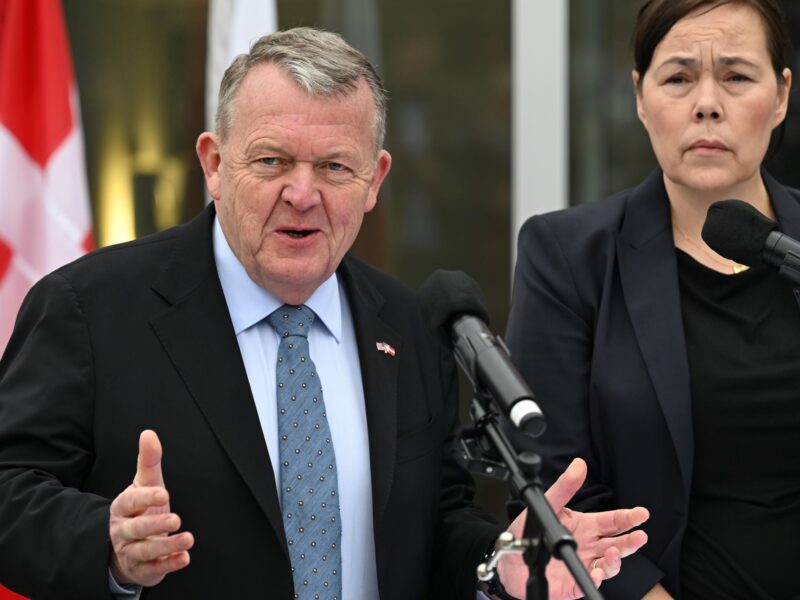
(CN) — President Donald Trump insisted on Wednesday the United States “needs” to take over Greenland for security reasons, and tensions over the Arctic island remained high after the foreign ministers of Denmark and Greenland held crucial talks in Washington with Vice President JD Vance and Secretary of State Marco Rubio.
Following an hourlong meeting Wednesday, Danish Foreign Minister Lars Løkke Rasmussen described the talks as “frank, but also constructive.”
“Our aim was to find a common understanding,” he said. But he added the two sides still had a “fundamental disagreement” over Trump’s desire to occupy Greenland and that they would “agree to disagree.”
He said a high-level working group would be created to discuss Greenland’s security.
Since the Jan. 3 raid on Caracas by U.S. special forces and capture of Venezuelan leader Nicolás Maduro, Trump has shocked European leaders by insisting the U.S. needs to seize Greenland “either the nice way or the more difficult way.”
He repeated his threat Wednesday in a post on Truth Social, arguing Greenland was crucial for his plans to develop a space-based missile defense system, the Golden Dome. The U.S. has long had a military presence on Greenland and stationed nuclear weapons there during the Cold War.
“It is vital for the Golden Dome that we are building,” he wrote. “NATO should be leading the way for us to get it. If we don’t, Russia or China will, and that is not going to happen.”
“NATO becomes far more formidable and effective with Greenland in the hands of the United States,” he added. “Anything less than that is unacceptable.”
The U.S. reportedly is offering to buy the island from Denmark, but the White House also has not ruled out using the military to seize it. In his first term in the White House, Trump broached the possibility of buying Greenland.
Greenland, the world’s largest island, is a semi-autonomous territory inside the kingdom of Denmark with a population of about 57,000 people, the majority of whom are Inuit.
In news reports, Greenlanders have expressed indignation and anger at Trump’s comments about taking over their territory. On Tuesday, Greenland Prime Minister Jens-Frederik Nielsen said the island did not want to become part of the U.S. and that it wanted to remain part of Denmark.
Most of the island lies inside the Arctic Circle and sits under ice and snow. Under Denmark’s constitution, Greenland can break away and become independent — a path many Greenlanders view favorably.
But tensions are ratcheting up with the White House arguing Greenland must come under American control to ensure American dominance of the Western Hemisphere is not threatened.
American officials also have made it clear they want to seize Greenland to exploit it for its natural resources, including rare earth minerals needed for advanced technologies.
As talks were underway in Washington, Denmark, Sweden and Norway announced plans to beef up their military presence in Greenland in a bid to ward off American aggression, an extraordinary development that underscored the raw tensions inside the NATO alliance. Meanwhile, Germany and France said they too would send military personnel. France also announced plans to set up a consulate on the island to send a signal to Washington.
Danish Prime Minister Mette Frederiksen has warned an American invasion of Greenland would spell the end of NATO.
But experts say Denmark and its European allies would likely not put up much, if any, resistance if the U.S. actually tried to seize Greenland militarily.
“It’s enough to show up because what could Denmark possibly do except protest it? This seems to be the American gambit,” said Iver Neumann, an expert on the Arctic region and director of the Fridtjof Nansen Institute in Norway.
He said there was a “distinct possibility” the U.S. might try to annex Greenland. His assessment was in line with comments made by many other experts in recent days.
Neumann said the NATO alliance was on the rocks because of Trump’s threats.
“Seeing the U.S. waltzing into a friendly country, probably with European representatives in place, will be not only detrimental but downright damaging to NATO,” he said, speaking by telephone. “The use of threat of force against allies has now become routine for the American president and it’s hard to see how NATO can survive that.”
He added: “The fact that Denmark and the U.S. have been close allies for 80 years seems to count for nothing.”
He dismissed the White House’s security and economic arguments about the need to occupy Greenland.
“It is not the case that Russia and China present clear and present dangers,” he said. “It is simply not true.”
He said the U.S. already has a military agreement with Denmark allowing it to station troops and weapons in Greenland.
“If the U.S. wanted more security, they could beef up what they have,” he said. “They used to have more presence in Greenland, now they have a mere skeleton base.”
He added that the U.S. could get Denmark and other NATO countries to strengthen defenses on Greenland and in the Arctic region.
As for economic rationale for seizing Greenland, he found that unpersuasive due to the high costs of doing business in such an inhospitable terrain where there is virtually no infrastructure, such as roads.
“The economic argument is also bogus because it costs a lot of money to extract minerals, rare earth minerals, in the Arctic climate, and it is a hell of an operation logistically to get those things back to market,” he said.
Instead, he said Trump appeared to be motivated by hubris, vanity, domestic politics and a sense he can wield absolute power.
“This is a breach with Western traditions about how to govern,” he said. “Absolutism was the idea that the king could do whatever he wanted, whenever he wanted to.”
Courthouse News reporter Cain Burdeau is based in the European Union.
 Follow @cainburdeau
Subscribe to our free newsletters
Our weekly newsletter Closing Arguments offers the latest about ongoing trials, major litigation and rulings in courthouses around the U.S. and the world, while the monthly Under the Lights dishes the legal dirt from Hollywood, sports, Big Tech and the arts.