
 Search Articles


WASHINGTON (CN) — President Donald Trump asked the Supreme Court on Monday to take emergency action and prevent the reinstatement of thousands of probationary federal employees terminated in a firing spree.
The Trump administration said Senior U.S. District Judge William Alsup, a Bill Clinton appointee, allowed a group of nonprofits to hijack the employment relationship between the federal government and its workforce. Alsup’s order to reinstate over 16,000 probationary workers across a half-dozen departments and agencies, the Justice Department said, is part of an ongoing assault on the constitutional structure.
“The lower courts should not be allowed to transform themselves into all-purpose overseers of executive branch hiring, firing, contracting, and policymaking,” the government wrote. “Only this court can end the interbranch power grab.”
According to the administration, federal judges are unfairly targeting the administration through nationwide orders commandeering the executive’s policy proposals. The Justice Department made a similar argument in a separate emergency appeal seeking to enforce Trump’s order ending birthright citizenship.
“This court should not allow a single district court to erase Congress’s handiwork and seize control over reviewing federal personnel decisions — much less to do so by vastly exceeding the limits on the scope of its equitable authority and ordering reinstatements en masse,” the government wrote.
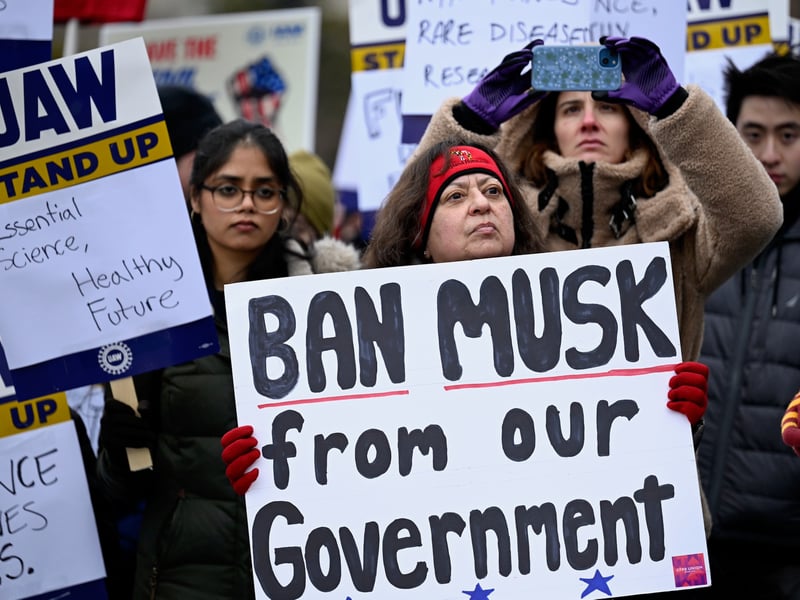
The mass firing of federal employees became the face of Trump and billionaire Elon Musk’s campaign to gut the federal government. Last month, the government purged rolls of probationary workers across several agencies, sending out immediate termination notices to civil service workers who lacked job protections and the right to appeal.
Probationary employees are typically new entrants into the service with only a year or two on the job. However, this can also apply to federal employees who take on new roles in the workforce.
Federal civil servants are shielded from the political will of the White House and can only face immediate termination for poor performance or misconduct. The government can lay off employees to cut the workforce, but that requires a more arduous process and can take time, and only Congress can call for mass reductions to the size of federal agencies.
Civil service workers fired last month reported receiving “performance-based” terminations, which came as a shock to employees who had only received positive reviews or had never been evaluated due to their short tenure.
Four labor unions and five advocacy organizations say Charles Ezell, the acting director of the Office of Personnel Management, ordered the firings through a template letter that falsely stated that the terminations were for performance reasons.
Alsup issued a temporary restraining order, finding that the Office of Personnel Management had no authority to tell federal agencies to fire employees. Weeks later, he extended the temporary relief into a preliminary injunction after Ezell failed to appear at a hearing.
Alsup ordered the immediate reinstatement of probationary workers who were fired from the Department of Veterans Affairs, Pentagon and many other government agencies at the behest of the Office of Personnel Management.
Last week, the Ninth Circuit refused to block Alsup’s order, finding that any pause in reinstatements would disrupt, rather than preserve, the status quo.
At the Supreme Court, the government framed the nonprofits’ concerns as trivial compared to the extraordinary relief they received.
“The notion that immediate reinstatement of thousands of probationary employees is the way to improve customer service at national park bathrooms also underscores fatal flaws with respondents’ theory of Article III standing — flaws that should have foreclosed any relief,” the government wrote.
The government claimed Alsup had no jurisdiction to assess the legality of the executive branch’s personnel actions, stating that federal courts have limited review over federal agency decisions.
Even though it disagreed, the Justice Department stated that it complied with Alsup’s order instructing the Office of Personnel Management to rescind terminations it acted on. However, the government claimed that the terminations came from the agencies themselves so the office only had to clarify agencies’ independence.
The government says any additional relief at the agency level would be intolerable. It would be a profound invasion, the Justice Department said, for a judge to prevent agencies from exercising independent judgment to terminate employees.
“Each day the preliminary injunction remains in effect subjects the executive branch to judicial micromanagement of its day-to-day operations,” the government wrote.
Norm Eisen, whose State Democracy Defenders Fund represents the plaintiffs in this case, dismissed the Trump administration’s arguments and said he’s confident the court would reject the last-ditch effort to avoid complying with Alsup’s ruling.
“The Trump administration illegally terminated tens of thousands of federal employees, as duly noted by Judge Alsup,” Eisen said in a statement. “The administration’s efforts to block relief have so far failed and now they are turning to the Supreme Court — baselessly. Our coalition remains committed to ensuring that justice prevails for every affected probationary worker and we are confident that the courts will uphold the rule of law. We look forward to seeing the government in court.”
 Follow @KelseyReichmann
 Follow @kelseyreichmann.bsky.social
Subscribe to our free newsletters
Our weekly newsletter Closing Arguments offers the latest about ongoing trials, major litigation and rulings in courthouses around the U.S. and the world, while the monthly Under the Lights dishes the legal dirt from Hollywood, sports, Big Tech and the arts.