
 Search Articles


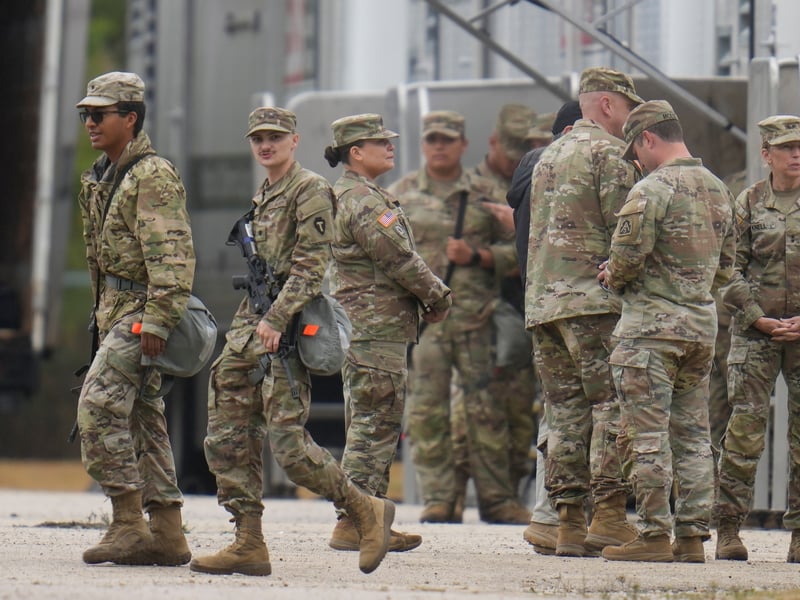
CHICAGO (CN) — A federal judge on Thursday issued a temporary restraining order that bars the Trump administration from federalizing and deploying the National Guard to Illinois for two weeks.
Ruling from the bench, U.S. District Judge April Perry said the Department of Homeland Security’s perception of events are simply unreliable. She also indicated that a more detailed written order wouldn’t be available until Friday morning.
Illinois and the city of Chicago jointly filed a lawsuit on Monday after President Donald Trump ordered the deployment Sunday, in response to what he described as aggression toward federal Immigration and Customs Enforcement agents.
Chicago and Illinois claim the mobilization of the National Guard in the city violates the First and Fourth Amendment.
Christopher Wells, an attorney representing the state, argued in court Thursday that Trump’s decision to deploy the National Guard to Chicago had nothing to do with the safety of ICE agents — rather, he claimed the president deployed the guard solely because of his animus for the city.
Since the start of his term, Trump vowed to crackdown on immigration enforcement. In Illinois, he launched “Operation Midway Blitz,” during which officials estimated they’ve arrested around 1,000 people already.
Protesters have showed up in full force in response to the intensified immigration enforcement, particularly at the immigration processing facility in Broadview.
But protesters at Broadview aren’t out of the ordinary, Perry noted. The Joe Biden appointee said people have been gathering to pray in front of the immigration processing center for the past 19 years, and it wasn’t until federal law enforcement arrived last week that things escalated.
The federal government requested that the judge limit the injunction to only the Broadview facility, which she swiftly denied.
Eric Hamilton, an attorney with the Department of Justice, argued that what he called protesters’ violent resistance to federal law enforcement officers equates to a rebellion and, as such, Trump was well within reason to order the National Guard to Chicago.
Federal law prescribes limited instances in which the president can call in the National Guard: to stop an invasion, to quell an ongoing rebellion or if the president is unable to enforce U.S. laws with regular forces.
“The president of the United States of America believes that there is a rebellion brewing in the United States,” Wells said to Perry. “Where is the rebellion? Who are the rebels?”
Hamilton argued that the threat of a rebellion in it of itself is enough for the president to call in the National Guard.
“Chicago is seeing a brazen new form of hostility from rioters targeting federal law enforcement,” Hamilton said. “They are not protesters. They are the violent resistance to duly enacted immigration laws.”
Perry pressed Hamilton on how exactly ICE agents are unable to execute federal laws.
“You think that ‘unable to execute the laws’ doesn’t mean ‘unable to respond to legal violations’, it’s ‘unable to prevent legal violations?’” she asked.
Hamilton paused for a moment and then responded, “I think the term could be understood in both ways. The fact that there has been a diversion of resources would also impact law enforcement.”
He added that the Ninth Circuit Court of Appeal’s decision regarding the presence of the National Guard in Los Angeles made it clear that impeding law enforcement from doing their job is tantamount to them being “unable to execute the law.”
But Perry said while issuing her ruling Thursday that the Ninth Circuit’s definition of “unable to execute the law” wouldn’t apply here.
“There is no evidence that the president is unable, with regular forces, to execute the laws of the United States,” Perry said.
Wells argued that Hamilton’s claim that federal law enforcement is unable to effectively enforce the laws was “untethered from reality.”
“I heard statements about law enforcement being at risk and we take that very seriously,” Wells said. “Most of our evidence comes from law enforcement.”
Perry also noted that a federal judge issued an injunction Tuesday that prohibits ICE agents from using excessive force on journalists, protesters and religious leaders, which Hamilton said he wasn’t aware of.
Perry also noted that two people indicted for assaulting ICE officers had their cases dismissed by a grand jury. A third person charged with assaulting an ICE officer had his charges dismissed in the midst of Thursday’s hearing. Another federal judge on Wednesday also ruled that the manner in which ICE agents have arrested people violates a federal consent decree.
“In the last 48 hours, in four separate unrelated legal decisions from different neutral parties, they all cast significant doubt on DHS’s credibility and assessment of what is happening on the streets of Chicago,” Perry said.
Hamilton maintained that ICE officers are at risk for just doing their jobs.
Perry said the main threats they’ve faced have been getting tires slashed or their car keyed.
“Some of this frankly sounds like a Carrie Underwood song,” she said.
“This is no Carrie Underwood song,” Hamilton rebutted. He then cited an instance where an ICE agent had his beard pulled off by a protester, about which Perry seemed dubious.
“How did that happen? Was it real facial hair? Not pieces of hair, his beard was ripped off his face?” she asked.
“That’s what the declaration says,” Hamilton said.
Following the hearing, Illinois Attorney General Kwame Raoul said he thought Perry made the right decision. Speaking to a gaggle of reporters, he got choked up as he acknowledged the attorneys standing behind him who argued in court Thursday.
As to how Perry’s decision will be enforced or whether the troops must leave the state, he couldn’t exactly say.
“There’s a temporary restraining order that they should not be active in the state,” Raoul said. “They’re welcome to stay at our hotels if they pay the hotel rate. They’re welcome to eat at our restaurants like any other American citizen.”
Perry’s temporary restraining order expires on Oct. 23, and she scheduled a hearing for Oct. 22 to decide whether an extension is necessary.
 Follow @RosenCaitlyn
Subscribe to our free newsletters
Our weekly newsletter Closing Arguments offers the latest about ongoing trials, major litigation and rulings in courthouses around the U.S. and the world, while the monthly Under the Lights dishes the legal dirt from Hollywood, sports, Big Tech and the arts.