
 Search Articles


WASHINGTON (CN) — Congress observed a sordid anniversary Tuesday, as the government shutdown that has laid bare deep partisan divisions on Capitol Hill lurched into its second week.
But despite mounting frustration among both Democratic and Republican leaders, neither party so far seems willing to make any concessions to reach a deal that would end the shutdown that has bottlenecked government programs and prompted the Trump administration to fire federal employees in droves.
And with no signs of a bipartisan funding deal on the horizon, both parties have amped up the blame game for what threatens to become an extended shutdown.
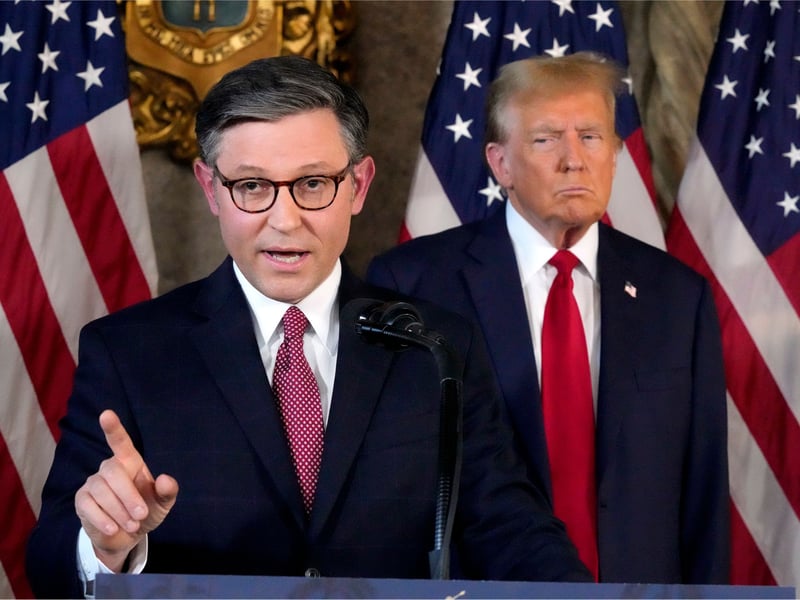
“It’s been two weeks of Democrats in Congress inflicting untold hate on the American people for nothing other than pure politics,” House Speaker Mike Johnson fumed from the lectern during a news conference on Capitol Hill Tuesday morning.
Democrats late last month refused to back a GOP-led proposal for a monthlong extension to government funding, commonly referred to as a continuing resolution. They pointed out that Republicans had effectively cut them out of the negotiation process by moving the budget stopgap without any minority participation. Democrats said they would only vote for such a short-term spending resolution if Republicans agreed to a raft of conditions, including an extension to Affordable Care Act health care subsidies set to expire at the end of the year.
Opposing the continuing resolution has widely been viewed as one of the few political levers Democrats can pull to oppose the Trump administration’s agenda from the minority.
Republicans, by contrast, slammed their colleagues for attempting to extract concessions ahead of a fiscal deadline. The proposed continuing resolution, they argued, was “clean” — that is, without any additional policy riders.
The House narrowly passed the GOP proposal last month. Since the government shut down Oct. 1, the Senate has tried and failed on more than a half dozen occasions to approve that measure.
So far, the GOP has refused to budge on Democrats’ demands. Asked on Tuesday whether he thought Republicans should consider changing their strategy, Johnson appeared exasperated.
“I don’t have any strategy,” the House speaker said. “I’m doing the right thing, the clearly obvious thing, the traditional thing. I don’t have anything to negotiate.”
Johnson pushed back on the idea that the GOP could move closer to Democrats’ negotiating position, arguing that his colleagues — who have demanded Congress repeal certain sections of Republicans’ flagship “Big, Beautiful Bill” — were asking for “nonsense.”
“We are not going to do that,” the speaker said. “The American people don’t want us to do it, and they’re using this for political purposes.”
Democrats, meanwhile, have maintained that any plan to reopen the government would need to address their health care priorities — which have become the focal point of their argument for opposing the GOP’s continuing resolution.
House Minority Leader Hakeem Jeffries told reporters during a separate news conference Tuesday that Democrats were open to negotiating with Republicans and the Trump administration, but that neither had been willing to come to the table.
“Since the White House meeting over two weeks ago, Republicans have gone radio silent,” said Jeffries, alluding to a fruitless summit between Democrats, President Donald Trump and Republican leadership ahead of the Oct. 1 shutdown. “Donald Trump has spent more time on the golf course than talking to Democrats on Capitol Hill.”
The Democratic leader also dinged House Republicans, who have refused to call the lower chamber into session for weeks in an effort to force the Senate to pass its continuing resolution.
“The Republican strategy is to bring the same failed, partisan Republican spending bill to the floor over and over again, knowing it’s going to go down,” he said.
Jeffries added that Democrats were open to having a “good faith discussion” with Republicans on a potential path forward.
But Johnson maintained that there was nothing to negotiate.
“We did not load up the temporary funding bill with any Republican priorities, or partisan priorities at all,” the top House Republican said. “I don’t have anything that I can take off of that document to make it more palatable for them.”
The federal funding that elapsed this month was itself appropriated under a separate continuing resolution, approved by lawmakers back in March. The six-month stopgap was intended to give Congress time to negotiate full-year spending bills and to avert a government shutdown.
House Republicans, though, used the summer to debate and pass Trump’s flagship “Big, Beautiful Bill,” a sweeping package of Trump administration policy priorities — which among other things injected $75 billion into U.S. Immigration and Customs Enforcement.
As the shutdown continues to drag out, the administration has seized the opportunity to lay off thousands of federal workers, a plan that the White House Office of Management and Budget has long signaled that it was considering if government funding were to lapse.
The Trump administration has also said that it will shift existing funds around to ensure members of the military do not miss a paycheck scheduled for Wednesday — a legally questionable move that is aimed at tamping down a hot-button political issue.
Government services are also facing increasing drawbacks as the shutdown goes on. Airports are facing shortages of air traffic controllers — who, like many federal workers are going without pay, thanks to the lack of federal appropriations — causing expanding air travel delays across the country.
The Senate was scheduled Tuesday evening to take an eighth vote on Republicans’ ill-fated continuing resolution. It is expected to fail.
 Follow @BenjaminSWeiss
Subscribe to our free newsletters
Our weekly newsletter Closing Arguments offers the latest about ongoing trials, major litigation and rulings in courthouses around the U.S. and the world, while the monthly Under the Lights dishes the legal dirt from Hollywood, sports, Big Tech and the arts.