
 Search Articles



(CN) — Thousands of prisoners in Britain are set to be released early, officials announced Friday, as a capacity crisis unfolds for the newly elected United Kingdom government.
Justice Secretary Shabana Mahmood called the mass early release of prisoners “the only way to avert disaster” as British prisons reportedly are days away from reaching their maximum number of detainees.
“If we fail to act now, we face the collapse of the criminal justice system, and a total breakdown of law and order,” Mahmood warned in a heavily anticipated press conference.
The government will temporarily reduce the minimum time served by prisoners from 50% to 40% of their total sentences. The early release policy excludes those incarcerated for violent, sexual or terror offenses, as well as most domestic abuse cases. The government will also recruit 1,000 more probation officers as part of the package of emergency measures.
The prison population has been narrowly kept below maximum capacity for a number of months: There are roughly 87,505 prisoners in the system, which has a capacity of 88,956, according to the Ministry of Justice.
In June, the Prison Governor’s Association said in a sobering open letter that “the entire criminal justice system stands on the precipice of failure” and warned that neglecting to tackle the crisis immediately “will put the public at risk.”
“New prison places which are planned are too little and too late to avert prisons running out of space. It is simply not possible to squeeze any more people into a full and overcrowded prison system,” the group warned.
More than 10,000 prisoners have been released early over the last year in order to keep the system afloat. In the dying days of the previous government, former Prime Minister Rishi Sunak initiated Operation Early Dawn, a series of emergency measures criticized by lawyers’ groups for prolonging rather than addressing the crisis.
Speaking on Thursday during his attendance at the NATO conference in Washington, Prime Minister Keir Starmer was scathing about the previous government’s handling of the prison system.
“It is shocking for our country to have got into a state where we have too many prisoners and not enough prison places,” he said, “to a point where any government is now in a position where it has to release prisoners early. Some of what we’ve found is shocking. The situation is worse than I thought it was.”
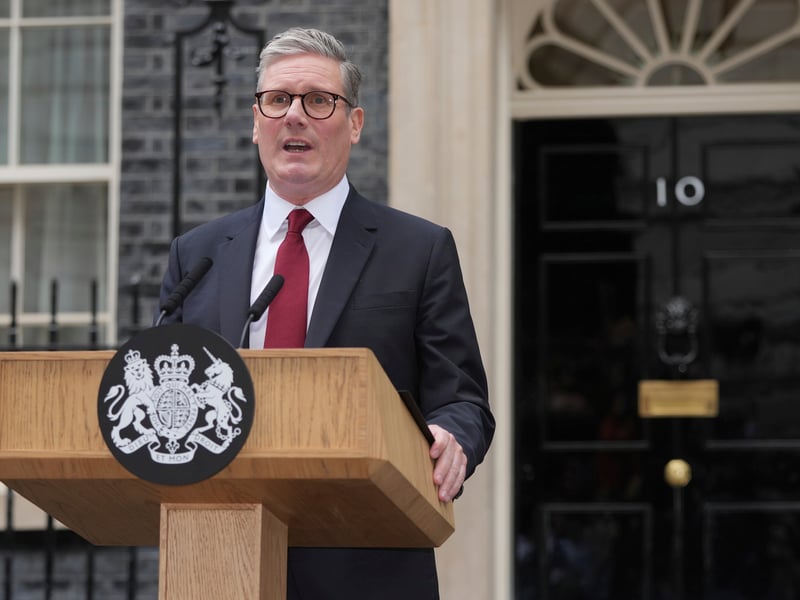
Whilst the overcrowding crisis in U.K. prisons has reached a tipping point, it has been more than a decade in the making. The Ministry of Justice was particularly affected by the 2010 to 2015 coalition government’s austerity program; it faced deep budget cuts for years. As a result, prison capacity has plateaued, while resources available to the probation service and court system have dwindled.
Growing waiting times for court proceedings have significantly increased the number of people in prison who are on remand — waiting either for trial, or for sentencing — according to the Institute for Government think tank. The court backlog has developed into a major failure of the British criminal justice system over the past decade, with 20% of the prison population on remand.
At the same time, the institute highlights much longer sentences being handed down for crimes such as assault and robbery. Increased sentence lengths have ensured the prison population has grown since 2010, even though convictions have fallen over the same time period. The think tank also points to a large increase in the number of people being recalled in recent years — that is, breaching the terms of their release and being sent back to prison. This figure has doubled since 2016, further reducing prison capacity.
There are signs that the new government intends to take a radically new approach to criminal justice. During his first full day of office, Starmer announced an unexpected appointee to serve as a junior minister for prisons: James Timpson, the owner of a popular chain of locksmiths around the country, and also a longstanding campaigner for criminal justice reform.
Timpson has argued that less than a third of people in prison should actually be there. Although Starmer was reluctant to endorse this position in his inaugural press conference last week, instead dodging the question from a reporter, the appointment does indicate the potential for a new direction of travel, toward rehabilitation and community orders, rather than incarceration.
Starmer, a lawyer before entering politics, was formerly the director of public prosecutions in the U.K., and therefore is highly familiar with the criminal justice system. Whilst a mass release of prisoners is unlikely to be how he envisioned kickstarting his new administration, it is billed as only the first step in a wider push to drive down the prison population.
The Labour Party has been at pains to avoid making financial commitments as it enters office, insisting the administration will stick to strict fiscal rules that leave little room for revenue generation. However, clearing the bulging courts backlog is likely to require resources on a different scale to that which the British justice system has become accustomed to for many years — adding further financial pressure on the fiscally overstretched Starmer administration.
Subscribe to our free newsletters
Our weekly newsletter Closing Arguments offers the latest about ongoing trials, major litigation and rulings in courthouses around the U.S. and the world, while the monthly Under the Lights dishes the legal dirt from Hollywood, sports, Big Tech and the arts.