
 Search Articles


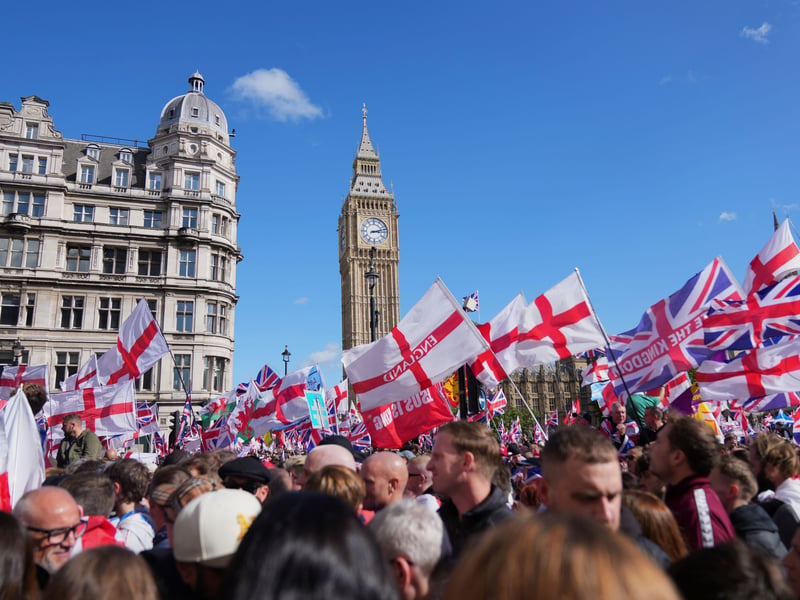
MANCHESTER, England (CN) — More than 100,000 people gathered in central London on Saturday to hear Elon Musk, Steve Bannon and British leaders at a “Unite the Kingdom” rally, a far-right anti-immigrant protest billed as a free speech march by the English provocateur Tommy Robinson.
Musk appeared by video link, warning: “Whether you choose violence or not, violence is coming to you. You either fight back or you die.”
Prime Minister Keir Starmer said Sunday that while protest is a right, “we will not stand for assaults on police officers doing their job or for people feeling intimidated on our streets because of their background or the color of their skin.”
Starmer’s spokesperson Dave Pares said, “The U.K. is a fair, tolerant and decent country. The last thing the British people want is this sort of dangerous and inflammatory language.” He said it threatened “violence and intimidation on our streets.
“I don’t think the British public will have any truck with that kind of language,” Pares said.
Business Secretary Peter Kyle called Musk’s words “totally inappropriate” and “slightly incomprehensible.”
Musk has praised far-right causes in the U.K. and Europe, including the Alternative for Germany party, or AfD.
Police said there was “significant aggression” from some people among the 110,000 to 150,000 demonstrators, which left 26 officers injured and 24 people arrested.
Protesters waved Union Jack and St. George’s cross flags as Robinson hosted speakers including former White House strategist Bannon, who said earlier this month the U.K. was headed for civil war.
Starmer added: “Our flag represents our diverse country and we will never surrender it to those that use it as a symbol of violence, fear and division.”
A smaller counter-protest of about 5,000 people, organized by Stand Up To Racism, marched nearby.
Crowds chanted “We want our country back,” with some shouts of “Charlie, Charlie” in tribute to the assassinated American conservative activist Charlie Kirk.
The rally came against a backdrop of intensifying protests targeting former hotels housing asylum-seekers.
There were weeks of protest this summer outside the Bell Hotel in Epping, Essex, where thousands of people gathered after an asylum-seeker living there was charged with sexually assaulting a 14-year-old girl in the town. Far-right groups joined local protests and clashed with police.
Violence also flared in Southport last summer after the murder of three girls. Rioters torched a hotel housing asylum-seekers, leaving it badly damaged in one of the worst incidents tied to asylum accommodation.
Police said far-right agitators fueled unrest by spreading false claims online that the attacker was an asylum-seeker. More than 1,800 arrests were made.
Since taking office last year, the Labour government has cut the number of hotels used for asylum-seekers from 400 in 2023 to 210, and plans to phase them out entirely by 2029.
Immigration has become a flash point in politics. The number of people arriving in the U.K. via small boats in the first half of 2025 has increased 48% compared to the same period last year.
In July, the leader of the surging far-right party Reform UK, Nigel Farage, claimed that the U.K. was reaching “civil disobedience on a vast scale.”
Gavin Stephens, chair of the National Police Chiefs’ Council, said politicians must “reduce and defuse tensions” rather than stoke them.
Stephens said on Sept. 3 that the continuing focus on asylum-seekers had caused “a climate of increasing tension and polarity.”
He added, “It’s clear to all of us that we can see more community tension and more division. And I think we all have a responsibility, policing included, to set the tone.”
Who is Stephen Yaxley-Lennon?
Stephen Yaxley-Lennon, Robinson’s real name, founded the English Defence League in 2009 to counter “the rise of radical Islam,” initially recruiting members from soccer clubs.
His criminal record includes financial fraud, stalking and harassment of journalists, contempt of court and cocaine possession. He spent $135,000 on gambling before declaring bankruptcy in 2021.
Robinson was released from prison in May after serving a sentence for ignoring a court order not to repeat false claims about a Syrian refugee.
He raises money from his audience, followers and wealthy American backers, including the U.S. tech billionaire Robert Shillman.
The Unite the Kingdom rally echoes another ongoing campaign called “Operation Raise the Colours,” which has seen Union Jacks and the English red and white St. George’s cross flags fixed to council facilities around the country.
Local authorities say fixing flags to public property is not allowed, but many have allowed them to remain.
Immigration as rallying point
Populist leaders like Robinson and Farage use immigration as a rallying point because it offers a simple story of insiders and outsiders, said Lone Sørensen, associate professor of political communication at the University of Leeds.
“Populists tell a story about politics in which the professional political elite are the bad guys, and the populist is one of us, one of the good guys,” Sørensen said. “Adding another set of bad guys — usually immigrants — makes this story even more effective, because it creates a handy scapegoat for a whole range of grievances that people suffer in their daily lives.”
She said that such rhetoric works not only because of the message, but also because it breaks the norms of formal politics.
“Since disruption is newsworthy, either because it creates conflict or shakes things up, the populist act gets a lot of media attention, which in turn gradually normalizes new ways of speaking and behaving in politics,” she said.
Sørensen said the populist narrative casts elites as self-serving and ordinary people as powerless, channeling anger toward perceived elites and other outgroups, especially immigrants.
That pattern of anger is visible in public opinion. Research from the University of Edinburgh found that 60% of voters in England say politics makes them angry, 55% say it makes them fearful, and 78% say it makes them frustrated.
Reform UK supporters reported the highest anger, at 82%, but frustration cut across the political spectrum: 85% of the Greens, 80% of Labour voters and 77% of Conservatives said they were frustrated with politics.
Sørensen said this atmosphere feeds culture war politics. “Increasingly, anger is also channeled toward those citizens who support the elite by engaging with mainstream politics and its insistence on formal language and behavior, and this takes the form of culture war politics.”
As one of the largest nationalist protests in decades, the London rally capped a summer of heightened tension over immigration and asylum-seekers.
The scale of the protest has also shown how populist rhetoric around immigration and identity has moved from the margins into the heart of England’s public squares.
Courthouse News reporter James Francis Whitehead is based in England.
 Follow @jayfranklinlive
Subscribe to our free newsletters
Our weekly newsletter Closing Arguments offers the latest about ongoing trials, major litigation and rulings in courthouses around the U.S. and the world, while the monthly Under the Lights dishes the legal dirt from Hollywood, sports, Big Tech and the arts.