
 Search Articles


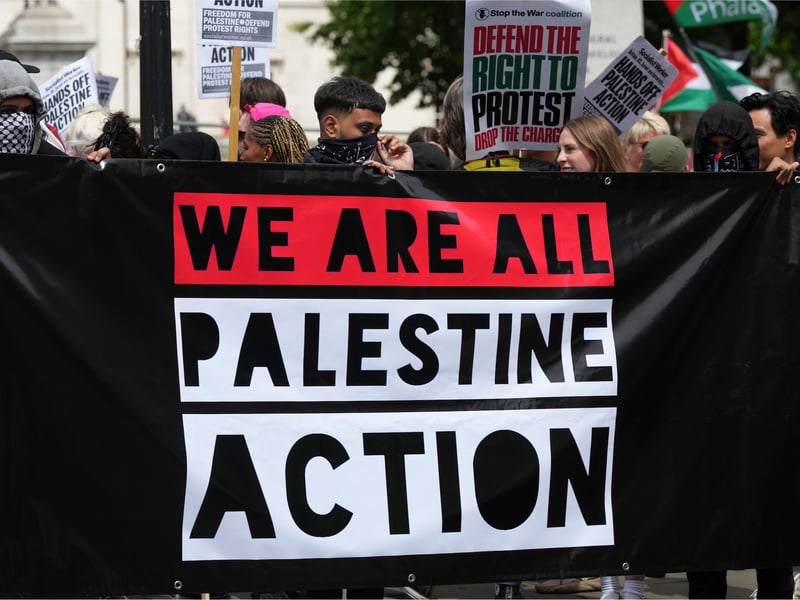
MANCHESTER, England (CN) — The U.K. Parliament has voted to ban the direct action group Palestine Action despite human rights groups warning of its damage to the right to protest.
Palestine Action is an organization that targets companies with ties to Israel’s military. Its tactics include breaking into sites, spraying red paint and staging sit-ins or rooftop occupations.
The government’s order, tabled by Home Secretary Yvette Cooper, passed with a 385-26 vote and will outlaw the group under the Terrorism Act 2000.
The order also prohibits two other groups: the Russian Imperial Movement, an ultranationalist and white supremacist military group, and the Maniacs Murder Cult, an Eastern European neo-Nazi organization.
The proscription order now goes to the upper chamber, the House of Lords, with approval expected by this weekend.
It would make being a member of Palestine Action or a supporter of the group a criminal offense, carrying a maximum sentence of 14 years in prison.
Home Office Minister Dan Jarvis, who outlined the government’s case, said that the right to protest “does not provide a blank check to seriously damage property,” adding that the group’s methods “have become more aggressive.”
Jarvis described the group’s most recent action, in which members broke into an Royal Air Force base and spray-painted military aircraft with red paint, an “attack” that “provoked shock and anger” across the country.
“Palestine Action has orchestrated a nationwide campaign of property damage,” resulting in “serious damage to property and crossed the threshold from direct criminal action into terrorism.”
By implementing this measure, the government aims to “remove Palestine Action’s veil of legitimacy, tackle its financial support and degrade its efforts to recruit and radicalize people into committing terrorist activity.”
Despite passing by a large majority, dozens of lawmakers spoke out against the proscription before the vote, mostly Labour MPs.
Labour’s Clive Lewis spoke about the historical parallels in the group’s direct action tactics.
“When the suffragettes carried out a campaign of window smashing, poster paint defacement, cutting telegraph from railway lines, targeted bombing and arson, specifically avoiding harming people, I think we have to understand that there is a long history in this country of direct action which pushes the boundaries of our democracy,” Lewis told the House of Commons.
Labour MP Richard Burgon criticized the government’s decision to group Palestine Action with the two other groups, calling it “regrettable,” adding that “this is no way to bring in terror legislation.”
Independent lawmaker Zarah Sultana called out “an unprecedented and dangerous overreach of the state,” adding that Palestine Action’s real crime is to “expose the blood-soaked ties between this government and the genocidal Israeli apartheid state and its war machine.”
“To equate a spray can of paint with a suicide bomb isn’t just absurd, it is grotesque,” Sultana added, designed to “chill dissent, criminalize solidarity and suppress the truth.”
She urged Parliament to not ignore what is happening in Gaza, “where the real crimes are being ignored.”
Scottish National Party lawmaker Pete Wishart warned that terrorism legislation hands broad powers to the state, and that it is “extremely concerning that this decision could lead to these powers being extended to other campaigning organizations.”
“For Palestine Action to be included alongside these groups is at best a cynical and calculated move by the government,” he said.
Human rights organizations, including Amnesty and Liberty, had urged the government to rethink the proscription.
In a statement, Amnesty said that the government “risks an unlawful interference with the fundamental rights of freedom of expression, association and peaceful assembly.”
UN experts have urged the U.K. government to not misuse terrorism laws against Palestine Action.
“We are concerned at the unjustified labelling of a political protest movement as ‘terrorist,’” the experts said in a press release. “According to international standards, acts of protest that damage property, but are not intended to kill or injure people, should not be treated as terrorism.”
 Follow @jayfranklinlive
Subscribe to our free newsletters
Our weekly newsletter Closing Arguments offers the latest about ongoing trials, major litigation and rulings in courthouses around the U.S. and the world, while the monthly Under the Lights dishes the legal dirt from Hollywood, sports, Big Tech and the arts.