
 Search Articles


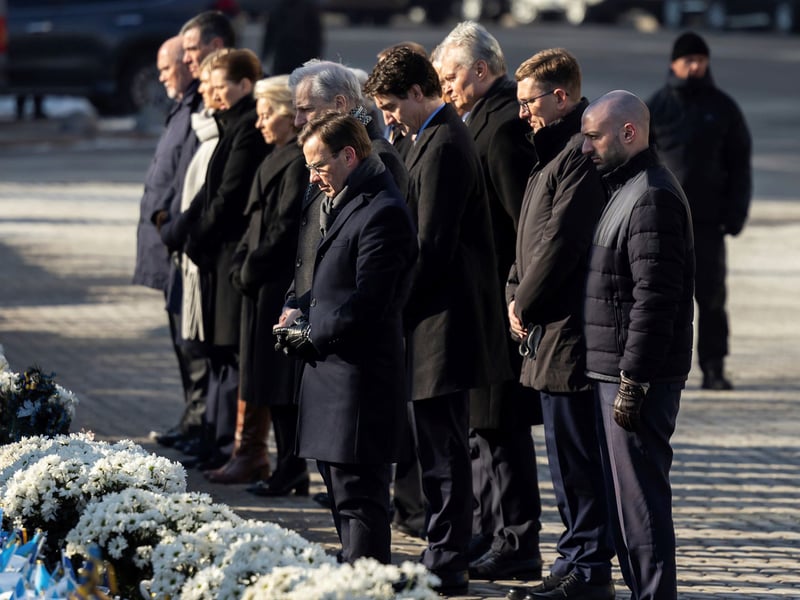
(CN) — The deepening chasm between Washington and its European allies over the war in Ukraine was displayed with striking poignancy on Monday, the third anniversary of Russia’s invasion of its southern neighbor.
On the American side, U.S. President Donald Trump continued to press for an end to the war by normalizing relations with Moscow and curtailing aid to Kyiv. On Monday, Trump said on social media he was “in serious discussions” with Russian President Vladimir Putin about “ending the war” and agreeing on major business deals between the United States and Russia. “Talks are proceeding very well,” he added.
For Europeans, he is effectively seeking to force Ukraine to concede defeat and give up territory to Russia. In carrying out this strategy, he angered European and Ukrainian leaders by sidelining them in negotiations with Russia over the war. More talks are set to take place this week.
On Monday, the U.S. presented a resolution calling for an end to the war to the United Nations Security Council, but it did not blame Russia for its invasion. The resolution passed with France and the United Kingdom, permanent Security Council members, abstaining after they were put in the awkward and rare position of going against an American proposition. Earlier in the day during a session of the U.N. General Assembly, the U.S. voted against a resolution backed by Europeans and Kyiv demanding Russia immediately withdraw from Ukraine.
On the flip side, European allies stayed on the offensive against Moscow with an announcement ofnew sanctions against Russia and Russian individuals and companies, including banks and aluminum imports. European leaders also renewed pledges of unwavering military, political and financial support for Kyiv. EU leaders are expected to announce more than $20 billion in new aid in the coming days.
To back up their words of support, European Commission President Ursula von der Leyen and other European leaders showed up in Kyiv to mark the grim anniversary. Canadian Prime Minister Justin Trudeau and former British Prime Minister Boris Johnson also joined the events in Kyiv. Noticeably absent were U.S. officials.
The stark differences also were highlighted during a Washington visit by French President Emmanuel Macron to discuss the war with Trump. Macron is trying to convince Trump of the necessity to prevent Russia from claiming victory in the war and reportedly to end bilateral talks with the Kremlin.
British Prime Minister Keir Starmer is heading to Washington on Thursday with similar requests. France and Britain are proposing to send troops as peacekeepers to Ukraine in the event of a ceasefire and they want U.S. backing for the plan. Trump has excluded sending U.S. troops to Ukraine.
In Kyiv, von der Leyen paid tribute to those killed in the war andlaid flowers in Maidan Square, the site of a popular uprising in 2013 and 2014 that brought down Viktor Yanukovych, the country’s pro-Russian president. Those events led to Russia’s annexation of Crimea in 2014 and the outbreak of armed conflict in eastern Ukraine.
“We are in Kyiv today because Ukraine is Europe,” von der Leyensaid on social media. “In this fight for survival, it is not only the destiny of Ukraine that is at stake. It’s Europe’s destiny.”
“Putin is trying harder than ever to win this war on the ground. His goal remains Ukraine’s capitulation,” she said. She called the war in Ukraine “the most central and consequential crisis for Europe’s future.”
EU leaders renewed a pledge to make Ukraine a member of the bloc in the near future. Ukraine has begun the process to join the EU, but it remains far from clear how and when that will happen.
A similar tone was struck by Friedrich Merz, the presumptive next German chancellor. His conservativeswon elections on Sunday.
“Europe remains firmly on the side of Ukraine,” Merz said. “Now more than ever, we must put Ukraine in a position of strength.”
In tune with other European leaders, Merz said it was time for Europe to become independent of U.S. military power. Trump’s overtures to Russia, his unease with the NATO alliance and his threats to draw down troop levels in Europe have prompted panic in Europe and sparked renewed talk of building up Europe’s militaries.
European leaders and policymakers continue to argue that Ukraine can hold out against Russia’s invasion and turn the tide in the war. They say Russia’s military and economy are far weaker than they appear and that Ukraine can prevail.
“I have to be honest and say that I don’t believe Putin,” Danish Prime Minister Mette Frederiksen said in Kyiv. “I don’t think he wants peace in Ukraine. I understand that many people think that a peaceful solution or a ceasefire sounds like a good idea, but we risk that peace in Ukraine is actually more dangerous than the war that is happening now.”
But a scenario where Russia retreats seems unlikely as its forces continue to make steady advances on the battlefields in Ukraine and the country shows surprising resilience to Western sanctions. Russian troops have seized numerous villages and small cities in recent months and they appear poised to make even bigger advances as Ukraine struggles with manpower and weapons shortages.
For now, Europe is promising to fill gaps left by the U.S. in its support for Ukraine, but it is doubtful the EU has the capability to do so fully. The bloc lacks the military industrial base to supply Ukraine with the missiles, air defenses and other hardware it needs to fight Russia. Ukrainian leaders have said U.S. aid is critical to their success in fending off Russian forces.
Meanwhile, the dramatic shift in Washington following Trump’s reelection shows no sign of slowing down with White House officials even saying Russia was provoked into launching the invasion by the West’s attempt to make Ukraine a NATO member.
Speaking on Fox News on Monday, National Security Adviser Michael Waltz said Ukraine becoming a NATO member “is not back on the table.”
“I do not see the United States having Ukraine enter into NATO,” Waltz said. “We are absolutely committed to NATO at large, our Article Five treaty agreements with other NATO countries, but the security guarantees for Ukraine is a different conversation.”
Ukraine is seeking NATO membership as a sure way to keep Russia from attacking in the future. However, even former U.S. President Joe Biden and European leaders showed little appetite for making Ukraine a NATO member any time soon for fear of triggering a conflict between the alliance and Russia. The Kremlin has said it will not allow Ukraine to join NATO because that would constitute a major danger to its security.
On Sunday, Ukrainian President Volodymyr Zelenskyy said he would resign in exchange for Ukraine being admitted into NATO.
His offer appeared to be a response to Trump’s desire to see him out of office. Trump called Zelenskyy a “dictator” for not holding elections. Zelenskyy postponed elections last year, saying they could not be conducted while the country was under martial law.
Despite an acrimonious relationship between Zelenskyy and Trump, negotiations between Washington and Kyiv are taking place on how to end the war.
They center on adeal where the U.S. would get about $500 billion worth of rare earth minerals extracted from Ukraine. Washington says the U.S. should get the minerals as compensation for the more than $175 billion in aid it has given Ukraine. Kyiv is asking for American military protection in exchange for the minerals, a difficult proposition for the White House.
Daniel Kochis, an expert on European security at the Hudson Institute, a Washington think tank, doubted Trump’s efforts to make a deal with Putin to end the war will succeed.
“For President Trump, he very much believes in the power of himself to be able to securely end the conflict,” Kochis said, speaking at an online forum organized by the European Policy Centre, a Brussels think tank. “He actually believes that these negotiations are going to bear fruit. I don’t agree with that.”
Kochis said Ukraine and the EU are unlikely to accept any deal concocted through U.S.-Russia talks. Moreover, he questioned whether the Kremlin wants to reach an agreement on a ceasefire.
“Ultimately this is going to be doomed to failure,” he said. “And so then the question becomes, what does the U.S. administration do after that?”
He said the White House might walk away from the war or double down on its support for Ukraine. “My perspective is that in the immediate term, Europe needs to be thinking very, very clearly and very deliberately about what happens after the negotiations fail,” he said. With that in mind, he said Europe should be ready to continue supporting Ukraine militarily and financially.
Courthouse News reporter Cain Burdeau is based in the European Union.
 Follow @cainburdeau
Subscribe to our free newsletters
Our weekly newsletter Closing Arguments offers the latest about ongoing trials, major litigation and rulings in courthouses around the U.S. and the world, while the monthly Under the Lights dishes the legal dirt from Hollywood, sports, Big Tech and the arts.