Search Articles


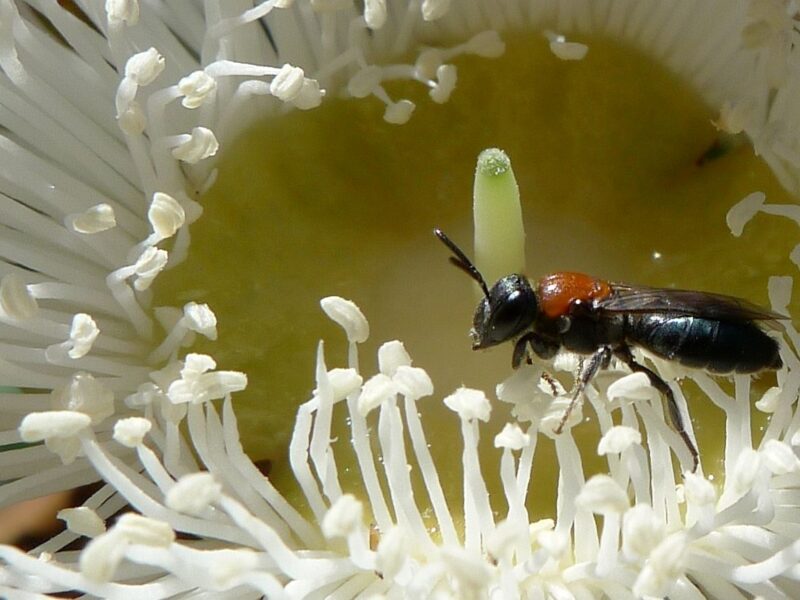
(CN) — Australia’s slender-stem-nesting native bees face the greatest near-term risk from rising temperatures, even though they have evolved the highest heat tolerances among their peers, according to the authors of a comprehensive new study.
Researchers tested the critical thermal maximum temperature at which bees lose coordinated movement in 95 native bee species collected across eastern Australia, from tropical northern to cooler southern latitudes. The work, involving nearly 3,500 individual bees, shows that nesting behavior strongly shapes how these essential pollinators adapt to heat, more than broad climate patterns alone.
The collaborative team from Macquarie University, University of Sydney, La Trobe University, Flinders University, University of Wollongong, University of Adelaide and University of Queensland found that stem-nesters experience the hottest nest microclimates and, despite their superior heat tolerance, end up with the narrowest buffer between what they can withstand and the temperatures they actually encounter.
In contrast, ground-nesting bees, which burrow into soil that buffers extreme heat, have evolved lower heat tolerances but enjoy greater protection in their cooler underground homes. Cavity-nesters, which burrow in wood like tree hollows, fall in between.
“Bees that nest underground can hide from extreme heat — as a result, they don’t experience temperatures as high as those that live above ground, particularly species that live in thin plant stems that offer very little insulation from the heat outside,” said lead author Carmen da Silva of Macquarie University’s Pollinator Futures Research Center, in a news release.
The study, published Monday in Nature Communications, highlights the “Bogert effect,” where behavior like choosing a nest site influences the strength of natural selection on physiological traits such as heat tolerance. Macro-scale climate data explained little variation in heat tolerance, but incorporating nest microclimate temperatures doubled the explanatory power.
Australia harbors about 1,700 native bee species, vital for wild ecosystems and crops such as macadamias, avocados, mangoes and lychees in tropical regions.
“Bees are critical in ecosystems all over the world because of their role as pollinators, and they’re under threat from warming and drying climates,” da Silva explained. “Bees sustain native ecosystems and play a crucial role in agricultural crop production.”
The research also revealed a latitudinal gradient. Tropical bees near the equator are most vulnerable overall, as they already live closer to their thermal limits.
Senior author Vanessa Kellermann of La Trobe University pointed to a key nuance: “Predicting which species will be vulnerable to climate change is one of the biggest challenges in ecology,” Kellermann said. “We found bee species with the highest heat tolerance were not necessarily the safest from warming, because many of them already live in extremely hot environments.”
Co-senior author Ros Gloag from the University of Sydney stressed the knowledge gap.
“We still know so little about most of Australia’s amazing native bees,” Gloag said. “This study helps us recognize that having a better understanding of native bee behavior is key to identifying the greatest threats to their wild populations.”
Importantly, the team ruled out major roles for body size or short-term adaptability to known changes in the environment in driving the patterns. They also demonstrated that ignoring nesting behavior flips vulnerability rankings, so ground-nesters appear most at risk when only air temperatures are considered, but stem-nesters rise to the top when realistic nest microclimates are factored in.
While all bees forage outside their nests and will feel longer-term climate impacts, the authors say near-term conservation priorities should focus on stem-nesters, whose limited margin of error for how much heat they can stand leaves them with the least capacity to escape unfavorable conditions in the coming decades.
 Follow @gabetynes
Subscribe to our free newsletters
Our weekly newsletter Closing Arguments offers the latest about ongoing trials, major litigation and rulings in courthouses around the U.S. and the world, while the monthly Under the Lights dishes the legal dirt from Hollywood, sports, Big Tech and the arts.
Additional Reads
 Scientists rethink how much carbon forests can store June 12, 2026