
 Search Articles


BUENOS AIRES (CN) — It was a startling Saturday morning as the world woke up to hear the news of Venezuela’s Nicolás Maduro’s deposition in an unprecedented land operation that included air strikes and the extraction of the country’s president and his wife from their residency into U.S. warships that transported them to be tried in New York.
“We’re gonna run the country,” President Donald Trump said at a press conference at 11 a.m. from Mar-a-Lago. “Until we can do a safe, proper and judicious transition.”
Trump framed the intervention as both a security operation and an economic reconstruction effort, explicitly linking Venezuela’s future to U.S. corporate investment and oversight.
“We’re going to have our very large United States oil companies spend billions of dollars, fix the oil infrastructure, and start making money for the country,” he said.
Venezuela holds the world’s largest proven oil reserves — about 303 billion barrels — giving it long-term potential as a stabilizing force in global energy markets and making it strategically important to the United States, China, Russia and OPEC.
Maduro, the country’s authoritarian leader, was seized by Delta Forces alongside his wife, Cilia Flores. U.S. Attorney General Pamela Bondi released a statement saying the pair had been indicted in the Southern District of New York on charges including narcoterrorism and cocaine importation conspiracies, possession of machine guns and destructive devices, and conspiracy to possess machine guns and destructive devices against the United States, adding they would face justice in the U.S.
The charges echo accusations made during Trump’s first presidency, but mark the first time Maduro has been taken into U.S. custody.
It was the first U.S. bombing of a Latin American city in 36 years; the last, in Panama in 1989, ousted military leader Manuel Noriega. That invasion remains one of the region’s most controversial U.S. military actions and continues to shape views of U.S. interventionism.
The events followed months of escalating military pressure after Trump accused Maduro of leading Cartel de los Soles, a group designated as a “foreign terrorist organization” in late 2025, and of funneling drugs into the United States, worsening the nation’s drug abuse epidemic.
More recently, Trump offered additional justifications, claiming Venezuela’s oil reserves were “stolen” from American companies and accusing the socialist government of illegally seizing infrastructure built by U.S. firms such as ExxonMobil and ConocoPhillips. He demanded the “return” of those assets as a condition for a leadership transition.
In the weeks leading up to the operation, the administration pursued a strategy that included a naval blockade and the seizure of “dark fleet” tankers, with Trump suggesting the oil could replenish the U.S. Strategic Petroleum Reserve. The measures effectively cut Venezuela off from most global oil markets even before military action began.
“This was one of the most stunning, effective and powerful displays of American military might and competence in American history,” Trump said. He offered no indication of civilian casualties or damage in his statement.
Martín Schapiro, a foreign policy analyst, deemed today’s events unprecedented. “The consequences are still hard to outline,” he said. “It’s unclear what will happen in Venezuela.”
During his press conference, Trump unexpectedly discarded María Corina Machado, opposition leader and Nobel Peace Prize winner, as the one to lead the regime change in Venezuela. Instead, he said Delcy Rodríguez, currently Maduro’s vice president, was in contact with U.S. Secretary of State Marco Rubio to discuss the power transition.
Schapiro said Trump is unlikely to face strong global resistance. “The United States have proved they can operate freely in the region,” he said. “There are no political limits.”
Had this happened in another time, he said, international organizations and Latin American leaders may have responded collectively. Now, the region is showing weakness to stand up in the face of the U.S. government.
The operations began around 2 a.m. Caracas time, with explosions reported across the capital and other parts of the country. Social media posts showed Venezuelans reacting with shock and fear as blasts hit areas near federal buildings and military installations.
“I watched it like it was a TV show,” Trump said in an interview, adding that he followed the intervention remotely minute by minute. “It’s really amazing.”
Several subway stations and shops remained closed throughout the day after the attacks, though media reports showed mixed public reactions, with some people protesting and others celebrating.
The international response to Saturday’s U.S. military strikes was divided, with global powers split over the legality of the intervention and the capture of Maduro. Russia and China condemned the operation as a violation of international law and an act of armed aggression, while the U.S. defended the strikes as necessary to dismantle a “criminal regime.”
In Latin America, reactions largely followed ideological lines. Brazilian President Luiz Inácio Lula da Silva criticized the “unilateral use of force” and warned of regional instability, while Argentine President Javier Milei praised the intervention as a victory for democracy. Officials from the European Union called for immediate de-escalation and urged a transition of power consistent with the United Nations Charter.
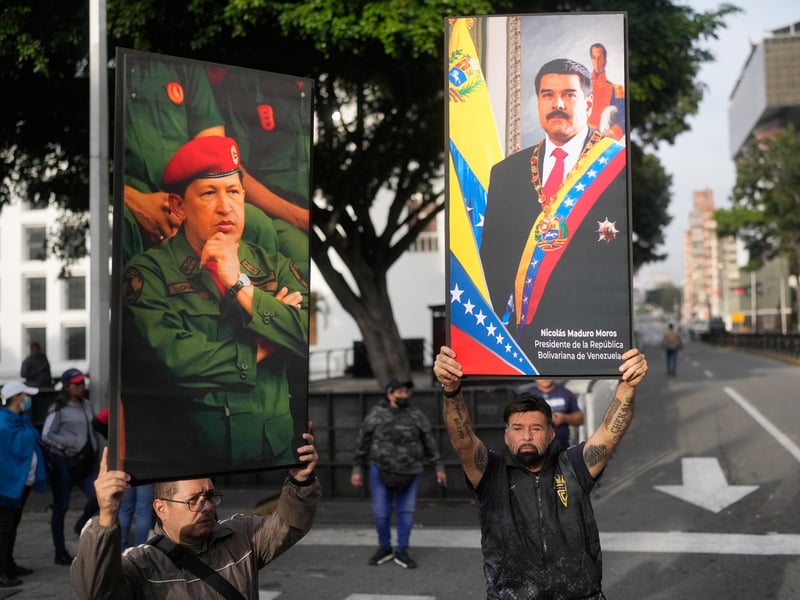
Maduro, 63, a former union leader, has ruled Venezuela since Hugo Chávez’s death in 2013. Their movement, in power since 1999, promised a “Bolivarian revolution” inspired by the Latin American libertador but gradually lost legitimacy amid economic collapse, growing authoritarianism, soaring inflation, shortages and mass emigration.
Ahead of the July 2024 presidential election, opposition candidates led polls, raising the prospect of an end to the Chavista process. Maduro nevertheless claimed victory over opposition challenger Edmundo González Urrutia, without producing ballots or evidence to substantiate the result. International observers declined to recognize the outcome.
The disputed election eroded Maduro’s regional support, including from leaders such as Brazil’s Lula and Chile’s Gabriel Boric, who urged a return to the democratic track. Since then, watchdog organizations say the government has intensified repression, including illegal detentions and disappearances, with human rights organizations reporting a sharp increase in political prisoners.
More than a quarter of Venezuelans now live abroad for political or economic reasons. The rapid growth of Venezuelan communities in neighboring countries, the United States and parts of Europe has evolved into a broader migratory crisis, reshaping political debates over migration across the Americas.
After Saturday’s attacks on Caracas, thousands gathered in cities including Buenos Aires, Santiago and Madrid, expressing hope that a regime change would improve the situation in their countries. Many Venezuelan expatriates voiced cautious optimism, tempered by fears of further instability.
Stability inside Venezuela remains uncertain. Gustavo Petro, Colombia’s president and one of Maduro’s few allies in Latin America, said Colombia would deploy troops along its border with Venezuela and expand refugee programs, anticipating a possible surge in displacement if violence escalates.
Although Trump said the U.S. doesn’t plan to strike Venezuela again in the short term, he did warn the country had the resources to do so.
“All political and military figures in Venezuela should understand that what happened to Maduro could happen to them — and it will happen to them if they aren’t just, fair, even to their people,” he said.
Lucía Cholakian Herrera is a Courthouse News correspondent based in Buenos Aires, Argentina.
 Follow @luciacholakian
Subscribe to our free newsletters
Our weekly newsletter Closing Arguments offers the latest about ongoing trials, major litigation and rulings in courthouses around the U.S. and the world, while the monthly Under the Lights dishes the legal dirt from Hollywood, sports, Big Tech and the arts.