
 Search Articles


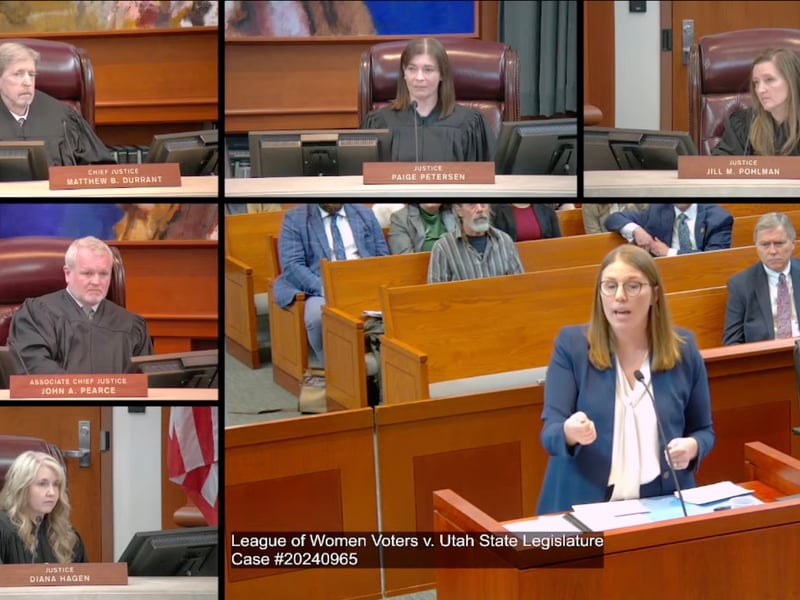
(CN) — The Utah Supreme Court on Wednesday took up a trial judge’s injunction of a constitutional amendment put on the November ballot by the state’s Legislature that would give lawmakers unlimited power to alter or veto voter-approved ballot initiatives.
The Utah Legislature is appealing a ruling issued earlier this month by Judge Dianna Gibson of the Third District Court in Salt Lake City, who found that the ballot summary language of Amendment D is “counterfactual” because, while it tells voters the amendment strengthens the initiative process, it in fact curtails citizens’ ability to alter and amend state laws through ballot initiatives.
Gibson had also concluded that the Legislature had failed to publish the full text of the amendment in a newspaper for two months prior to the November 5 election, as required by the state’s constitution, and ruled that the amendment was void and no votes for it should be counted.
The five-judge court didn’t indicate whether they will vacate the injunction, but they expressed some reservations about the Legislature’s argument that votes for the amendment should be counted notwithstanding any shortcomings of the summary language used to describe it on the ballot.
“It’s not contrary to the amendment itself, and no reasonable voter would think that it is given all surrounding circumstances,” Taylor Meehan, an attorney representing the Legislature told the court during the more than three-hour hearing. “An amendment can be lawfully submitted to the voters without a ballot summary at all.”
Although a ballot summary can’t be completely counterfactual, Meehan argued, it isn’t meant to educate voters but to inform them what the issue is they’re asked to vote on.
That line of reasoning didn’t appear to persuade the court, however.
“Since 1900, almost 125 years, the people of Utah have had the right to alter or reform their government through an initiative,” Justice Paige Petersen observed. “And the consequence of these amendments will be to subject a successful citizen initiative that reforms the government to a veto by the Legislature.”
“Where does the ballot summary tell people that?” Petersen asked Meehan. “Does it have to tell people about the actual change to the constitution?”
In relevant part, the certified ballot language for Amendment D reads “should the Utah Constitution be changed to strengthen the initiative process by … clarifying the voters and legislative bodies’ ability to amend laws.”
“Can you point me to a dictionary definition of ‘clarify’ that would put someone on notice that by clarifying you are working a substantive change to the existing scenario?” Associate Chief Justice John Pearce asked the Legislature’s lawyer. “Is there a definition of ‘clarify’ that suggests a substantive modification?”
A reasonable intelligent voter, Meehan responded, won’t look just at the ballot summary but will look also at the voter information pamphlet where they can find the full text of the amendment as well as arguments of both the proponents and opponents of the amendment.
The overwhelmingly Republican state Legislature called a special session last month to put together the constitutional amendment after the Utah Supreme Court had ruled against them in July 2024 in a long-running lawsuit brought by the League of Women Voters of Utah and the Mormon Women for Ethical Government over a 2020 state law that had repealed a voter-approved ballot initiative banning partisan gerrymandering.
The Utah Supreme Court ruled then that the right to alter or reform the state government through a ballot initiative was a fundamental constitutional right that the Legislature couldn’t ignore, prompting lawmakers to introduced Amendment D in an effort to undermine the court’s decision.
“The central feature of Amendment D is that the Legislature has unfettered power under the amendment to repeal any initiative that voters pass,” Mark Gaber, an attorney representing the League of Women Voters told the court Wednesday. “You don’t see the word ‘repeal’ anywhere on the ballot summary, but that is the key power that the Legislature is transferring to itself — to simply throw out whatever voters pass.”
The standoff between voters’ rights groups and the Legislature dates back to 2018 when Utahns passed a bipartisan initiative, Proposition 4, also known as “Better Boundaries,” which created the Utah Independent Redistricting Commission and banned partisan gerrymandering.
Two years later, the state’s Legislature replaced the proposition with a new law that, the voters’ rights advocates claim, gutted its key redistricting reforms and enacted a congressional map that was an extreme partisan gerrymander, prompting the lawsuit by the two voters’ groups.
 Follow @edpettersson
Subscribe to our free newsletters
Our weekly newsletter Closing Arguments offers the latest about ongoing trials, major litigation and rulings in courthouses around the U.S. and the world, while the monthly Under the Lights dishes the legal dirt from Hollywood, sports, Big Tech and the arts.