
 Search Articles


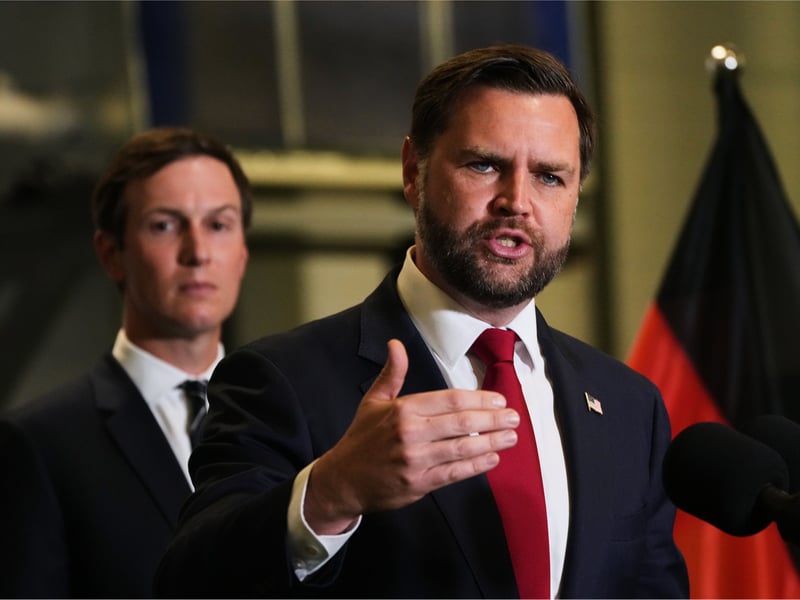
WASHINGTON (CN) — Speculation over Vice President JD Vance’s potential 2028 presidential run got air time at the Supreme Court on Tuesday as the justices considered striking down restrictions on campaign spending between political parties and candidates.
Vance’s hypothetical future campaign would validate a Republican challenge to campaign finance regulations aimed at inhibiting quid pro quo corruption. But the vice president’s public waffling on the subject left the justices to ponder whether their intervention was necessary at all.
“With respect to the vice president, what does he mean when he says that it was way too early to decide whether or not to run?” Justice Clarence Thomas, a George H.W. Bush appointee, asked.
While running for Senate in 2022, then-Senator Vance initiated the challenge to campaign contribution limits that political parties can spend in coordination with a candidate. Two Republican Party committees and former Representative Steve Chabot joined him.
Vance said that he has tried to steer away from the 2028 conversation in favor of focusing on his current role.
“It’s something that could happen. It’s something that might not happen,” Vance told NBC News in a recent interview.
Republicans were singing a different tune at the Supreme Court Monday, suggesting that Vance had concrete plans to run in 2028.
“We know that virtually every vice president goes on to run for the presidency — particularly young ones like Vice President Vance,” Noel Francisco, an attorney with Jones Day representing the Republicans, said. “This court doesn’t have to blind itself to the reality that’s obvious to everybody else.”
The vice president’s office did not respond to a request for comment following oral arguments.
The Trump administration vowed not to enforce the challenged regulation, which Roman Martinez, an attorney from Latham & Watkins, said added to the list of reasons why the justices should decide not to decide this case.
“This poses a really interesting and important question for the court, which is, are you going to be in the business of second-guessing the public statements of politicians and plaintiffs when they’re telling you essentially that they don’t have standing or that their case has become moot?” Martinez asked.
Martinez is a seasoned advocate who the Supreme Court appointed to defend the statute after the federal government refused to do so. Martinez has argued 15 cases before the high court, securing wins in consequential disputes such as Loper Bright v. Raimondo.
Vance’s electoral prospects were just the tip of the political iceberg during the two hour argument session probing the influence of money on politics, including a jab at President Donald Trump’s relationship with SpaceX billionaire and former DOGE head Elon Musk.
“You mean to suggest that the fact that the most major donor to the current president got a very lucrative job immediately upon election from the new administration does not give the appearance of a quid pro?” Justice Sonia Sotomayor, a Barack Obama appointee, asked.
Throughout the argument, Justice Brett Kavanaugh, a Trump appointee, repeatedly asked how the high court could assist increasingly marginalized political parties.
“I am concerned that the combination of campaign finance laws and this court’s decisions over the years have together reduced the power of political parties as compared to outside groups with negative effects on our constitutional democracy,” Kavanaugh remarked.
Since the Supreme Court’s landmark Citizens United v. FEC decision in 2010, independent expenditure-only political action committees, better known as super PACs, have allowed wealthy individuals to contribute vast sums to their preferred candidates or policy preferences. Subsequent rulings struck down aggregate limits for individuals to donate funds to campaigns in McCutcheon v. FEC in 2014, and caps on post-election contributions used to pay back candidates for personal loans made to their own campaigns in FEC v. Ted Cruz for Senate in 2022.
The Federal Election Campaign Act, or FECA, sets limits on donations to political candidates to counter quid pro quo corruption. This includes cash payments and expenditure contributions such as payments directly for advertisements.
Federal law regulates individual and political committee donations to prevent end runs around contribution limits. The national committee of a political party — the Republican National Committee and the Democratic National Committee — are exempt from the standard donation limits of $3,500 per election per candidate and $5,000 per year to any other political committee. Instead, donors can give party committees up to $44,300.
The RNC and DNC also get a special exemption allowing the parties to make expenditures in connection with the general election campaign of a candidate for federal office. Under this provision, the national committees can spend over $32 million for presidential campaigns, around $127,200 on Senate campaigns and $63,600 for most House campaigns.
But Sotomayor noted that the Supreme Court’s decisions gave donors loopholes. She said that in 2016 Hillary Clinton’s joint victory fund with the DNC and 32 state parties allowed a single donor to give up to $356,000. Last year, Sotomayor said, Trump’s joint fundraising operation with his own leadership PAC, the RNC and 40 state committees asked for donations up to $814,600.
Because of the disclosure requirements, Sotomayor said, Trump knows exactly who gave him all that money, but clarified, “I’m not picking on Donald Trump.”
“Every time we interfere with the congressional design we make matters worse,” Sotomayor said.
Noting the “unfairly maligned” Citizens United decision, Justice Samuel Alito, a George W. Bush appointee, tried to define the winners and losers if the high court undercut campaign contribution limits that political parties can spend in coordination with a candidate, known as coordinated expenditures.
“Who is helped and who is hurt by the provision that is before us?” Alito asked.
Republicans argued that tossing the spending cap would restore political parties to a position of power. That claim came under scrutiny, however, since Democrats were arguing in opposition to the GOP case.
Without the restriction, Marc Elias, an Elias Law Group attorney representing the DNC, said that political parties would become bill payers, instead of party-building activities like registering people to vote.
“Look, if this court wants to enact new rules that benefit parties, I’ve got a long list,” Elias said, getting a laugh from the justices. “But it would not even be on the list to strike down the limits on coordinated-party expenditures.”
The liberal justices seemed in favor of the DNC’s arguments, fearing that knocking down the regulation would tear down one of the remaining barriers to quid pro quo corruption. Justice Elena Kagan, an Obama appointee, appeared less than impressed with Republicans’ claims that inserting political parties as a middle man between donors and candidates negated bribery schemes.
“Boy, you are assuming a lot there about people’s, honestly, dumbness,” Kagan said. “I mean, everybody knows where the money is coming from when it’s done this way. So the fact that I have a party as a conduit … it’s not hard to figure out where the money is coming from.”
The conservative majority seemed to align with Republicans argument, however, appearing skeptical that tossing the regulation would benefit one party more than the other.
“Normally, regulated parties are happy to get rid of regulation,” said Justice Amy Coney Barrett, a Trump appointee. “And, obviously, this ties the DNC’s hands just as much as it ties the RNC’s hands.”
Along with Vance and Chabot, the National Republican Senatorial Committee, NRSC, and the National Republican Congressional Committee, NRCC, claim the spending caps are a restriction on speech, violating the First Amendment. The committees argued that Congress enacted spending caps to reduce excessive campaign spending, not to stave off quid pro quo corruption.
Alito said that heightened scrutiny review was made to ferret out the true motivations of a statute, regardless of the asserted reasons for the provision.
“If we look at all of the limitations and the restrictions and the variable limits, how can the provision satisfy any sort of heightened scrutiny?” Alito asked. “And does that cause reason for legitimate skepticism about whether this is about circumvention at all as opposed to other things like favoring incumbents, favoring major parties, et cetera?”
Even without the coordinated expenditure spending caps, Francisco said other barriers to corruption were still in place, such as disclosures, earmarks and bribery laws. However, he would not foreclose future challenges on remaining regulations.
“I am not going to say that my clients are not going to come back and try to challenge other limitations,” Francisco said. “I think it’s well known that we have discomfort with different parts of the campaign finance laws.”
Martinez warned the justices that this set up “bait-and-switch 2.0.”
“This wolf comes as a wolf,” Martinez said. “He has basically told you that they’re going to keep litigating to knock down every single one of the restrictions, and that includes the limits on donors to candidates directly.”
 Follow @KelseyReichmann
 Follow @kelseyreichmann.bsky.social
Subscribe to our free newsletters
Our weekly newsletter Closing Arguments offers the latest about ongoing trials, major litigation and rulings in courthouses around the U.S. and the world, while the monthly Under the Lights dishes the legal dirt from Hollywood, sports, Big Tech and the arts.