
 Search Articles


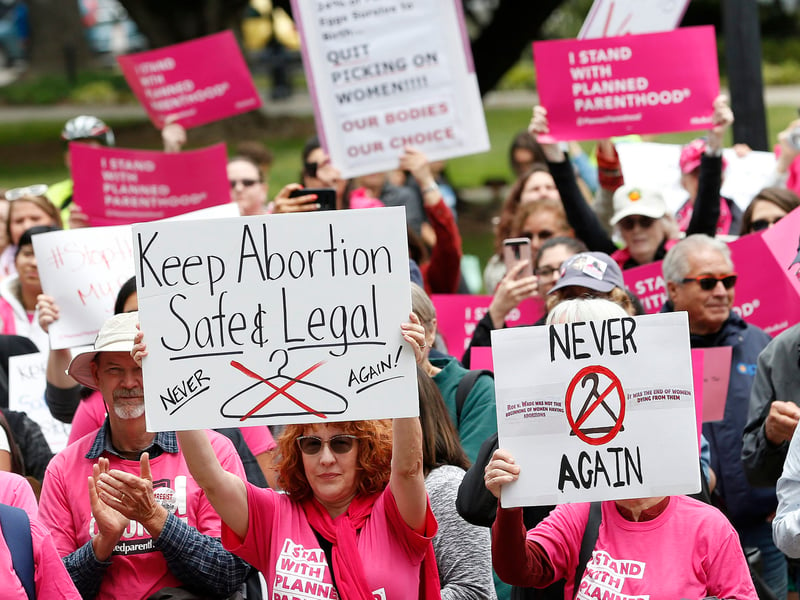
RICHMOND, Va. (CN) — Virginia’s House of Delegates’ Privileges and Elections Committee — a Democratic-controlled committee in Virginia’s General Assembly — held an out-of-session meeting on Wednesday culminating in a vote to advance a trio of controversial amendments.
The three amendments would guarantee Virginians’ right to abortion care, automatically restore voting rights to disenfranchised felons and remove an antiquated law banning same-sex marriage.
The General Assembly continued the measures from last spring’s session after laying them on the table. Now, all three measures have passed the initial hurdle and will go through the bill process in 2025.
In two sessions, the General Assembly must pass the resolutions to change the state’s Constitution. Should the amendments pass in 2025 and 2026, voters will have their say during the 2026 election.
Republicans criticized the last-minute meeting as an attempt to legislate in the dark. Usually, a bill’s first committee meeting occurs during the session, giving the public plenty of time to express their opinions.
“These are big emotional topics, and the Constitution is a big, important document,” Republican Delegate Israel O’Quinn told the committee. “This is something that I personally believe should be done in full session when everyone’s paying attention.”
But Virginia Democrats are anxious to pass progressive measures while they have the majority in the General Assembly.
Committee Chair Marcia “Cia” Price insisted that these aren’t new issues the committee is debating for the first time.
“These are not new topics,” Price told O’Quinn. “We have tried to pass measures like this before, so in whichever way people want to cut it, I do want everyone to leave with the understanding that we are well within the rules.”
The measures still need to be passed before the public can vote. The General Assembly begins its 2025 session in January.
Abortion rights
Dozens lined up on both sides to express their support or opposition to an amendment — introduced by Democrat Delegate Charniele Herring — that would grant Virginians reproductive rights, including the ability to make and carry out decisions relating to one’s own prenatal care, childbirth, postpartum care, contraception, abortion care, miscarriage management and fertility care.
Virginia currently has no bans on abortion.
“If autonomy, freedom and privacy mean anything to this committee, they would ensure that conscience is permitted and protected as stated,” psychiatrist Dennis Petrocelli said in opposition. “Calling these things rights suggests that physicians and other providers could be held to do things that their conscience would prohibit.”
The measure passed on a partisan 12 to 9 vote, prompting a loud groan from half of the audience.
Voting rights
Virginia is one of three states whose Constitution permanently disenfranchises citizens with past felony convictions but grants the state’s governor the authority to restore voting rights.
Democrat Delegate Elizabeth Bennet-Parker introduced the amendment that would automatically restore voting rights after felons serve their sentence.
More than one in seven Black Virginia men lack voting rights. Rich Walker, founder and executive director of Bridging The Gap, spoke on Virginia’s history of voter suppression.
“These individuals know that our forefathers fought and were bloodied and beaten to have the right to vote,” Walker said. “This adversely affects primarily minority African American men, and it’s high time for this piece of legislation, for this constitutional amendment to go through.”
Some Republicans quibbled with whether felons that judges order to pay restitution to the victim rather than serving time in incarceration should be able to vote before completing the payment. Bennett-Parker called that a poll tax.
“I would say that denying the right to vote based on the ability to pay creates a modern-day poll tax,” Bennett-Parker said. “The right to vote should be fundamental and should not be subject to financial barriers.”
Some who question the state’s election integrity opposed the amendment. The bill passed on a partisan 12 to 9 vote.
“This is so pro-criminal,” Hanover County resident Kristen Holte told the committee. “Society has become so concerned about criminals these days and not about the victims.”
Marriage equality
An amendment repealing constitutional language defining marriage as only a union between one man and one woman — and the related provisions that are no longer valid as a result of the United States Supreme Court’s 2015 decision in Obergefell v. Hodges — passed 16 to 5, with four Republicans joining the Democrats.
Some members of the public expressed concern that the amendment introduced by Democrat Delegate Mark Sickles could lead to expanded marriage rights for those in polygamous relationships. Christians and conservatives also took issue with the use of the word gender rather than sex.
“For the first time in Virginia’s Constitution, sex and gender would be separated as two distinct categories,” Todd Gathje of the Family Foundation said. “This would enshrine the concepts of gender identity or transgenderism into the Constitution. This language can then be used to elevate gender, to protect the status in other contexts.”
Narissa Rahaman, the executive director of the LGBTQ+ organization Equality Virginia, told the committee that Wednesday was her and her wife’s sixth anniversary. According to Rahaman, Virginia has roughly 20,000 married LGBTQ+ couples.
“There are folks here in this room who don’t yet believe in the joyous right of marriage equality, but when I look at their marriage, and the marriages of those 20,000 couples, including mine, I see more similarities than differences,” Rahaman said. “We’ve all experienced special days and anniversaries that not only make a marriage but also make a lifetime.”
Subscribe to our free newsletters
Our weekly newsletter Closing Arguments offers the latest about ongoing trials, major litigation and rulings in courthouses around the U.S. and the world, while the monthly Under the Lights dishes the legal dirt from Hollywood, sports, Big Tech and the arts.