
 Search Articles


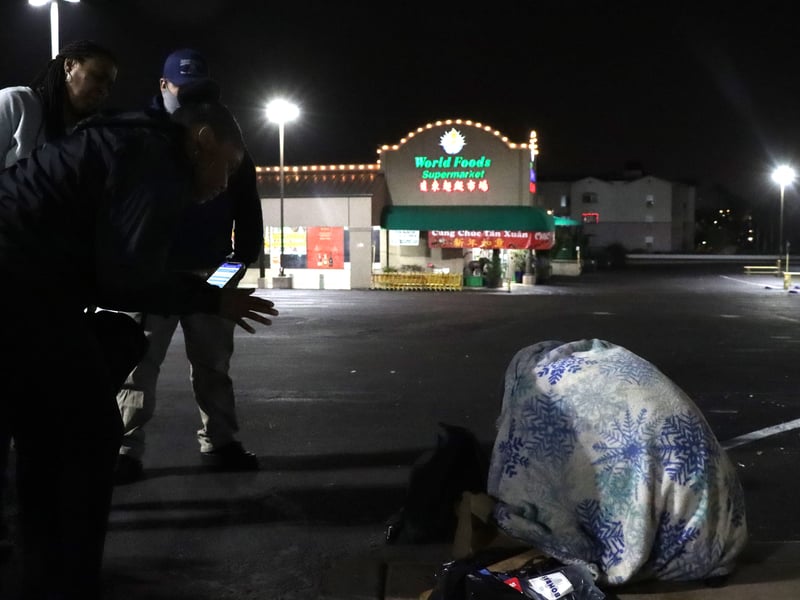
SAN DIEGO (CN) — It’s 5 a.m., before most lights are on in the neighborhood, but a trio of volunteers have been snaking up and down the strip malls and alleyways of San Diego’s Talmadge community for over an hour, looking for people to ask them some important questions.
As they slowly make their way through an alley they spot someone in the shadows between two buildings. They approach and see the man is naked, trying to wash himself with a bucket of water.
Brandon Salinas asks first in English, then Spanish, if the man can put some clothes on and talk to them. The man obliges, then the questions start.
What’s your name? Have you served in the United States Armed Services? How long have you been homeless this time?
He said his name is Manuel Jean, and he’s been homeless since migrating to San Diego from Haiti two months ago. He came for a better life, he said, but so far he doesn’t have any money and doesn’t know anybody in town.
The volunteers hand him a pack of mini toiletries, a pair of socks, and a small gift card for answering their questions. Jean dips back into the shadows, and the volunteers move on to find more people to talk to.
Salinas is one of 1,600 people in San Diego County, and countless more across the country, who signed up to take either a 4 to 8 a.m. or a 6:30 to 9 p.m. shift on Thursday to count and survey local sheltered and unsheltered homeless populations for the U.S. Department of Housing and Urban Development’s annual point-in-time count.
HUD requires local and state governments that receive federal funds for homeless programs to conduct the count.
In 2023, volunteers found 10,264 people experiencing homelessness in San Diego County, a 14% increase from the previous year. Across the U.S., more than 650,000 people experienced homelessness last year, a 12% increase from 2022.
When volunteers met at a YMCA facility between 3:30 and 3:45 a.m. they were split into small groups, given a handful of mini-toiletry bags, socks, and gift cards, an app with survey questions, and a map with a census tract to look for people in.
When Elizabeth Tate got her group’s map she said she was a little hesitant, describing the area as akin to the sister of Beverly Hills.
For the previous decade Tate has participated in the annual count. Usually, though, she gets the tract that requires trekking through the city’s canyons looking for homeless encampments, she said.
After rolling past a 7-11 blaring opera music to annoy people away from sleeping next to the shop, parking lots with glaringly bright lights, and even a local volunteer patrol car that looked like a police vehicle stopped in a residential street, Tate’s prognosis seemed to be correct.
But after passing by a seemingly empty strip mall, the group spotted what at first looked like a bundle of clothes in front of a laundromat, but on closer inspection turned out to be a man sleeping perilously close to the edge of a sidewalk.
“Hey, how’s it going boss? Good morning,” Salinas said, barely after 4 a.m.
The man, who gave his name as B.S., answered volunteer Ghina Perez’s questions, rarely making eye contact.
“Thank you for allowing us to disturb your rest,” Tate said as the group drove away.
Minutes after passing an empty bakery parking lot, the group returned to see a man curled up on the ground, his face buried in a yellow jacket.
As Take and Perez tried to talk to him, he kept his face buried in his jacket, refusing to answer.
“Just get the fuck away from me,” he said.
The group backed away and continued on their way, meeting a woman in a tent next to an auto repair shop who said she’s waiting for municipal services to get her some sort of housing or support.
Tate convinced the group to go back to the man in the yellow jacket. She offered to buy him a ham and cheese croissant and a coffee at the bakery and he agreed, and began to answer some of Perez’s questions.
“I love to be involved,” Perez said back at the YMCA at the end of her shift. This year was her first time being involved in the count. She had participated in community efforts to feed local homeless people, but that ended when first the county passed a short-lived ban on sharing food in parks in 2017 during a hepatitis A outbreak, and then in 2019 the state Assembly passed a bill requiring charities to provide handwashing stations and other facilities.
She said participating made her feel like she was staying connected to the community, and that she hopes the data she helped collect has value, and that it actually will be tied to funding for services for people in need.
Subscribe to our free newsletters
Our weekly newsletter Closing Arguments offers the latest about ongoing trials, major litigation and rulings in courthouses around the U.S. and the world, while the monthly Under the Lights dishes the legal dirt from Hollywood, sports, Big Tech and the arts.