
 Search Articles


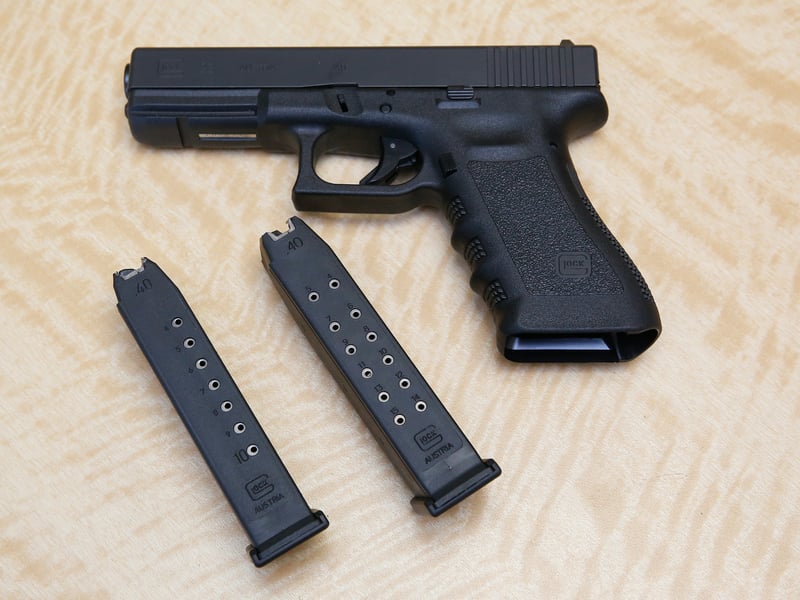
OLYMPIA, Wash. (CN) — A Washington law restricting the sale of high-capacity firearm magazines is under review in the state’s highest court as a gun store argues the restriction impedes the Second Amendment right to bear arms to defend oneself.
In late 2023, Washington Attorney General Bob Ferguson sued Gator’s Custom Guns, a gun shop in the southwest city Kelso, and its owner Walter Wentz for continuing to sell high-capacity magazines after Senate Bill 5078 went into effect restricting the sale, import and manufacture of magazines that can accept more than 10 rounds of ammunition.
The Cowlitz County Superior Court sided with the gun shop in April 2024 and declared the bill facially unconstitutional.
On appeal, the state argues that the lower court incorrectly interpreted the constitution, and that by granting protections to magazines, anything from battery acid to baseball bats could be deemed weapons subject to Second Amendment protections.
“If you think about the contrary rule that the other side is proposing, it quickly leads to absurd consequences,” Noah Purcell, Washington state solicitor general, told the Washington Supreme Court on Tuesday morning.
Purcell argued that large capacity magazines are not integral to the function of a firearm and don’t implicate the right to self-defense — scenarios that often see at most two or three shots fired.
“A ban on triggers, for example, would clearly impair the right to self-defense because you couldn’t use virtually any firearm,” Purcell said. “A ban on large-capacity magazines has no such impact because the other side has conceded that every single firearm will operate exactly as intended with an ordinary magazine.”
Further, Purcell argued, there’s a danger in allowing high-capacity magazines in the state.
“The record in this case is full of evidence that large-capacity magazines are not necessary for self-defense and are routinely used in mass shootings, and that this law will have virtually no impact on self-defense and will improve public safety,” he said.
In its own arguments, Gator’s Custom Guns pointed to the popularity of high-capacity magazines.
“The simple fact that citizens of the nation and the state have overwhelmingly chosen magazines of capacity more than 10 rounds necessarily leads to the conclusion that they are used for self-defense, they’re used for lawful purposes,” said Austin Hatcher, an attorney for the gun store.
Justice Raquel Montoya-Lewis pushed back on Hatcher’s assertion that high-capacity magazines should be protected as arms because they are integral components of firearms. She questioned whether any firearms require large-capacity magazines to function.
Hatcher conceded that the magazine capacity doesn’t impact functionality but argued magazines should still be considered firearms.
“There’s no principled basis in which the state can answer that a certain amount of rounds is suddenly an arm, whereas above that, is not an arm,” Hatcher said.
The attorney argued that the abundance of large-capacity magazines shouldn’t be discounted in the court’s consideration.
“This is simply a commonly owned arm magazine,” he said. “They’re owned in the tens, if not hundreds, of millions throughout the country, and they are central to the functioning of the most popular type of weapon platform, the AR-15 specifically.”
To the state, the bill simply follows historical precedent of regulating and restricting dangerous weapons.
“That’s exactly what states are doing now with large-capacity magazines. It’s what they did with machine guns, it’s what they did with Bowie knives, it’s what they did with clubs and trap guns,” Purcell said.
To the gun store, previous weapon restrictions are not analogous to the restriction at hand.
“There is no historical tradition of regulating the amount of rounds held by a weapon,” Hatcher said.
On rebuttal, Justice Montoya-Lewis questioned the state about its opposition to the danger posed by large-capacity magazines.
“If they are banned or regulated because they kill, doesn’t that conflict with the basic rule of self-defense that if you draw a gun, you have to be willing to kill the person that you’re pointing it at?” Montoya-Lewis asked.
“The point is not that they can kill people,” Purcell said. “It’s that they can kill a lot of people very quickly, and that is why large-capacity magazines are different and why states have routinely regulated them.”
The court did not indicate when it would rule.
Subscribe to our free newsletters
Our weekly newsletter Closing Arguments offers the latest about ongoing trials, major litigation and rulings in courthouses around the U.S. and the world, while the monthly Under the Lights dishes the legal dirt from Hollywood, sports, Big Tech and the arts.