Search Articles


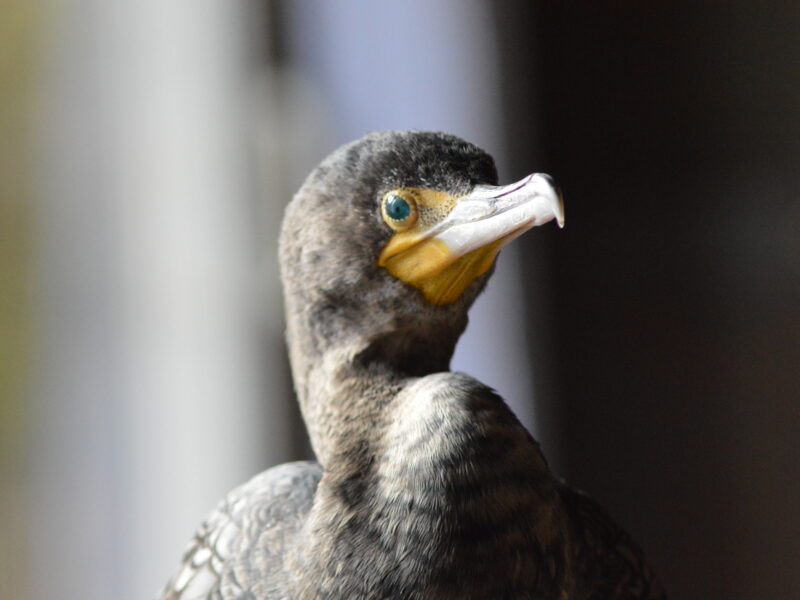
ASTORIA, Ore. (CN) — At first glance, Cormie doesn’t look like the type of bird at the center of a regional controversy.
Standing little more than a foot tall, she’s sleek and dark-feathered with arresting, glassy blue eyes. Found injured in a parking lot after likely being abducted by a predator, Cormie was rescued and rehabilitated, eventually becoming a permanent resident at the Wildlife Center of the North Coast in Astoria, Oregon.
These days, Cormie spends much of her time playing and eating. When she dives into her pool, she does so with confidence, vanishing beneath the surface before reappearing with her chosen prey: a marker, a spatula, a carefully hidden toy.
She goes on occasional field trips to teach schoolchildren about conservation and native species, including double-crested cormorants like her, which are endemic to both coasts of North and Central America. It’s a charmed life, and one that leaves Cormie blissfully unaware of the drama swirling around her wild counterparts — a complex ecological conflict involving endangered fish, hydroelectric power, federal law and the cascading impacts of human intervention in the Pacific Northwest.
The controversy starts in an unlikely place: a shifting island of dredged soil near the mouth of the Columbia River.
For decades, the 62-acre East Sand Island hosted a thriving seabird habitat. By 2013, this humanmade island had more than 30,000 cormorants. That made it the largest cormorant breeding site in North America, with more than 40% of all West Coast specimens.
There were other major bird populations, too, including around 10,700 breeding pairs of Caspian terns — the largest gathering of these birds on the planet. More than 10,000 brown pelicans also congregated here, making it the largest post-breeding roost for that species as well.
The island was a marvel of nature, but with it came ecological problems — ones so big that they ran afoul of federal law.

Every year, the birds on East Sand Island consumed millions of migrating juvenile salmon and steelhead. These fish are protected under the Endangered Species Act, as they already face a gauntlet of threats, including warming waters, habitat loss and hydroelectric dams that disrupt migration.
The birds on East Sand Island became such prolific poachers of these vulnerable fish that the feds began to notice. In 2014, NOAA Fisheries asked the U.S. Army Corps of Engineers to reduce these impacts by shrinking the East Sand Island bird colony to no more than 5,939 breeding pairs.
A controversial management plan followed. Officials killed birds and destroyed nests. They said these moves were necessary to protect fish, but it ruffled the feathers of many bird-lovers.
But cormorants are what scientists call “habitat generalists.” They’re intelligent and adaptable, trained by evolution to seek out new food sources, escape predators and build new nesting sites if needed. Rather than being a death knell for these birds, the management plan on East Sand Island was exactly that type of challenge.
Fast forward to today, and these cormorants — while fewer in number — are arguably an even bigger threat to vulnerable migratory fish.
Although officials successfully culled the East Sand Island colony, the birds didn’t just disappear. Rather, as scientists predicted, they simply moved. More specifically, they moved upstream, where their diets now include a higher proportion of salmon and steelhead.
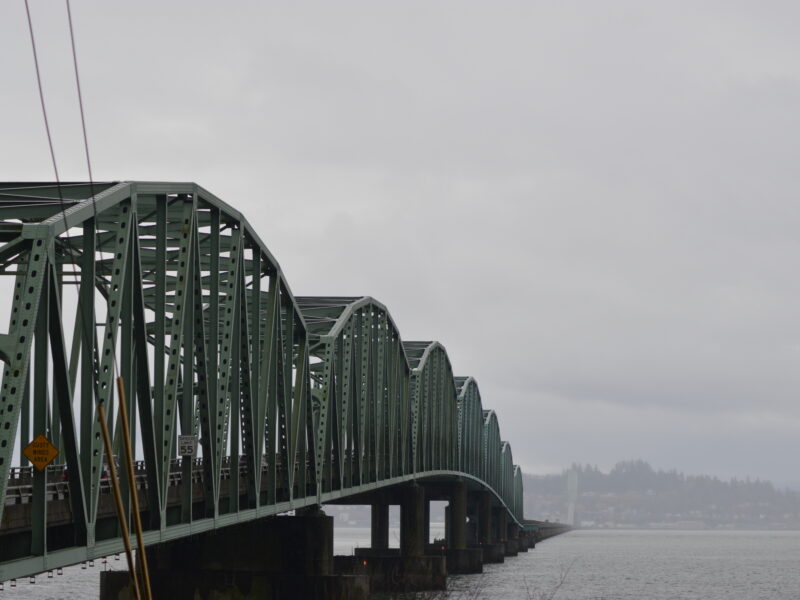
Today, as many as 10,000 double-crested cormorants live on the steel trusses of the Astoria-Megler Bridge, which spans the Columbia River between Oregon and Washington just a few miles from East Sand Island.
In some ways, the bridge is an even better nesting site. Bald eagles, one of the cormorants’ primary natural predators, almost never attack nests on large humanmade structures. Once established, cormorants exhibit strong site fidelity, returning to the same nesting locations year after year.
Drive across the bridge and one sees signs of them everywhere: nests wedged into beams, white streaks of guano degrading the metal.
All these birds create safety hazards for drivers and require seasonal cleaning crews. In late spring and summer, peak breeding and nesting season, bird bodies litter the bridge after being struck mid-flight by passing vehicles. A 2025 report from the Oregon Department of Transportation attributes a significant portion of the bridge’s current damage to the cormorant colony.
In hindsight, many see the initial East Sand Island plan as both a success and a defeat. While it achieved its objective of reducing the island’s colony, ecosystems don’t operate within the boundaries of a single island.
“That’s the dilemma,” said James Lawonn, an avian biologist with the Oregon Department of Fish and Wildlife. “If you move them, they’ll find another place that works.”
Lawonn is an expert in avian predation. He’s a key member of the informal Columbia Basin Avian Predation Work Group, one of many tribal, state, federal and regional bodies that collect data and conduct research alongside the Northwest Power and Conservation Council’s Columbia River Basin Fish and Wildlife Program.
Updated every five years, the program aims to mitigate the environmental impacts of hydrosystems — a main source of the Columbia’s conservation headaches. A 2026 draft is expected to be finalized this May.
For now, it’s back to the drawing board for wildlife officials as they race to save migratory fish and sort out what to do with these birds — and the stakes are high. While steelhead and salmon face many challenges, experts fear predation could be the tipping point that ultimately drives them to extinction. Cormorant colonies like the one on Astoria-Megler Bridge, Lawonn said, “can be what finally pushes them over the edge.”
It would be easy to cast cormorants as villains in this story: calculated, hook-billed divers, moving in unison to devour endangered baby fish.
But cormorants are not invaders. They’re a native species that has thrived in a profoundly altered landscape. And while they may be devouring lots of fish, in many ways it’s people who have created this problematic situation.
Humans have transformed the Columbia River Basin over the past century, building nearly 200 hydropower dams along the Columbia River watershed between just the 1930s and the 1970s.
There are more than 400 dams in the watershed today, creating warm, calm reservoirs where migratory fish are exposed and vulnerable. The dredging of millions of cubic meters of sediment every year has produced artificial islands, while the construction of bridges and towers has introduced further nesting sites. All of it has been a boon for predators like cormorants, creating safe homes and bountiful hunting grounds.

To monitor double-crested cormorant populations and their impacts, biologists track these birds using aerial surveys, first photographing colonies, then literally counting the birds in them.
They examine regurgitated material to analyze the birds’ diets. Tracking devices implanted in fish can let scientists know about the fate of salmon (for example, if a tracking device ends up in a cormorant stomach). Still, “we can never count every bird, pump every stomach, or measure every impact,” said Kate Self, program scientist for the Northwest Power and Conservation Council. “We rely on trends and on expert review.”
As for what will come next in the management of cormorants, there are no easy answers.
“Maybe the view needs to be more expansive, more regional,” said Patty O’Toole, director of the Northwest Power and Conservation Council’s Fish and Wildlife Division. Otherwise, “we’re just chasing them around and moving them back and forth … You apply pressure in one area, and they move. You press here, they slide over there.” But a bigger management plan would require coordination across countless local, state and federal authorities, as well as lots more money.
“This is a really complicated issue, and there are people with strong opinions on both sides,” Lawonn said. “We’ve altered the system quite a bit, and birds are exploiting that.”
One answer, Lawonn said, might be a push-pull strategy: promoting a successful, alternative colony elsewhere by creating a place cormorants would like to live.
Even so, there’s no guarantee the cormorants would move where researchers want. For example, if they were relocated to East Sand Island, Lawonn said they would likely end up back at the Astoria-Megler Bridge, either to escape bald eagles or as the colony grew. And who could blame them? In an ecology radically altered by humans, cormorants are simply a species that has adapted and thrived.
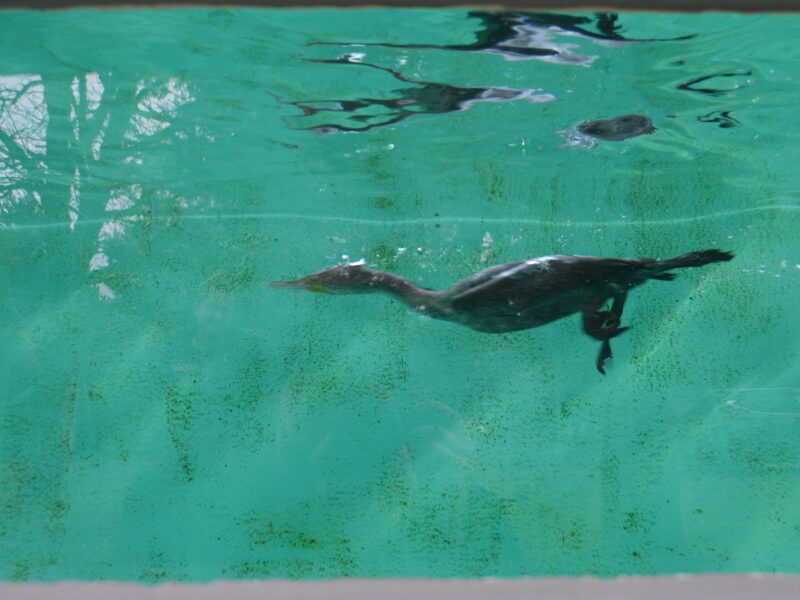
Back at the Wildlife Center of the North Coast, Cormie luckily doesn’t have to deal with these messy realities of fish conservation and river management policy. Unlike her peers, she isn’t familiar with the wild watershed that spans 258,000 square miles across Oregon, Washington, Idaho, Montana and parts of southwestern Canada.
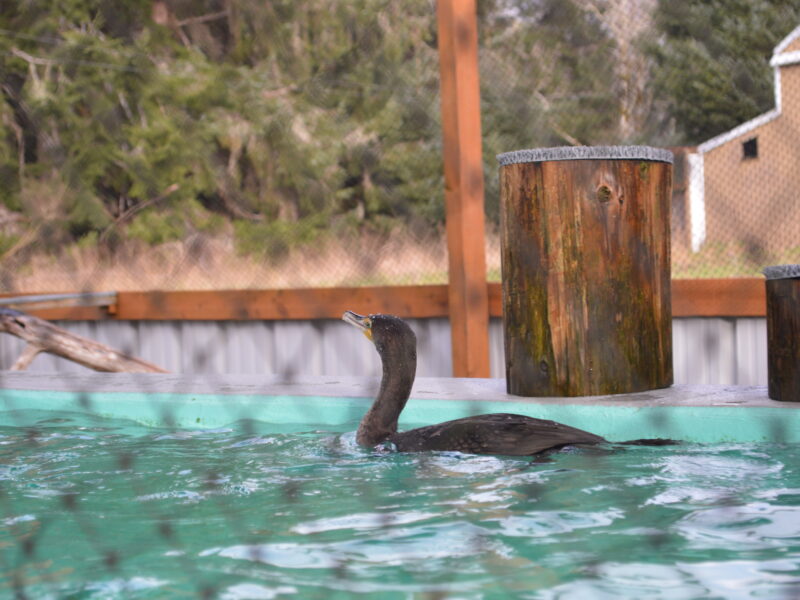
On a recent rainy spring afternoon, Cormie’s caretaker Melisa Colvin tossed paper towel tubes inside her large outdoor enclosure, which even features a sizable swimming pool. Cormie happily waddled over, flinging the toy into the air and letting out a series of prehistoric-sounding squawks. Colvin chuckled, watching the bird she raised from a chick.
“She thinks she’s the best hunter,” Colvin said. “She catches her prey 100 percent of the time.”
From afar, many may recognize cormorants as distant silhouettes: dark birds perched on pilings, their snaky heads held high with their wings spread wide to dry.
Take a closer look, and the majesty of these birds comes into focus.
“They’re beautiful,” said Rachael Orben, an Oregon State University associate professor who is an expert in seabirds. “Strikingly beautiful.”
Look closer still, and more nuance becomes apparent. After training sessions, Colvin said Cormie likes to explore her enclosure, engaging curiously with her environment. In these playtimes, Colvin says she sees more than pure instinct.
“There’s a thoughtfulness,” she said: “a different level of activity in her mind.”

Subscribe to our free newsletters
Our weekly newsletter Closing Arguments offers the latest about ongoing trials, major litigation and rulings in courthouses around the U.S. and the world, while the monthly Under the Lights dishes the legal dirt from Hollywood, sports, Big Tech and the arts.
Additional Reads
 Fashion Nova faces class action over urgent sale emails April 29, 2026