
 Search Articles


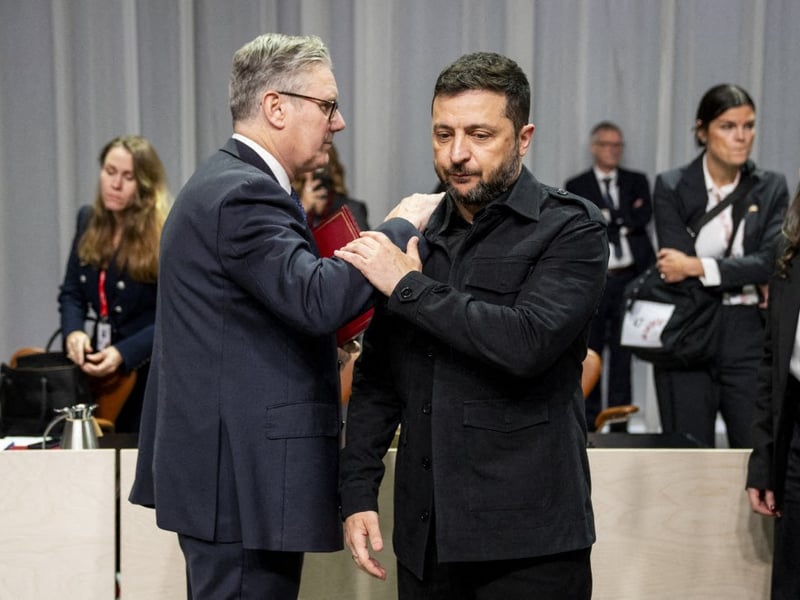
(CN) — While Europe and Russia traded barbs and threats during a gathering of 45 world leaders in Copenhagen on Thursday, Ukrainian President Volodymyr Zelenskyy made his priorities clear: He’s looking to America for actual weapons, not European promises.
Zelenskyy hinted that concrete help might come from Washington instead of Europe, saying that until now his country relied on “domestic production of its own missiles.” When asked about reports of potential U.S. long-range missile access, he said: “After my meeting with the president of the United States, yes, we will maybe have something more. I don’t know. We’ll see.” It was not immediately clear if he was referring to a past or future meeting.
His comments came as reports emerged that the U.S. will provide Ukraine with intelligence on Russian energy targets deep inside the country — actual capabilities, while Europeans spent two days in heated rhetoric that produced no concrete commitments to help Ukraine’s urgent funding needs.
Zelenskyy revealed his forces can only deploy 100 to 150 drones each day while Russia launches 100 to 600. “Just capabilities, we have enough capabilities. Just now the question of finance,” he told reporters after Thursday’s summit. European leaders offered sympathy but no new money.
Thursday’s meeting brought together 45 countries — basically all of Europe except Russia and Belarus — to discuss giving Ukraine better weapons, building a “drone wall” defense system across Europe, using frozen Russian money to fund Ukraine’s military and hitting Russia’s oil tankers harder with sanctions.
They also talked about fast-tracking Ukraine into the EU and boosting defense spending to 5% of GDP by 2030. But the meetings produced no new agreements on any of these fronts.
The heavily-guarded Copenhagen gathering followed Wednesday’s European Union summit, where the EU’s 27 member countries also failed to approve a 140-billion-euro ($164 billion) loan backed by frozen Russian assets or approve new sanctions against Moscow.
Instead, Europeans exchanged increasingly hostile words with Russia. British Prime Minister Keir Starmer delivered some of the strongest warnings, saying Russian attacks “are unrelenting” and “we must fight it with everything that we have,” before rushing home to handle a terrorist attack at a Manchester synagogue Thursday that killed two people during Yom Kippur services.
Polish Prime Minister Donald Tusk declared “we are in time of war today” and reported “more than 100 attempts per day” of Russian and Belarusian forces testing his country’s eastern border.
Moscow dismissed the European hand-wringing: “We are already in another form of conflict. There has been no cold [war] here for a long time; there is already fire here,” Russian foreign ministry spokeswoman Maria Zakharova told reporters Thursday when asked about European plans for a “drone wall” defense system. She said European accusations of Russian aggression were just cover for preparing “provocations” against Moscow.
Russian President Vladimir Putin piled on during a speech at the Valdai Discussion Club in Sochi, criticizing Western nations as trapped in “geopolitical and historical stereotypes” while declaring Russia “has demonstrated the highest degree of resilience and ability to withstand intensive global pressure.” He accused Europe of “escalating the conflict” in Ukraine.
Hungarian Prime Minister Viktor Orbán maintained his opposition to Ukrainian EU membership, telling reporters that admission “would mean that the war is coming into the European Union.”
“They have a war plan” and “a plan how to beat the Russians,” he said of other European leaders, while Hungary prefers peace negotiations. “We have a peace plan, but the others have [more of] a war plan, and that confrontation happened. The views are very far away from each other.”
Danish Prime Minister Mette Frederiksen, who hosted the summit, fired back: “I will not allow one country, and I will certainly not allow Viktor Orbán, to make decisions about the entire European future. … If middle ground means that we won’t do the best thing for Europe, then I don’t think middle ground is a good idea.”
French President Emmanuel Macron outlined how Russia’s “shadow fleet” — aging oil tankers that dodge sanctions by using fake flags and unclear ownership — generates “more than 30 billion” euros annually, financing “30 to 40% of the war effort.”
He urged Europeans to “kill the business model” by detaining vessels, as French authorities announced Wednesday the Chinese captain of a Russian tanker detained off France’s coast would face trial in February for refusing to cooperate with authorities. The ship, carrying 750,000 barrels of Russian crude oil from St. Petersburg to India, is suspected of launching mystery drones that forced Danish airports to close in September.
The most tangible result from two days of tense discussions was an agreement to station Ukrainian drone experts in Denmark — military cooperation that was could have been happening anyway.
When asked if Europe was ready to help scale up Ukraine’s drone and missile production, Frederiksen replied simply: “Yes.” But Zelenskyy’s hints about American support suggested he sees Washington, not Copenhagen, as the source of game-changing capabilities.
Macron tried to put a positive spin on recent developments, arguing that “the situation is much better today than it was at the beginning of the year” due to the “Coalition of the Willing” and success in “reengaging with the United States.” Trump’s recent statements represent “a huge change” that counters “misinformation spread by Russia,” he said.
The assessment highlighted Europe’s dependence on American leadership even as leaders keep talking about continental security requiring European solutions. NATO Secretary General Mark Rutte praised Ukraine as a “powerhouse” of innovation in drone warfare and cyber defense, suggesting European countries are learning from Ukrainian expertise rather than leading technological development themselves.
Zelenskyy confirmed that “our military guys with solid experience in drones are now in Denmark,” supporting joint defense that “can be called anything — the drone wall, a drone dome or drone rapid response.”
The summit wasn’t without its lighter moments. Albanian Prime Minister Edi Rama was caught on camera playfully ribbing French President Emmanuel Macron about Trump’s confusion between Armenia and Albania. “You should make an apology … to us because you didn’t congratulate us on the peace deal that President Trump made between Albania and Azerbaijan,” Rama joked, sending Azerbaijan’s President Ilham Aliyev into fits of laughter as Macron played along with the gag.
As leaders flew home, the fundamental questions that brought them to Copenhagen remained unresolved. European unity keeps showing up mainly in diplomatic statements rather than concrete military and financial commitments that could actually change the war’s trajectory, leaving the continent’s most urgent security challenges unaddressed despite increasingly dire warnings about the threats they pose.
Courthouse News correspondent Yuval Molina is based in Brussels, Belgium.
Subscribe to our free newsletters
Our weekly newsletter Closing Arguments offers the latest about ongoing trials, major litigation and rulings in courthouses around the U.S. and the world, while the monthly Under the Lights dishes the legal dirt from Hollywood, sports, Big Tech and the arts.