
 Search Articles


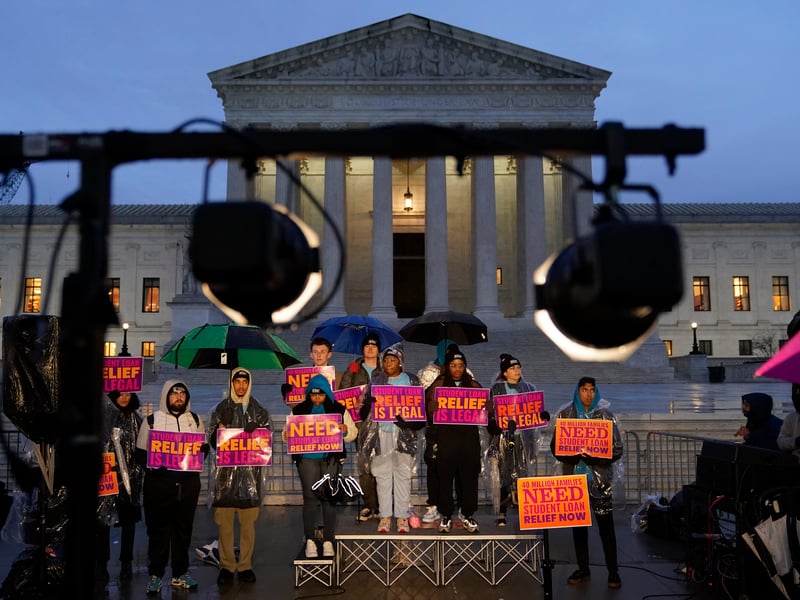
WASHINGTON (CN) — The Biden administration cautioned the Supreme Court on Wednesday against striking down a plan to lower student loan payments, telling the justices that recalculating rates would take months and force borrowers back into forbearance.
U.S. Solicitor General Elizabeth Prelogar told the justices they should reject an emergency appeal from conservative states attempting to halt the administration’s loan repayment plan, claiming that doing so would lead to irreparable harm.
“To revert to the pre-SAVE plan approach, the department and its servicers would have to reprogram their systems, retrain their staff, and recalculate monthly payments,” Prelogar wrote in the government’s brief. “That process would take at least several months, during which the department would have no choice but to place many borrowers into forbearance until servicers are able to bill them for the new amounts.”
The Saving on Valuable Education program, known as SAVE, cut borrowers’ loan payments in half, reducing monthly payments from 10% to 5% of income above 225% of the federal poverty line.
President Joe Biden announced the SAVE program after the Supreme Court threw out his student loan forgiveness plan, which would have eliminated up to $20,000 of debt from some borrowers. The justices ruled that Biden had exceeded his authority, finding that the plan triggered the major questions doctrine.
The administration faces a similar challenge to its repayment plan.
A group of 11 states challenged the SAVE plan, claiming the program would lead to lost loan interest. After dismissing most states from the suit for lack of standing, a Kansas judge ruled that Alaska, South Carolina and Texas could be harmed by the plan and put its rollout on hold.
The Department of Education paused payments and interest charges for 3 million borrowers to comply with the ruling. The 10th Circuit granted the administration’s stay request on appeal, allowing the department to implement the repayment plan.
After more than a year of preparations, the department said the SAVE plan would begin on July 1.
Alaska, South Carolina and Texas told the Supreme Court that the SAVE plan will cost the public hundreds of billions of dollars and must be put on hold while litigation over its legality continues.
“The legality of a program that costs taxpayers $45 billion more than the program the court considered and rejected in Nebraska is clearly ‘a question of great significance’ for this court’s resolution,” South Carolina Assistant Deputy Solicitor General Joseph Spate wrote in the appeal.
Prelogar said the justices’ intervention is unnecessary. The government argues that millions of borrowers throughout the country would be affected if the plan is paused even though the states’ claims only impact a small portion of borrowers.
The government said the states’ citation to the loan forgiveness plan is misplaced. Prelogar said Biden’s previous program tried to create an entirely new loan forgiveness program through an old law, but the repayment plan comes from an existing authority.
Prelogar pushed back on the states’ request for the justices to review the case next term. She said the states’ had not shown that it was dire enough for extraordinary relief.
“If the Tenth Circuit reverses the injunction, this case would not be worthy of this court’s review at all,” Prelogar wrote. “And there is no valid reason for this court to short-circuit the court of appeals’ review, particularly given the speed with which that court is moving.”
 Follow @KelseyReichmann
 Follow @kelseyreichmann.bsky.social
Subscribe to our free newsletters
Our weekly newsletter Closing Arguments offers the latest about ongoing trials, major litigation and rulings in courthouses around the U.S. and the world, while the monthly Under the Lights dishes the legal dirt from Hollywood, sports, Big Tech and the arts.