Search Articles


LOS ANGELES (CN) — Nearly eight years ago, Leah Williams almost died after being shot in the face at close range by Gene Evin Atkins, a man she’d lived with for more than a year.
He had attacked her physically before, she testified in court Tuesday. But this was different.
“I woke up in his bed,” Williams told Deputy District Attorney Ben Schwartz. “And I don’t know how I got there.” She added: “I woke up to him staring at me… I thought i was gonna die. I just had a bad feeling.”
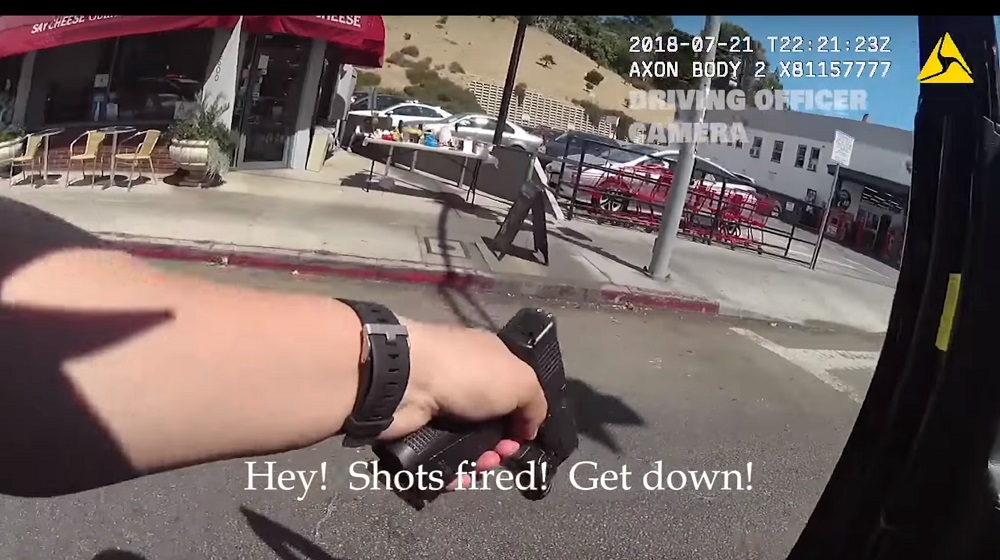
After shooting Williams, Atkins then shot his grandmother Mary Madison. He took her car keys and led police on a wild car chase from Hollywood to Silver Lake, where he crashed into a utility pole outside a Trader Joe’s grocery store.
As he ran inside, he fired his gun at police, who returned fire. One of their shots hit a Trader Joe’s assistant manager, killing her. Atkins is on trial for her murder, under the theory that it was his “provocative act” that led to the fatal shooting, as well as 42 other criminal counts, including attempted murder of the two women and kidnapping.
Little has been known about Williams, who was 17 at the time of the shooting, or about her relationship with Atkins, who was 28. His grandmother, whose house the two had been staying at, once called her his “girlfriend,” but that may have just been an assumption.
Williams’ hourlong testimony provided only glimpses into their relationship, rather than a full narrative. She had been to Madison’s house before but had only ever seen the inside of Atkins’ bedroom. She had never spoken to any of his family members, had never been formally introduced to them, despite being in the same house with them.
“He always had a strange look in his eye,” Williams testified, her voice calm and quiet, though poised, certain of herself. “Wide-eyed, like he was on something. He looked scary.”
Atkins was noticeably absent from proceedings Tuesday. According to audio played in court, he refused to leave his jail cell in the morning. When asked why by sheriff’s deputies, he replied, “I’m just tired.” It was not the first time he’s skipped out on court appearances, and has been admonished for it. The judge indicated that he may be forced to attend court on Wednesday.
Atkins had previously attempted to plead not guilty by reason of insanity, but was declared mentally competent to stand trial. He also represented himself for two lengthy stretches, in the years between his arrest and trial, but finally settled on defense attorney Errol Cook, who opted to reserve his opening statement until the prosecution rests its case. His defense strategy, therefore, remains a mystery.
According to Madison’s videotaped testimony, played in court on Monday — she died in 2024 — the shootings were preceded by a short argument between her and Atkins. She was upset he was laying in bed with the lights on during the day, rather than looking for a job. She was also displeased that he had a female guest over. On Tuesday, Schwartz informed the judge that Atkins had been seen scratching himself on the neck when Madison’s tape was played — so hard that he began to bleed.
After the exchange with his grandmother, Atkins appears to have turned his ire on Williams.
“Prior to shooting me, he was saying a lot of wacky things,” Williams testified. “Like crazy things. He said, ‘If I can’t have you, no one can.” He was ’tired of chasing me.’ I know there’s more." She added: “He said ‘you left me here with these people.’ I don’t know what that means at all.”
Williams said she started hyperventilating. Terrified, she asked Atkins to open the door or a window. She walked out of the bedroom and sat down on a dining room chair.
“When I stood,” she testified, “a barrel of the gun was in my face.”
“What happened next?” Schwartz asked.
“He shot me,” Williams answered, almost matter-of-factly. She fell to the floor, screaming. “I tried to open my eyes, but there was blood in my eyes. All I could see was pitch black.” She heard five gun shots, the sound of Atkins shooting his grandmother.
“You made me shoot my grandmother,” Williams said he told her, before carrying her outside, dumping her into the passenger’s seat of his grandmother’s car and driving away. Though he told her he was going to drive her to the hospital, he never did. “That obviously wasn’t his intention.”
Williams could hear sirens, and Williams firing his gun at police, while still driving. He muttered some curse words. She said she felt paralyzed.
“I seen in the mirror that my head was busted open and my brain was showing,” Williams recalled. Finally, Atkins addressed her: “He told me to put my seatbelt on. I couldn’t. Because my body was paralyzed.” He reached over and buckled her seatbelt for her. Moments later, he crashed the car into the utility pole. He ran into the Trader Joe’s, leaving Williams in the car.
LAPD Sergeant James Decoite, who also testified Tuesday, said he was ordered to get Williams out of the car after Atkins had entered the stpre and had taken more than 20 hostages.
“The amount of blood, the level of injury that was to her head was shocking,” Decoite said. “I could see bone fragments, I could see skull. She was going in and out of consciousness. I was extremely concerned.”
When asked about her lasting injuries, Williams said the shooting left her with broken bullet fragments still in her head, where doctors had to put a metal plate. The gunpowder caused her to lose vision in her right eye, and the trauma to her brain left her with epilepsy which she takes medication for.
 Follow @hillelaron
Subscribe to our free newsletters
Our weekly newsletter Closing Arguments offers the latest about ongoing trials, major litigation and rulings in courthouses around the U.S. and the world, while the monthly Under the Lights dishes the legal dirt from Hollywood, sports, Big Tech and the arts.